
A UK operation against Russian sanctions evasion has resulted in 128 arrests and the seizure of $32.6 million in cryptocurrency and cash.
The UK's National Crime Agency (NCA) has revealed that a UK-led operation to crack down on Russian sanctions evasion has resulted in the arrest of 128 people and the seizure of $32.6 million in cryptocurrency and cash.🚨🚨🚨
The operation, dubbed "Operation Destabilize," was first announced in 2024. As of December last year, it had resulted in 84 arrests and the seizure of $25.5 million.💡💡💡
However, the latest NCA data shows that the operation has also resulted in the arrest of a further 45 people suspected of money laundering and the seizure of more than $6.6 million in cash.⭐️⭐️⭐️
#InternationalNews #cryptocurrency #blockchain #Jucom #finance $BTC/USDT $ETH/USDT $JU/USDT

Lee | Ju.Com
2025-11-22 04:50
⭐️⭐️⭐️#InternationalNews

Disclaimer:Contains third-party content. Not financial advice.
See Terms and Conditions.

What Are the Inherent Risks of Interacting with DeFi Protocols?
Decentralized Finance (DeFi) has emerged as a transformative force in the financial industry, offering innovative ways to lend, borrow, trade, and earn yields without traditional intermediaries. While DeFi provides increased accessibility and transparency, it also introduces a range of inherent risks that users must understand before engaging. This article explores these risks comprehensively to help users navigate the complex landscape of DeFi safely.
Understanding Smart Contract Vulnerabilities
At the core of DeFi protocols are smart contracts—self-executing code that automates financial transactions based on predefined rules. Although they enable trustless operations, smart contracts are susceptible to bugs and vulnerabilities. Historically significant incidents like the DAO hack in 2016 demonstrated how exploited vulnerabilities could lead to massive losses; approximately 3.6 million Ether were drained due to a reentrancy bug[1]. These vulnerabilities often stem from coding errors or overlooked edge cases during development. As smart contracts are immutable once deployed, fixing such issues post-launch can be challenging and costly.
To mitigate this risk, rigorous security audits by third-party firms are essential before deploying new protocols or updates. Additionally, ongoing monitoring and bug bounty programs incentivize community participation in identifying potential flaws early.
Liquidity Risks in Decentralized Pools
Liquidity is vital for smooth trading and borrowing activities within DeFi ecosystems. Many protocols rely on liquidity pools—collections of tokens supplied by users—to facilitate transactions without centralized order books[2]. However, these pools can face liquidity shortages during periods of high volatility or market downturns. Insufficient liquidity can lead to slippage—where trades execute at unfavorable prices—or even transaction failures.
For example, during sudden market crashes or large trades (known as "whale" movements), prices may swing sharply due to low liquidity levels[3]. Users participating in yield farming or providing liquidity should be aware that their assets might become illiquid if market conditions deteriorate unexpectedly.
Market Volatility Impact
Cryptocurrencies used within DeFi platforms are inherently volatile assets; their values can fluctuate dramatically over short periods[3]. Such volatility directly affects collateral valuations in lending protocols and impacts yield calculations for farmers earning interest or rewards. A sudden price drop could trigger liquidation events where collateral is sold off automatically at unfavorable rates—a process known as "liquidation risk."
This unpredictability underscores the importance for users engaging with leverage-based strategies or staking assets: they must closely monitor market trends and set appropriate risk parameters like collateralization ratios to avoid unexpected losses.
Regulatory Uncertainty Surrounding DeFi
The regulatory landscape for DeFi remains largely undefined globally[4]. Governments and regulators are increasingly scrutinizing decentralized platforms due to concerns about consumer protection, money laundering risks, tax evasion potential—and whether existing laws apply effectively within decentralized environments.
This ambiguity exposes users and platform operators to legal uncertainties; regulations could change abruptly leading to restrictions on certain activities or shutdowns of platforms altogether[4]. Staying informed about evolving legal frameworks is crucial for participants who wish to avoid unintended compliance violations while maintaining access.
Security Threats: Phishing & Hacks
Beyond technical vulnerabilities within smart contracts themselves lies an array of security threats targeting individual users’ funds[5]. Phishing attacks remain prevalent—attackers impersonate legitimate services via fake websites or emails designed specifically to steal private keys or seed phrases necessary for wallet access(5). Once compromised, hackers can drain user accounts instantly.
High-profile hacks such as Wormhole’s $320 million breach in 2022 highlight how security lapses at bridge infrastructure points pose significant risks [10], emphasizing that no component is immune from attack vectors targeting cross-chain interoperability solutions used widely across DeFi ecosystems.
Users should adopt best practices including multi-factor authentication (MFA), hardware wallets when possible—and always verify URLs—to reduce susceptibility toward phishing schemes [5].
Reentrancy Attacks: A Persistent Threat
Reentrancy attacks exploit specific vulnerabilities where malicious actors repeatedly call functions within a contract before previous executions complete[6]. This loophole allows attackers unauthorized access—potentially draining funds from affected protocols if not properly guarded against reentrant calls(6).
The infamous DAO hack was an early example illustrating this threat’s severity [1], prompting developers worldwide toward implementing safeguards like mutexes (mutual exclusions) into their codebases today [6].
Ensuring robust coding standards combined with formal verification methods significantly reduces reentrancy-related exploits' likelihood across new protocol deployments.
Front-Running & Sandwich Attacks Exploiting Transaction Ordering
In blockchain networks where transaction ordering isn’t strictly controlled by centralized authorities—the phenomenon known as front-running becomes problematic.[7] Traders with faster access may observe pending transactions via mempool data—and place their own orders ahead intentionally (“front-run”) —altering prices unfavorably for others(7).
Sandwich attacks take this further by placing one order just before a target trade while another immediately afterward—effectively “sandwiching” it—to manipulate asset prices temporarily.[7] These tactics undermine fair trading principles within DEXs like Uniswap but also pose financial risks for regular traders unfamiliar with such exploits.[7]
Mitigation strategies include implementing time-weighted average pricing mechanisms (TWAP)and utilizing privacy-preserving techniques such as zero-knowledge proofs where feasible .
Dependence on Oracles & Data Integrity Issues
Many advanced DeFi applications depend heavily on external data sources called “oracles” — which provide real-time information like asset prices,[8] interest rates,[8] etc., necessary for executing automated decisions accurately(8). However , inaccuracies stemming from faulty data feeds—or malicious manipulation—can cause severe miscalculations leading either into unwarranted liquidationsor incorrect payouts(8).
Protocols employing multiple independent oracle sources coupled with decentralization techniques aimto improve resilience against false data injection but cannot eliminate all associated risks entirely .
Navigating the Risks: Best Practices & Future Outlook
While inherent dangers exist across various facets—from technical bugs through regulatory shifts—the key lies in adopting comprehensive risk management strategies . Regularly auditing codebases , diversifying investments , employing secure wallets , staying updated about legal developments ,and understanding protocol mechanics form partof prudent engagement practices .
Recent developments indicate increased focus on enhancing security measures—including more rigorous audits post-hack incidents—as well as efforts towards clearer regulation frameworks aimed at protecting investors while fostering innovation . As the ecosystem matures—with improved standards around transparency,safety,and compliance—the overall safety profile will likely improve over time—but vigilance remains essentialfor all participants involvedin decentralized finance activities.
JCUSER-WVMdslBw
2025-05-22 08:07
What are the inherent risks involved in interacting with DeFi protocols?
What Are the Inherent Risks of Interacting with DeFi Protocols?
Decentralized Finance (DeFi) has emerged as a transformative force in the financial industry, offering innovative ways to lend, borrow, trade, and earn yields without traditional intermediaries. While DeFi provides increased accessibility and transparency, it also introduces a range of inherent risks that users must understand before engaging. This article explores these risks comprehensively to help users navigate the complex landscape of DeFi safely.
Understanding Smart Contract Vulnerabilities
At the core of DeFi protocols are smart contracts—self-executing code that automates financial transactions based on predefined rules. Although they enable trustless operations, smart contracts are susceptible to bugs and vulnerabilities. Historically significant incidents like the DAO hack in 2016 demonstrated how exploited vulnerabilities could lead to massive losses; approximately 3.6 million Ether were drained due to a reentrancy bug[1]. These vulnerabilities often stem from coding errors or overlooked edge cases during development. As smart contracts are immutable once deployed, fixing such issues post-launch can be challenging and costly.
To mitigate this risk, rigorous security audits by third-party firms are essential before deploying new protocols or updates. Additionally, ongoing monitoring and bug bounty programs incentivize community participation in identifying potential flaws early.
Liquidity Risks in Decentralized Pools
Liquidity is vital for smooth trading and borrowing activities within DeFi ecosystems. Many protocols rely on liquidity pools—collections of tokens supplied by users—to facilitate transactions without centralized order books[2]. However, these pools can face liquidity shortages during periods of high volatility or market downturns. Insufficient liquidity can lead to slippage—where trades execute at unfavorable prices—or even transaction failures.
For example, during sudden market crashes or large trades (known as "whale" movements), prices may swing sharply due to low liquidity levels[3]. Users participating in yield farming or providing liquidity should be aware that their assets might become illiquid if market conditions deteriorate unexpectedly.
Market Volatility Impact
Cryptocurrencies used within DeFi platforms are inherently volatile assets; their values can fluctuate dramatically over short periods[3]. Such volatility directly affects collateral valuations in lending protocols and impacts yield calculations for farmers earning interest or rewards. A sudden price drop could trigger liquidation events where collateral is sold off automatically at unfavorable rates—a process known as "liquidation risk."
This unpredictability underscores the importance for users engaging with leverage-based strategies or staking assets: they must closely monitor market trends and set appropriate risk parameters like collateralization ratios to avoid unexpected losses.
Regulatory Uncertainty Surrounding DeFi
The regulatory landscape for DeFi remains largely undefined globally[4]. Governments and regulators are increasingly scrutinizing decentralized platforms due to concerns about consumer protection, money laundering risks, tax evasion potential—and whether existing laws apply effectively within decentralized environments.
This ambiguity exposes users and platform operators to legal uncertainties; regulations could change abruptly leading to restrictions on certain activities or shutdowns of platforms altogether[4]. Staying informed about evolving legal frameworks is crucial for participants who wish to avoid unintended compliance violations while maintaining access.
Security Threats: Phishing & Hacks
Beyond technical vulnerabilities within smart contracts themselves lies an array of security threats targeting individual users’ funds[5]. Phishing attacks remain prevalent—attackers impersonate legitimate services via fake websites or emails designed specifically to steal private keys or seed phrases necessary for wallet access(5). Once compromised, hackers can drain user accounts instantly.
High-profile hacks such as Wormhole’s $320 million breach in 2022 highlight how security lapses at bridge infrastructure points pose significant risks [10], emphasizing that no component is immune from attack vectors targeting cross-chain interoperability solutions used widely across DeFi ecosystems.
Users should adopt best practices including multi-factor authentication (MFA), hardware wallets when possible—and always verify URLs—to reduce susceptibility toward phishing schemes [5].
Reentrancy Attacks: A Persistent Threat
Reentrancy attacks exploit specific vulnerabilities where malicious actors repeatedly call functions within a contract before previous executions complete[6]. This loophole allows attackers unauthorized access—potentially draining funds from affected protocols if not properly guarded against reentrant calls(6).
The infamous DAO hack was an early example illustrating this threat’s severity [1], prompting developers worldwide toward implementing safeguards like mutexes (mutual exclusions) into their codebases today [6].
Ensuring robust coding standards combined with formal verification methods significantly reduces reentrancy-related exploits' likelihood across new protocol deployments.
Front-Running & Sandwich Attacks Exploiting Transaction Ordering
In blockchain networks where transaction ordering isn’t strictly controlled by centralized authorities—the phenomenon known as front-running becomes problematic.[7] Traders with faster access may observe pending transactions via mempool data—and place their own orders ahead intentionally (“front-run”) —altering prices unfavorably for others(7).
Sandwich attacks take this further by placing one order just before a target trade while another immediately afterward—effectively “sandwiching” it—to manipulate asset prices temporarily.[7] These tactics undermine fair trading principles within DEXs like Uniswap but also pose financial risks for regular traders unfamiliar with such exploits.[7]
Mitigation strategies include implementing time-weighted average pricing mechanisms (TWAP)and utilizing privacy-preserving techniques such as zero-knowledge proofs where feasible .
Dependence on Oracles & Data Integrity Issues
Many advanced DeFi applications depend heavily on external data sources called “oracles” — which provide real-time information like asset prices,[8] interest rates,[8] etc., necessary for executing automated decisions accurately(8). However , inaccuracies stemming from faulty data feeds—or malicious manipulation—can cause severe miscalculations leading either into unwarranted liquidationsor incorrect payouts(8).
Protocols employing multiple independent oracle sources coupled with decentralization techniques aimto improve resilience against false data injection but cannot eliminate all associated risks entirely .
Navigating the Risks: Best Practices & Future Outlook
While inherent dangers exist across various facets—from technical bugs through regulatory shifts—the key lies in adopting comprehensive risk management strategies . Regularly auditing codebases , diversifying investments , employing secure wallets , staying updated about legal developments ,and understanding protocol mechanics form partof prudent engagement practices .
Recent developments indicate increased focus on enhancing security measures—including more rigorous audits post-hack incidents—as well as efforts towards clearer regulation frameworks aimed at protecting investors while fostering innovation . As the ecosystem matures—with improved standards around transparency,safety,and compliance—the overall safety profile will likely improve over time—but vigilance remains essentialfor all participants involvedin decentralized finance activities.
Disclaimer:Contains third-party content. Not financial advice.
See Terms and Conditions.
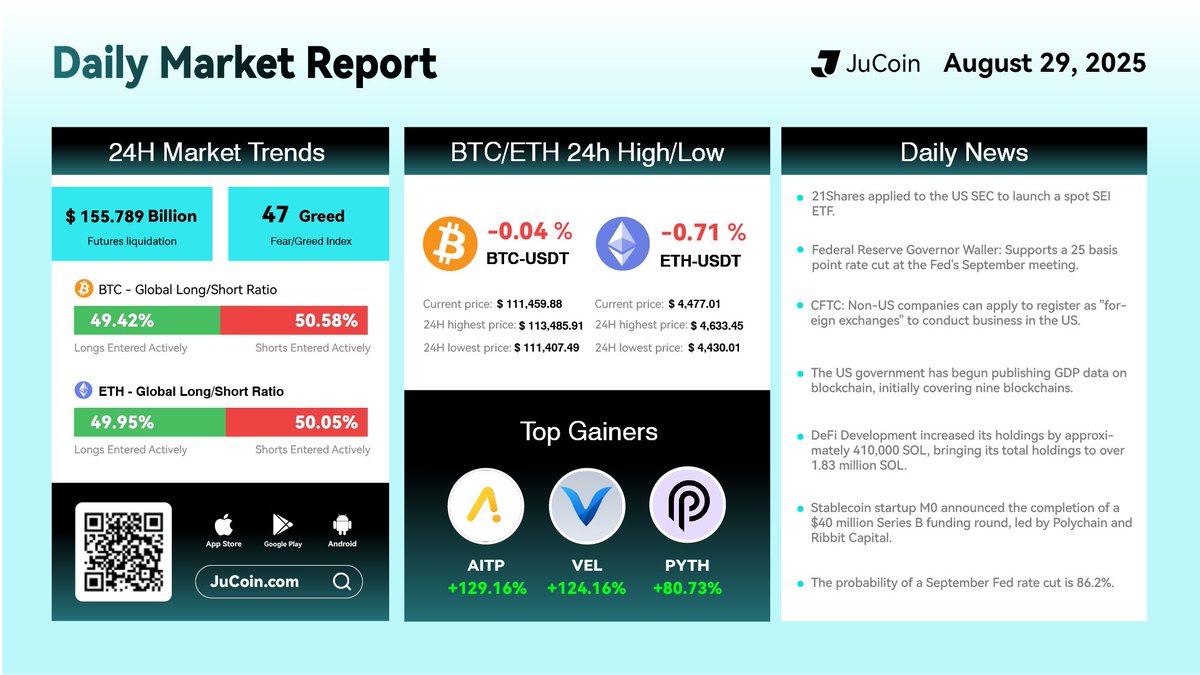
Today’s Top Gainers:
$AITP/USDT: 129%
$VEL/USDT: 124%$PYTH/USDT : 80%
$JU Token is close to reach $22 a new ATH
#cryptocurrency #blockchain #finance
Mrconfamm
2025-08-29 07:37
Market Daily Report
Disclaimer:Contains third-party content. Not financial advice.
See Terms and Conditions.
Interest Rate Decisions and Chart Patterns in Cryptocurrency Markets
Understanding how interest rate decisions influence cryptocurrency chart patterns is essential for traders, investors, and analysts aiming to navigate the volatile digital asset landscape. Central banks, such as the Federal Reserve, play a pivotal role in shaping market sentiment through their monetary policy actions. When these institutions adjust interest rates, they trigger a cascade of effects that can alter price movements and chart formations across various cryptocurrencies.
Impact of Interest Rate Changes on Cryptocurrency Volatility
One of the most immediate effects of interest rate adjustments is increased market volatility. Higher interest rates tend to make risk-free assets like government bonds more attractive compared to riskier investments such as cryptocurrencies. This shift often results in decreased demand for digital assets, leading to sharp price declines or increased downward pressure on charts. Conversely, when central banks lower interest rates, borrowing becomes cheaper and investor confidence tends to rise. This environment encourages risk-taking behavior, often reflected in upward trends or bullish chart patterns within crypto markets.
For example, recent rate hikes by the Federal Reserve have been associated with heightened volatility in cryptocurrencies like Bitcoin (BTC) and Ethereum (ETH). These moves can cause rapid swings—sometimes breaking through established support or resistance levels—making technical analysis more challenging but also offering trading opportunities based on pattern recognition.
Trend Reversals Triggered by Monetary Policy Announcements
Interest rate decisions frequently serve as catalysts for trend reversals in cryptocurrency markets. An unexpected increase might lead investors to liquidate holdings quickly due to fears of reduced liquidity or declining economic prospects. Such sell-offs are visible on charts as sharp drops following central bank announcements—a classic reversal signal that traders watch closely.
Similarly, a surprise rate cut can boost investor optimism about economic growth prospects and risk appetite. This shift often manifests as bullish reversals where previous downtrends are halted or reversed into upward trajectories with recognizable chart patterns like double bottoms or ascending triangles forming during recovery phases.
Shifts in Support and Resistance Levels Due to Market Expectations
Market participants anticipate future monetary policy moves based on economic data releases and central bank guidance. These expectations influence support and resistance levels—the key horizontal lines that indicate potential turning points on price charts.
When an interest rate hike is expected but not fully priced into current prices, markets may experience sudden volatility once the decision is announced—breaking through previous support levels during sell-offs or surpassing resistance zones amid buying surges. Technical analysts monitor these shifts carefully because they signal changes in market sentiment driven by macroeconomic factors rather than just supply-demand dynamics alone.
Market Sentiment: The Psychological Aspect
Interest rate decisions significantly impact investor psychology within cryptocurrency markets. A higher-rate environment generally signals a robust economy but reduces appetite for speculative assets like altcoins due to perceived increased risks elsewhere—in traditional equities or fixed-income securities.
On the other hand, lower rates foster optimism about future growth prospects for digital currencies as alternative investments become less attractive financially. This change enhances demand-driven momentum visible through rising chart patterns such as flags or pennants indicating strong buying pressure fueled by positive sentiment shifts.
Recent Developments Highlighting Interest Rate Effects
In 2025 alone, multiple Federal Reserve rate hikes have exemplified how monetary policy influences crypto markets profoundly:
- The April 2025 announcement triggered notable declines across many tokens including Cryptonite USD (XCNUSD), illustrating sensitivity among certain assets.
- Cryptocurrencies like Bitcoin showed resilience historically; however, altcoins such as Litecoin (LTC) experienced sharper reactions aligned with broader market sentiment.
- Economic indicators suggesting slowing growth due to higher borrowing costs further complicated technical analysis by increasing unpredictability around key chart levels.
These developments underscore that understanding macroeconomic policies enhances predictive accuracy regarding potential pattern formations—and helps traders adapt strategies accordingly.
Key Factors Connecting Interest Rates With Chart Patterns
Several core concepts link monetary policy actions directly with technical analysis outcomes:
- Sensitivity: Cryptocurrencies tend to react more intensely than traditional assets because they are viewed both as speculative investments and stores of value.
- Volatility: Rate changes amplify fluctuations; thus larger candlestick bodies appear during periods surrounding major announcements.
- Sentiment Influence: Market mood swings driven by policy expectations shape breakout points at critical support/resistance zones.
- Historical Trends: Past data shows consistent impacts where certain pattern formations precede significant macroeconomic events related to interest rates—serving as valuable signals for informed trading decisions.
Dates That Marked Significant Interest Rate Impacts
Tracking specific dates helps contextualize how monetary policies influence crypto charts:
- April 2025 – Fed’s aggressive rate hike led directly to heightened volatility across multiple tokens.
- May 2025 – Litecoin Trust (LTCN) experienced notable price movements reflecting broader market reactions.
- May 8th – The BetaPro Silver ETF (HZD.TO) saw its value fluctuate sharply amid ongoing economic developments tied closely with fiscal policies affecting liquidity conditions globally.
How Traders Can Use These Insights
For those involved in cryptocurrency trading:
- Keep abreast of upcoming central bank meetings via financial news outlets.
- Monitor key support/resistance levels around scheduled announcement dates.
- Watch for breakout signals post-announcement indicating trend reversals influenced by changing macro conditions.
By integrating fundamental insights about interest rates with technical analysis tools—including candlestick patterns like dojis or engulfings—you enhance your ability not only to interpret current market conditions but also anticipate future movements rooted in macroeconomic fundamentals.
Understanding the Relationship Between Macro Policies And Technical Patterns
Ultimately, recognizing how central bank policies shape investor behavior provides deeper context beyond raw numbers displayed on charts alone—it adds an analytical layer grounded in real-world economic dynamics known collectively under E-A-T principles (Expertise–Authoritativeness–Trustworthiness). As global economies evolve amidst ongoing monetary adjustments worldwide—including those from major institutions—the importance of aligning fundamental knowledge with technical skills becomes paramount for successful navigation within volatile cryptocurrency environments.
JCUSER-F1IIaxXA
2025-05-09 23:28
How can interest rate decisions impact chart patterns?
Interest Rate Decisions and Chart Patterns in Cryptocurrency Markets
Understanding how interest rate decisions influence cryptocurrency chart patterns is essential for traders, investors, and analysts aiming to navigate the volatile digital asset landscape. Central banks, such as the Federal Reserve, play a pivotal role in shaping market sentiment through their monetary policy actions. When these institutions adjust interest rates, they trigger a cascade of effects that can alter price movements and chart formations across various cryptocurrencies.
Impact of Interest Rate Changes on Cryptocurrency Volatility
One of the most immediate effects of interest rate adjustments is increased market volatility. Higher interest rates tend to make risk-free assets like government bonds more attractive compared to riskier investments such as cryptocurrencies. This shift often results in decreased demand for digital assets, leading to sharp price declines or increased downward pressure on charts. Conversely, when central banks lower interest rates, borrowing becomes cheaper and investor confidence tends to rise. This environment encourages risk-taking behavior, often reflected in upward trends or bullish chart patterns within crypto markets.
For example, recent rate hikes by the Federal Reserve have been associated with heightened volatility in cryptocurrencies like Bitcoin (BTC) and Ethereum (ETH). These moves can cause rapid swings—sometimes breaking through established support or resistance levels—making technical analysis more challenging but also offering trading opportunities based on pattern recognition.
Trend Reversals Triggered by Monetary Policy Announcements
Interest rate decisions frequently serve as catalysts for trend reversals in cryptocurrency markets. An unexpected increase might lead investors to liquidate holdings quickly due to fears of reduced liquidity or declining economic prospects. Such sell-offs are visible on charts as sharp drops following central bank announcements—a classic reversal signal that traders watch closely.
Similarly, a surprise rate cut can boost investor optimism about economic growth prospects and risk appetite. This shift often manifests as bullish reversals where previous downtrends are halted or reversed into upward trajectories with recognizable chart patterns like double bottoms or ascending triangles forming during recovery phases.
Shifts in Support and Resistance Levels Due to Market Expectations
Market participants anticipate future monetary policy moves based on economic data releases and central bank guidance. These expectations influence support and resistance levels—the key horizontal lines that indicate potential turning points on price charts.
When an interest rate hike is expected but not fully priced into current prices, markets may experience sudden volatility once the decision is announced—breaking through previous support levels during sell-offs or surpassing resistance zones amid buying surges. Technical analysts monitor these shifts carefully because they signal changes in market sentiment driven by macroeconomic factors rather than just supply-demand dynamics alone.
Market Sentiment: The Psychological Aspect
Interest rate decisions significantly impact investor psychology within cryptocurrency markets. A higher-rate environment generally signals a robust economy but reduces appetite for speculative assets like altcoins due to perceived increased risks elsewhere—in traditional equities or fixed-income securities.
On the other hand, lower rates foster optimism about future growth prospects for digital currencies as alternative investments become less attractive financially. This change enhances demand-driven momentum visible through rising chart patterns such as flags or pennants indicating strong buying pressure fueled by positive sentiment shifts.
Recent Developments Highlighting Interest Rate Effects
In 2025 alone, multiple Federal Reserve rate hikes have exemplified how monetary policy influences crypto markets profoundly:
- The April 2025 announcement triggered notable declines across many tokens including Cryptonite USD (XCNUSD), illustrating sensitivity among certain assets.
- Cryptocurrencies like Bitcoin showed resilience historically; however, altcoins such as Litecoin (LTC) experienced sharper reactions aligned with broader market sentiment.
- Economic indicators suggesting slowing growth due to higher borrowing costs further complicated technical analysis by increasing unpredictability around key chart levels.
These developments underscore that understanding macroeconomic policies enhances predictive accuracy regarding potential pattern formations—and helps traders adapt strategies accordingly.
Key Factors Connecting Interest Rates With Chart Patterns
Several core concepts link monetary policy actions directly with technical analysis outcomes:
- Sensitivity: Cryptocurrencies tend to react more intensely than traditional assets because they are viewed both as speculative investments and stores of value.
- Volatility: Rate changes amplify fluctuations; thus larger candlestick bodies appear during periods surrounding major announcements.
- Sentiment Influence: Market mood swings driven by policy expectations shape breakout points at critical support/resistance zones.
- Historical Trends: Past data shows consistent impacts where certain pattern formations precede significant macroeconomic events related to interest rates—serving as valuable signals for informed trading decisions.
Dates That Marked Significant Interest Rate Impacts
Tracking specific dates helps contextualize how monetary policies influence crypto charts:
- April 2025 – Fed’s aggressive rate hike led directly to heightened volatility across multiple tokens.
- May 2025 – Litecoin Trust (LTCN) experienced notable price movements reflecting broader market reactions.
- May 8th – The BetaPro Silver ETF (HZD.TO) saw its value fluctuate sharply amid ongoing economic developments tied closely with fiscal policies affecting liquidity conditions globally.
How Traders Can Use These Insights
For those involved in cryptocurrency trading:
- Keep abreast of upcoming central bank meetings via financial news outlets.
- Monitor key support/resistance levels around scheduled announcement dates.
- Watch for breakout signals post-announcement indicating trend reversals influenced by changing macro conditions.
By integrating fundamental insights about interest rates with technical analysis tools—including candlestick patterns like dojis or engulfings—you enhance your ability not only to interpret current market conditions but also anticipate future movements rooted in macroeconomic fundamentals.
Understanding the Relationship Between Macro Policies And Technical Patterns
Ultimately, recognizing how central bank policies shape investor behavior provides deeper context beyond raw numbers displayed on charts alone—it adds an analytical layer grounded in real-world economic dynamics known collectively under E-A-T principles (Expertise–Authoritativeness–Trustworthiness). As global economies evolve amidst ongoing monetary adjustments worldwide—including those from major institutions—the importance of aligning fundamental knowledge with technical skills becomes paramount for successful navigation within volatile cryptocurrency environments.
Disclaimer:Contains third-party content. Not financial advice.
See Terms and Conditions.

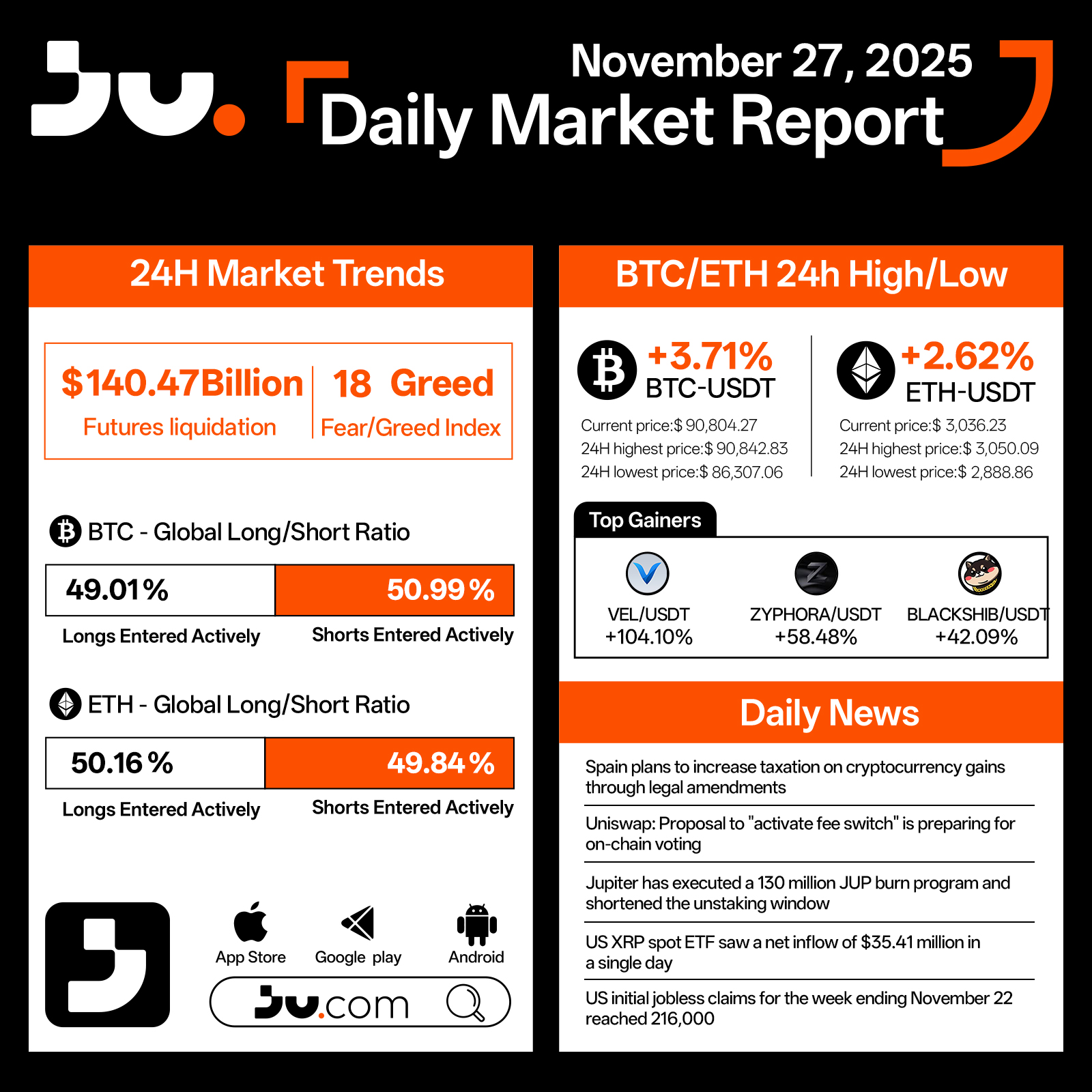
Daily Market Report - Nov 27, 2025
Crypto markets strengthened on November 27, showing a notable rebound in momentum. Total futures liquidations reached $140.47 billion, while the Fear & Greed Index climbed to 18, suggesting that although sentiment remains cautious, panic is gradually easing. Bitcoin (BTC) rose 3.71% to $90,804.27, trading between a high of $90,842.83 and a low of $86,307.06 over the past 24 hours. Ethereum (ETH) gained 2.62%, last trading at $3,036.23, with intraday movements ranging from $3,050.09 to $2,888.86.
Long–short ratios remain balanced but cautious. BTC saw 49.01% longs versus 50.99% shorts, while ETH skewed slightly bullish at 50.16% longs and 49.84% shorts, reflecting a market that is stabilizing but still hesitant to take strong directional positions. Among top-performing tokens, VEL/USDT surged 104.10%, ZYPHORA/USDT advanced 58.48%, and BLACKSHIB/USDT gained 42.09%, highlighting strong speculative activity in select high-volatility assets.
Regulatory and macro developments contributed to today’s narrative. Spain announced plans to increase taxes on cryptocurrency gains through upcoming legal amendments, underscoring the tightening regulatory climate across Europe. Uniswap’s proposal to activate its “fee switch” is moving toward on-chain voting, potentially reshaping the protocol’s long-term revenue design.
Jupiter executed a 130 million JUP burn program and shortened its unlocking schedule, reinforcing its commitment to token value management. Meanwhile, the US XRP spot ETF recorded an impressive $354.41 million net inflow in a single day, reflecting ongoing institutional appetite for digital assets. U.S. initial jobless claims for the week ending November 22 reached 216,000, indicating a gradually cooling labor market.
With BTC and ETH both staging strong rebounds, market sentiment shows signs of recovery, though investors remain highly sensitive to regulatory shifts and macroeconomic indicators. As the month draws to a close, liquidity conditions and policy developments will play an increasingly important role in shaping short-term market direction.
#cryptocurrency #blockchain #finance #Bitcoin
JU Blog
2025-11-27 03:25
Market Sentiment Improves as BTC and ETH Rally - November 27, 2025
Disclaimer:Contains third-party content. Not financial advice.
See Terms and Conditions.
What is the FATF Travel Rule and How Does It Impact Transfers?
Understanding the FATF Travel Rule
The FATF (Financial Action Task Force) Travel Rule is an international regulation designed to improve transparency in virtual asset transactions, including cryptocurrencies. Originally established to combat money laundering and terrorist financing, this rule mandates that financial institutions involved in virtual asset transfers collect and verify specific information about both parties involved in a transaction. Its primary goal is to prevent illicit activities by ensuring that authorities can trace the flow of funds across borders.
This regulation applies not only to traditional banks but also extends to cryptocurrency exchanges, custodial wallets, and other service providers handling virtual assets. By requiring detailed information about originators and beneficiaries—such as names, addresses, account numbers, or other identifying data—the Travel Rule aims to create a more secure environment for digital transactions.
Scope of the FATF Travel Rule
The scope of this regulation covers all entities engaged in transferring virtual assets. This includes:
- Cryptocurrency exchanges
- Wallet providers
- Payment processors dealing with digital currencies
- Any platform facilitating virtual asset transfers
The rule's implementation varies globally; some countries have fully adopted it into their legal frameworks while others are still developing compliance measures. This inconsistency can create challenges for cross-border transactions involving multiple jurisdictions.
How the Travel Rule Changes Cryptocurrency Transfers
Traditionally, cryptocurrency transactions are pseudonymous—meaning they do not require personal identification details at each transfer stage. The introduction of the Travel Rule shifts this paradigm by necessitating additional verification steps before completing transfers.
For users engaging in crypto transactions, this means providing personal identification information when sending or receiving funds through compliant platforms. These platforms must then verify identities according to local regulations before processing transfers further. As a result:
- Transactions may take longer due to added verification procedures.
- Users might need to submit documents like ID cards or proof of address.
- Smaller or less regulated platforms may struggle with compliance costs or technical implementation.
While these measures enhance security and reduce illicit activity risks, they also introduce friction into what was once a relatively quick process.
Implementation Challenges Across Countries
Different countries have adopted varying approaches toward enforcing the FATF Travel Rule:
- United States: Enforces regulations under existing laws such as the Bank Secrecy Act (BSA), requiring crypto businesses to implement KYC (Know Your Customer) procedures aligned with AML (Anti-Money Laundering) standards.
- European Union: Is working on integrating these requirements within its Anti-Money Laundering Directive (AMLD), aiming for harmonized rules across member states.
- Other Jurisdictions: Some nations are still drafting legislation or lack clear enforcement mechanisms altogether.
This patchwork creates regulatory uncertainty for industry players operating internationally because compliance strategies must adapt based on jurisdictional requirements.
Impact on Cryptocurrency Industry and Users
The adoption of the FATF Travel Rule has significant implications for both industry operators and end-users:
For Financial Institutions & Service Providers:
- Increased operational costs due to implementing new compliance infrastructure.
- Need for advanced technology solutions such as decentralized identity systems and data analytics tools.
- Potential reduction in transaction speed owing to additional verification steps.
For Users:
- Greater privacy concerns since more personal data is collected during transfers.
- Possible delays in transaction processing times.
- Enhanced security features that help prevent fraud but could complicate user experience if not well-managed.
Despite these challenges, many industry stakeholders see compliance with global standards like those set by FATF as essential for legitimizing cryptocurrencies within mainstream finance systems.
Recent Developments & Future Outlook
Since its initial proposal in 2019, several key milestones have shaped how countries approach enforcement:
- 2021 Guidance Release: The FATF issued comprehensive guidelines emphasizing robust customer due diligence (CDD) practices alongside ongoing monitoring processes.
- 2022 Enforcement Actions: Countries like the US began actively enforcing regulations under existing AML frameworks; meanwhile, EU regulators worked towards formalizing their own rules.
- Industry Adaptation: Crypto firms developed new tools such as decentralized identity solutions aimed at balancing privacy with regulatory demands while maintaining user trust.
Looking ahead, broader adoption worldwide seems inevitable given increasing international cooperation against financial crimes related to digital assets—a trend likely leading toward more uniform global standards over time.
Key Takeaways About How It Affects Transfers
To summarize how the FATF Travel Rule impacts cryptocurrency transfers:
- Adds mandatory collection and verification of sender/receiver information
- Extends transfer times due to extra checks
- Raises operational costs for compliant service providers
- Introduces privacy considerations around sharing personal data
- Creates regulatory complexity across different jurisdictions
Understanding these factors helps users navigate an evolving landscape where transparency meets innovation—balancing security needs against seamless user experiences remains central as regulators continue refining policies around virtual assets worldwide.
Semantic Keywords & Related Terms:cryptocurrency regulation | AML/KYC compliance | cross-border crypto transfer | blockchain transparency | digital asset oversight | anti-money laundering laws | crypto industry adaptation | identity verification protocols
JCUSER-IC8sJL1q
2025-05-22 23:59
What is the FATF Travel Rule and how does it impact transfers?
What is the FATF Travel Rule and How Does It Impact Transfers?
Understanding the FATF Travel Rule
The FATF (Financial Action Task Force) Travel Rule is an international regulation designed to improve transparency in virtual asset transactions, including cryptocurrencies. Originally established to combat money laundering and terrorist financing, this rule mandates that financial institutions involved in virtual asset transfers collect and verify specific information about both parties involved in a transaction. Its primary goal is to prevent illicit activities by ensuring that authorities can trace the flow of funds across borders.
This regulation applies not only to traditional banks but also extends to cryptocurrency exchanges, custodial wallets, and other service providers handling virtual assets. By requiring detailed information about originators and beneficiaries—such as names, addresses, account numbers, or other identifying data—the Travel Rule aims to create a more secure environment for digital transactions.
Scope of the FATF Travel Rule
The scope of this regulation covers all entities engaged in transferring virtual assets. This includes:
- Cryptocurrency exchanges
- Wallet providers
- Payment processors dealing with digital currencies
- Any platform facilitating virtual asset transfers
The rule's implementation varies globally; some countries have fully adopted it into their legal frameworks while others are still developing compliance measures. This inconsistency can create challenges for cross-border transactions involving multiple jurisdictions.
How the Travel Rule Changes Cryptocurrency Transfers
Traditionally, cryptocurrency transactions are pseudonymous—meaning they do not require personal identification details at each transfer stage. The introduction of the Travel Rule shifts this paradigm by necessitating additional verification steps before completing transfers.
For users engaging in crypto transactions, this means providing personal identification information when sending or receiving funds through compliant platforms. These platforms must then verify identities according to local regulations before processing transfers further. As a result:
- Transactions may take longer due to added verification procedures.
- Users might need to submit documents like ID cards or proof of address.
- Smaller or less regulated platforms may struggle with compliance costs or technical implementation.
While these measures enhance security and reduce illicit activity risks, they also introduce friction into what was once a relatively quick process.
Implementation Challenges Across Countries
Different countries have adopted varying approaches toward enforcing the FATF Travel Rule:
- United States: Enforces regulations under existing laws such as the Bank Secrecy Act (BSA), requiring crypto businesses to implement KYC (Know Your Customer) procedures aligned with AML (Anti-Money Laundering) standards.
- European Union: Is working on integrating these requirements within its Anti-Money Laundering Directive (AMLD), aiming for harmonized rules across member states.
- Other Jurisdictions: Some nations are still drafting legislation or lack clear enforcement mechanisms altogether.
This patchwork creates regulatory uncertainty for industry players operating internationally because compliance strategies must adapt based on jurisdictional requirements.
Impact on Cryptocurrency Industry and Users
The adoption of the FATF Travel Rule has significant implications for both industry operators and end-users:
For Financial Institutions & Service Providers:
- Increased operational costs due to implementing new compliance infrastructure.
- Need for advanced technology solutions such as decentralized identity systems and data analytics tools.
- Potential reduction in transaction speed owing to additional verification steps.
For Users:
- Greater privacy concerns since more personal data is collected during transfers.
- Possible delays in transaction processing times.
- Enhanced security features that help prevent fraud but could complicate user experience if not well-managed.
Despite these challenges, many industry stakeholders see compliance with global standards like those set by FATF as essential for legitimizing cryptocurrencies within mainstream finance systems.
Recent Developments & Future Outlook
Since its initial proposal in 2019, several key milestones have shaped how countries approach enforcement:
- 2021 Guidance Release: The FATF issued comprehensive guidelines emphasizing robust customer due diligence (CDD) practices alongside ongoing monitoring processes.
- 2022 Enforcement Actions: Countries like the US began actively enforcing regulations under existing AML frameworks; meanwhile, EU regulators worked towards formalizing their own rules.
- Industry Adaptation: Crypto firms developed new tools such as decentralized identity solutions aimed at balancing privacy with regulatory demands while maintaining user trust.
Looking ahead, broader adoption worldwide seems inevitable given increasing international cooperation against financial crimes related to digital assets—a trend likely leading toward more uniform global standards over time.
Key Takeaways About How It Affects Transfers
To summarize how the FATF Travel Rule impacts cryptocurrency transfers:
- Adds mandatory collection and verification of sender/receiver information
- Extends transfer times due to extra checks
- Raises operational costs for compliant service providers
- Introduces privacy considerations around sharing personal data
- Creates regulatory complexity across different jurisdictions
Understanding these factors helps users navigate an evolving landscape where transparency meets innovation—balancing security needs against seamless user experiences remains central as regulators continue refining policies around virtual assets worldwide.
Semantic Keywords & Related Terms:cryptocurrency regulation | AML/KYC compliance | cross-border crypto transfer | blockchain transparency | digital asset oversight | anti-money laundering laws | crypto industry adaptation | identity verification protocols
Disclaimer:Contains third-party content. Not financial advice.
See Terms and Conditions.
How Many Indicators Can MT4 Display Simultaneously?
MetaTrader 4 (MT4) remains one of the most popular trading platforms among forex traders and financial analysts worldwide. Its user-friendly interface, extensive charting tools, and customizable features have made it a preferred choice for both beginners and experienced traders. However, despite its versatility, MT4 has a notable limitation that can impact comprehensive technical analysis: the maximum number of indicators that can be displayed on a single chart.
Understanding MT4’s Indicator Limit
One of the key constraints in MT4 is its built-in cap on simultaneous indicator display. The platform allows up to 28 indicators per chart, which might seem sufficient at first glance but can become restrictive when traders rely on multiple complex or layered indicators for detailed analysis.
This limit has been consistent since the early versions of MT4, with no significant updates from MetaQuotes—the developer behind MT4—over the years to increase this capacity. As such, traders often find themselves needing to prioritize which indicators are most critical or seek alternative solutions.
Why Is There a Limit on Indicators?
The restriction primarily stems from technical considerations related to system performance and stability. Rendering numerous indicators simultaneously requires significant processing power and memory resources. By capping this number at 28, MetaQuotes aims to balance functionality with platform stability across various hardware configurations.
Furthermore, some complex indicators or custom scripts may also consume considerable resources; thus, limiting their number helps prevent potential crashes or lag during trading sessions.
Impact on Traders’ Technical Analysis
For many traders who prefer using multiple overlapping tools—such as moving averages combined with oscillators like RSI or Bollinger Bands—the indicator limit can be frustrating. It forces them into making strategic choices about which tools are essential for their trading style.
In practice:
- Traders might need to combine certain signals into composite indicators.
- They may use different charts for different sets of analyses.
- Some opt for third-party software integrations that bypass these restrictions altogether.
This limitation emphasizes the importance of efficient indicator management and strategic planning in technical analysis workflows within MT4's environment.
Workarounds and Alternatives
Given this constraint, many users turn to workarounds:
- Multiple Charts: Spreading different sets of indicators across several charts within the same workspace allows broader coverage without exceeding individual chart limits.
- Custom Scripts & Expert Advisors: Advanced users develop custom scripts that combine multiple signals into fewer overlays.
- Third-party Tools: Several third-party platforms or add-ons claim to extend indicator capacity beyond what native MT4 offers—though these often come at additional costs or require more technical expertise.
However, it's important to note that relying heavily on workarounds may introduce new challenges such as increased complexity in managing multiple charts or compatibility issues with updates.
Recent Developments & Future Outlook
As of May 2025, there have been no official announcements from MetaQuotes regarding an increase in this indicator limit. The platform remains largely unchanged since its initial release in 2005 concerning this aspect—a testament perhaps to prioritizing stability over feature expansion in this area.
The absence of updates suggests that traders seeking higher flexibility might consider transitioning toward other platforms like MetaTrader 5 (MT5), which supports more advanced features including an increased number of simultaneous indicators (up to 100). Nonetheless, many still prefer sticking with MT4 due to familiarity and widespread adoption among brokers worldwide.
How This Limitation Affects Trading Strategies
The inability to display unlimited indicators directly influences how traders develop their strategies:
- It encourages more streamlined setups focusing only on essential signals.
- Traders must optimize their use by selecting multi-purpose tools rather than numerous individual ones.
- For those requiring extensive analytical layers—such as institutional investors—it may necessitate integrating external software solutions outside native MT4 capabilities.
This constraint underscores a broader theme within trading technology: balancing feature richness against system performance and user experience is crucial but sometimes results in trade-offs like these limitations.
Final Thoughts
While MetaTrader 4 remains highly regarded for its reliability and ease-of-use within retail forex trading circles, its maximum indicator display limit continues to be a point worth considering when planning your analytical approach. For casual traders conducting straightforward analyses, 28 indicators often suffice; however, professional analysts demanding deeper insights might need supplementary tools or consider upgrading platforms altogether.
Key Takeaways
- Maximum Indicators per Chart: Typically capped at 28 in standard MT4 installations.
- Historical Consistency: No significant changes since initial release (2005).
- Workarounds: Use multiple charts; employ custom scripts; explore third-party software solutions.
- Future Prospects: No official plans from MetaQuotes yet; alternatives like MT5 offer higher capacities.
Understanding these limitations helps set realistic expectations while encouraging efficient strategy development tailored within existing platform constraints—and highlights areas where technological advancements could improve trader experience moving forward.
JCUSER-WVMdslBw
2025-05-26 12:50
How many indicators can MT4 display simultaneously?
How Many Indicators Can MT4 Display Simultaneously?
MetaTrader 4 (MT4) remains one of the most popular trading platforms among forex traders and financial analysts worldwide. Its user-friendly interface, extensive charting tools, and customizable features have made it a preferred choice for both beginners and experienced traders. However, despite its versatility, MT4 has a notable limitation that can impact comprehensive technical analysis: the maximum number of indicators that can be displayed on a single chart.
Understanding MT4’s Indicator Limit
One of the key constraints in MT4 is its built-in cap on simultaneous indicator display. The platform allows up to 28 indicators per chart, which might seem sufficient at first glance but can become restrictive when traders rely on multiple complex or layered indicators for detailed analysis.
This limit has been consistent since the early versions of MT4, with no significant updates from MetaQuotes—the developer behind MT4—over the years to increase this capacity. As such, traders often find themselves needing to prioritize which indicators are most critical or seek alternative solutions.
Why Is There a Limit on Indicators?
The restriction primarily stems from technical considerations related to system performance and stability. Rendering numerous indicators simultaneously requires significant processing power and memory resources. By capping this number at 28, MetaQuotes aims to balance functionality with platform stability across various hardware configurations.
Furthermore, some complex indicators or custom scripts may also consume considerable resources; thus, limiting their number helps prevent potential crashes or lag during trading sessions.
Impact on Traders’ Technical Analysis
For many traders who prefer using multiple overlapping tools—such as moving averages combined with oscillators like RSI or Bollinger Bands—the indicator limit can be frustrating. It forces them into making strategic choices about which tools are essential for their trading style.
In practice:
- Traders might need to combine certain signals into composite indicators.
- They may use different charts for different sets of analyses.
- Some opt for third-party software integrations that bypass these restrictions altogether.
This limitation emphasizes the importance of efficient indicator management and strategic planning in technical analysis workflows within MT4's environment.
Workarounds and Alternatives
Given this constraint, many users turn to workarounds:
- Multiple Charts: Spreading different sets of indicators across several charts within the same workspace allows broader coverage without exceeding individual chart limits.
- Custom Scripts & Expert Advisors: Advanced users develop custom scripts that combine multiple signals into fewer overlays.
- Third-party Tools: Several third-party platforms or add-ons claim to extend indicator capacity beyond what native MT4 offers—though these often come at additional costs or require more technical expertise.
However, it's important to note that relying heavily on workarounds may introduce new challenges such as increased complexity in managing multiple charts or compatibility issues with updates.
Recent Developments & Future Outlook
As of May 2025, there have been no official announcements from MetaQuotes regarding an increase in this indicator limit. The platform remains largely unchanged since its initial release in 2005 concerning this aspect—a testament perhaps to prioritizing stability over feature expansion in this area.
The absence of updates suggests that traders seeking higher flexibility might consider transitioning toward other platforms like MetaTrader 5 (MT5), which supports more advanced features including an increased number of simultaneous indicators (up to 100). Nonetheless, many still prefer sticking with MT4 due to familiarity and widespread adoption among brokers worldwide.
How This Limitation Affects Trading Strategies
The inability to display unlimited indicators directly influences how traders develop their strategies:
- It encourages more streamlined setups focusing only on essential signals.
- Traders must optimize their use by selecting multi-purpose tools rather than numerous individual ones.
- For those requiring extensive analytical layers—such as institutional investors—it may necessitate integrating external software solutions outside native MT4 capabilities.
This constraint underscores a broader theme within trading technology: balancing feature richness against system performance and user experience is crucial but sometimes results in trade-offs like these limitations.
Final Thoughts
While MetaTrader 4 remains highly regarded for its reliability and ease-of-use within retail forex trading circles, its maximum indicator display limit continues to be a point worth considering when planning your analytical approach. For casual traders conducting straightforward analyses, 28 indicators often suffice; however, professional analysts demanding deeper insights might need supplementary tools or consider upgrading platforms altogether.
Key Takeaways
- Maximum Indicators per Chart: Typically capped at 28 in standard MT4 installations.
- Historical Consistency: No significant changes since initial release (2005).
- Workarounds: Use multiple charts; employ custom scripts; explore third-party software solutions.
- Future Prospects: No official plans from MetaQuotes yet; alternatives like MT5 offer higher capacities.
Understanding these limitations helps set realistic expectations while encouraging efficient strategy development tailored within existing platform constraints—and highlights areas where technological advancements could improve trader experience moving forward.
Disclaimer:Contains third-party content. Not financial advice.
See Terms and Conditions.
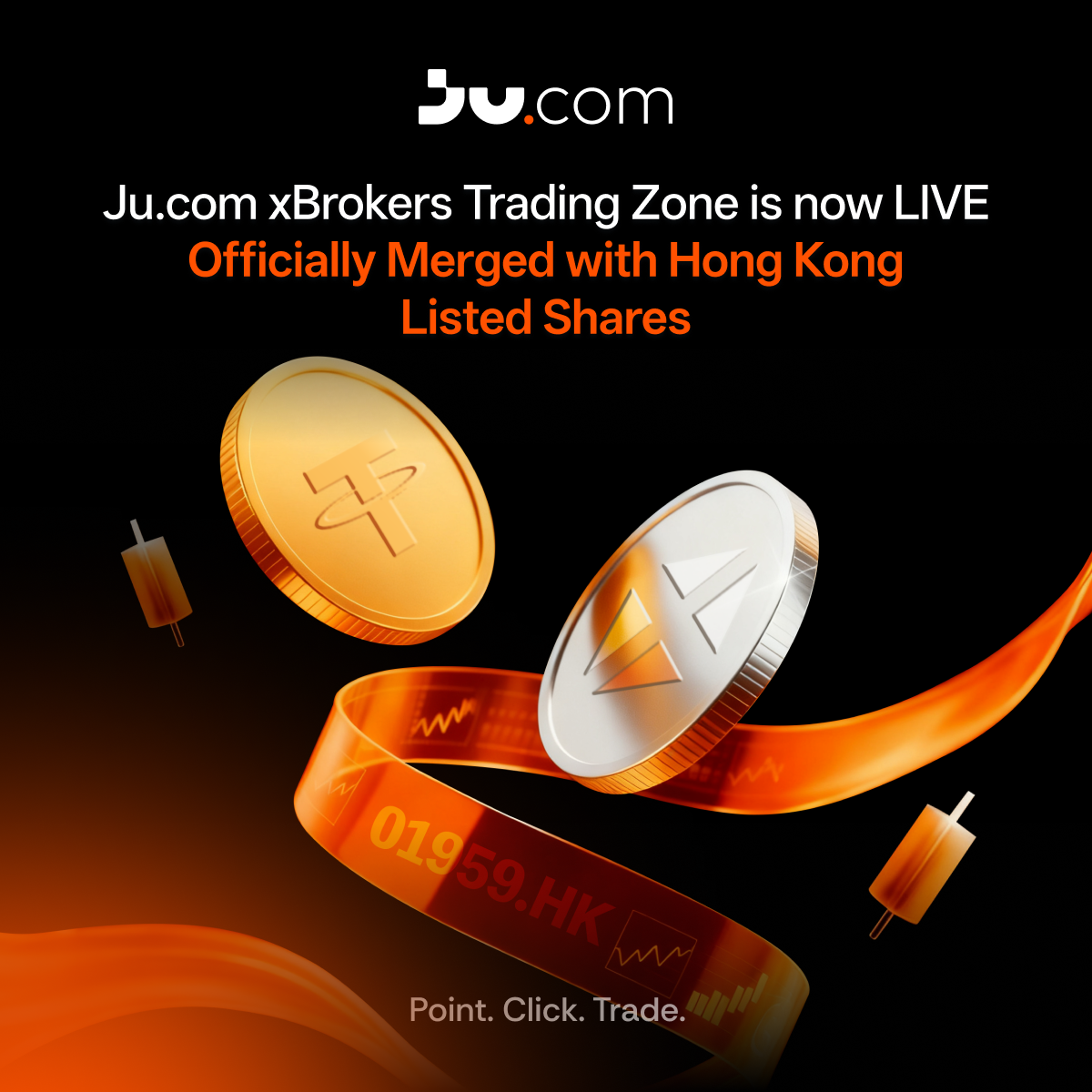
On December 1, 2025, Ju.com announced the successful completion of the merger between its trial-run stock and the official Hong Kong stock listing. The test stock code 0XXXX.HK was officially switched to 01959.HK (Century United Holdings Limited) at 18:00 (UTC+8) today, marking the full validation—under real market conditions—of the “zero-distance stock trading + stock liquidity rewards” mechanism. With this milestone, Ju.com becomes the world’s first platform to support zero-distance stock trading while providing on-chain incentives for stock liquidity.
Maintenance began at 16:00, and three hours later, users’ test-phase holdings were automatically converted into real listed company shares based on market value. This merger essentially served as a comprehensive stress test of the “real-stock custody + on-chain incentives” architecture. All holdings were settled at the closing price, with stock data verified by the broker before being fully mapped.
The significance of this step lies in the fact that trading data, withdrawal records, and user feedback gathered during the trial phase have now become the foundational samples and parameter inputs for full-scale operation. From the launch of the trial on October 20 to the stock switch on December 1—a total of 42 days—Ju.com validated a previously nonexistent trading logic: when a user buys a stock, they simultaneously inject liquidity into the market, enabling the listed company to achieve better pricing efficiency, while the holder, in addition to standard shareholder rights, can also earn additional liquidity rewards based on clear rules.
The Barriers of Traditional Brokers and Ju.com’s Strategic Path
In the traditional brokerage system, investors who wish to trade Hong Kong stocks must typically open an offshore account—often requiring substantial asset proof—while also bearing FX conversion losses, cross-border remittance fees, and per-trade commissions. Geographic barriers are also significant; for investors outside Hong Kong, many small- and mid-cap stocks suffer from extremely limited liquidity, with orders often left unfilled for long periods.
For more than a decade, Hong Kong has ranked among the top three global IPO fundraising hubs. However, secondary-market trading has remained heavily concentrated in a handful of blue-chip names, leaving a large number of small-cap stocks stagnant, illiquid, or effectively untradeable. This structural liquidity challenge makes it difficult for even long-term-oriented individual investors to consistently contribute liquidity at reasonable cost.
Ju.com dramatically lowers these barriers. After completing KYC, investors can convert USDT into HKDJ, a Hong Kong dollar-pegged stablecoin, and directly trade real Hong Kong stocks. Geographic restrictions are greatly reduced, and investors across time zones share the same order book and depth. More importantly, the act of buying stocks can be tied to staking and on-chain incentive mechanisms, meaning trading behavior is directly recognized as a liquidity contribution.
For example, when User A buys Tencent shares through Ju.com, the order is mapped 1:1 via a partner broker into real custodial holdings under User A’s name. Tencent receives genuine buying interest from global investors, improving secondary-market liquidity. Meanwhile, User A—according to predefined rules—can continue to earn long-term liquidity incentive rewards.
The core of this model is transforming liquidity from an abstract financial concept into a quantifiable, incentivized contribution. In the traditional system, investor returns primarily depend on price appreciation or dividends. In the Ju.com system, because trading behavior improves market efficiency, users gain an additional earnings path via liquidity rewards.
The Reserve Fund Mechanism: Underpinning the Incentive Model
The token incentive system is supported by a reserve fund pool jointly contributed by listed companies participating in the ecosystem. Each Hong Kong-listed company integrated into the Ju.com and xBrokers ecosystem allocates reserve funds equal to 30% of its market capitalization. These funds are dedicated to repurchasing ecosystem tokens in the secondary market and providing liquidity, thereby supporting token value and enhancing the sustainability of the incentive model.
When users receive token rewards, the reserve fund pool repurchases tokens according to set rules, generating continuous buy-side pressure. As more Hong Kong companies join, the size of the reserve fund grows, strengthening token liquidity and value stability over time. Users thus receive incentives backed by real financial resources.
This design addresses a common issue in crypto markets: when token prices fall, mining yields shrink, leading to user attrition, which further pressures the token price—a negative feedback loop. The reserve fund mechanism introduces external capital flows from listed companies, easing this internal circular pressure. As long as more companies join the system, the reserve pool continues to expand, giving the token stronger fundamental support.
A Three-Layer Closed Loop: Subscription, Trading, and Staking
The xBrokers ecosystem on Ju.com consists of three interconnected sectors corresponding to stock financing, secondary-market liquidity, and long-term incentives.
The Early-Bird Subscription Zone allows users to participate in early-stage Hong Kong stock offerings. Traditional IPO allocations are typically reserved for institutions; retail investors either cannot participate or must buy at higher secondary-market prices. On Ju.com, the subscription threshold is significantly lower, and users can participate using supported crypto assets. After subscription, stocks enter a staking period during which users earn token rewards while retaining full shareholder rights such as dividends.
The Free-Trading Zone provides secondary-market trading mapped 1:1 to real shares. All corresponding stocks are held by licensed brokers, and mapping data is stored on-chain for transparency. Users can withdraw stocks to any brokerage account that supports Hong Kong trading, verifying their authenticity. During the trial, several users successfully completed withdrawals, offering real validation of the “on-chain trading + broker custody” model.
The Stock-Staking Mining Zone turns static assets into yield-generating tools. Users stake their Hong Kong stocks to earn token incentives. Shareholder rights remain unaffected during staking—dividends continue as normal. Once the staking period ends, the stocks automatically unlock, and users may choose to hold, sell, or stake again.
Together, these three sectors form a complete cycle: the Subscription Zone introduces new quality assets, the Trading Zone provides liquidity for them, and the Staking Zone offers ongoing incentives for long-term holders. Users obtain shares in the Subscription Zone, freely trade them in the Trading Zone, and earn liquidity rewards through staking—each step reinforces the next.
Phase-One Validation Results and Future Direction
The December 1 stock merger was both a critical technical action and a phase-one validation of the entire architecture.
Trial results show that combining on-chain trading with traditional finance is fully viable. Users execute trades on-chain, stocks are held 1:1 by brokers, and shareholder rights follow traditional securities rules. This architecture preserves blockchain transparency and efficiency while meeting compliance requirements of traditional finance.
Liquidity incentives performed well during the trial. Data such as trading activity, order book depth, and bid-ask spreads provide a foundation for further optimization. Early participants reported that incentives significantly improved their willingness to trade previously illiquid assets.
Global participation paths have been successfully activated. Ju.com's diverse user base ensures that trading volumes are more evenly distributed across time zones, attracting global incremental liquidity into the Hong Kong market. For companies long constrained by liquidity shortages, this model provides a new structural solution.
After the trial, Ju.com will continue optimizing xBrokers mechanisms based on real-world operational data, focusing on the two core features: zero-distance stock trading and liquidity incentives, ensuring stable ecosystem development.
From 0XXXX.HK to 01959.HK, this merger has pushed the entire mechanism beyond white-paper theory and simulation into real-market execution. Earning liquidity incentives while buying stocks has now produced the first real trading dataset in the Hong Kong market. As more companies and institutions join, the architecture built around “zero-distance stock trading + liquidity incentives” will continue to be tested across a broader sample, and the incremental value it unlocks will be distributed to listed companies and long-term holders participating in the system.
#Jucom #xBrokers #RWA #finance #cryptocurrency
JU Blog
2025-12-01 06:18
Ju.com Completes Trial Stock Merger, Launches World's First Zero-Distance Stock Trading Platform
Disclaimer:Contains third-party content. Not financial advice.
See Terms and Conditions.
How Can Standard Deviation Be Applied to Price Analysis?
Understanding how prices fluctuate in financial markets is essential for investors, traders, and analysts. One of the most effective statistical tools used for this purpose is standard deviation. It provides a clear measure of volatility and risk, helping market participants make informed decisions. This article explores how standard deviation can be applied to price analysis across various assets, including stocks and cryptocurrencies, highlighting recent developments and potential risks.
What Is Standard Deviation in Price Analysis?
Standard deviation measures the dispersion or variability of data points around an average value. In finance and cryptocurrency markets, it quantifies how much asset prices deviate from their mean over a specific period. A low standard deviation indicates that prices tend to stay close to the average—implying stability—while a high standard deviation suggests significant fluctuations or volatility.
This metric is vital because it translates raw price data into actionable insights about market behavior. For example, investors seeking stable investments prefer assets with low volatility (low standard deviation), whereas traders aiming for quick gains might target more volatile assets with higher deviations.
Practical Applications of Standard Deviation in Price Analysis
1. Measuring Market Volatility
One primary use of standard deviation is assessing an asset’s volatility level. By calculating the historical price deviations over time, traders can determine whether an asset's current movement aligns with its typical behavior or signals increased risk.
For instance:
- High Standard Deviation: Indicates rapid price swings; common during market shocks or speculative bubbles.
- Low Standard Deviation: Suggests steadier prices; often seen in mature markets or during periods of economic stability.
Volatility measurement helps traders decide when to enter or exit positions based on their risk appetite.
2. Risk Management and Portfolio Diversification
Investors utilize standard deviation as part of broader risk management strategies:
- Estimating potential losses based on historical fluctuations.
- Comparing different assets’ volatilities to diversify portfolios effectively.
Assets with lower deviations are generally considered safer but may offer lower returns; those with higher deviations could provide higher gains but come with increased risks.
3. Technical Indicators and Trading Strategies
Standard deviation forms the backbone of several technical analysis tools:
- Bollinger Bands: These bands consist of a moving average plus/minus two times the standard deviation, helping identify overbought or oversold conditions.
- Volatility Breakouts: Sudden increases in standard deviation can signal upcoming significant price movements worth monitoring closely.
These tools assist traders in timing entries/exits more precisely by understanding current volatility levels relative to historical norms.
4. Comparing Asset Stability
Using standardized metrics like the coefficient of variation (standard deviation divided by mean), analysts compare different assets' relative stability regardless of their scale:
- A stock might have a high absolute fluctuation but be relatively stable compared to its own average return.
- Cryptocurrencies often exhibit much higher deviations than traditional stocks due to their speculative nature but may still be assessed comparatively using these metrics.
This comparative approach aids investors in aligning their choices with desired risk profiles across diverse markets.
Recent Developments Enhancing Price Analysis Using Standard Deviation
Cryptocurrency Market Volatility Trends
The cryptocurrency space has seen unprecedented volatility recently—Bitcoin's dramatic surges followed by sharp corrections exemplify this trend. During such periods, calculating the standard deviation reveals extreme fluctuations that highlight heightened risks associated with digital assets compared to traditional investments like stocks or bonds.
Market analysts now routinely incorporate these calculations into trading algorithms and dashboards for real-time monitoring—helping both institutional players and retail investors navigate turbulent waters more effectively.
Advanced Tools & Software Integration
Modern analytical platforms such as TradingView, MetaTrader, and specialized statistical software have simplified computing complex metrics like moving averages combined with multiple layers of standard deviations (e.g., Bollinger Bands). These tools enable users without advanced statistical backgrounds to visualize market conditions clearly—and adapt strategies accordingly—enhancing decision-making precision.
Machine Learning & Predictive Modeling
The integration of machine learning models has further expanded applications involving standard deviations:
- Algorithms analyze vast datasets incorporating technical indicators (like volatility measures).
- They generate predictive insights about future price movements based on patterns identified historically through statistical dispersion metrics.
Such innovations are transforming traditional reactive trading into proactive strategies grounded on robust quantitative analysis.
Risks Associated With High Volatility Indicated by Standard Deviations
While high-standard-deviation signals opportunities for profit through rapid trades during volatile periods, it also warns about potential pitfalls:
Market Crashes: Elevated dispersion often precedes sharp declines—as seen during crypto crashes in 2022—that can wipe out substantial portions of investment portfolios if not managed carefully.
Investor Behavior: Awareness that certain assets exhibit extreme variability influences investor psychology—prompting cautious approaches during turbulent phases which could lead either toward safer havens or missed opportunities if misjudged.
Regulatory Implications: As authorities recognize increasing reliance on statistical measures like standard deviations within crypto markets’ frameworks—for assessing systemic risks—they may implement regulations aimed at curbing excessive speculation driven by unpredictable swings.
Incorporating Standard Deviation Into Your Investment Strategy
To leverage this powerful tool effectively:
- Analyze Historical Data Regularly: Calculate daily/weekly/monthly standards deviations for your holdings.
- Use Technical Indicators: Integrate Bollinger Bands into your charts for real-time signals.
- Compare Assets: Employ coefficients like CVs when choosing between different investment options based on your risk tolerance.
- Stay Updated With Market News: Recognize that external factors influence volatility beyond what historical data shows—a sudden regulatory change can spike uncertainty unexpectedly.
- Combine Quantitative & Qualitative Insights: Use statistics alongside fundamental analysis for comprehensive decision-making.
By doing so, you align your investment approach closer to empirical evidence while maintaining awareness about inherent uncertainties present within volatile markets such as cryptocurrencies today.
In summary, applying standardized measures like standard deviation enhances understanding around asset price behaviors significantly—from gauging current market conditions through technical indicators up to managing overall portfolio risks amid evolving financial landscapes—including rapidly changing sectors like digital currencies.
Lo
2025-05-09 05:40
How can standard deviation be applied to price analysis?
How Can Standard Deviation Be Applied to Price Analysis?
Understanding how prices fluctuate in financial markets is essential for investors, traders, and analysts. One of the most effective statistical tools used for this purpose is standard deviation. It provides a clear measure of volatility and risk, helping market participants make informed decisions. This article explores how standard deviation can be applied to price analysis across various assets, including stocks and cryptocurrencies, highlighting recent developments and potential risks.
What Is Standard Deviation in Price Analysis?
Standard deviation measures the dispersion or variability of data points around an average value. In finance and cryptocurrency markets, it quantifies how much asset prices deviate from their mean over a specific period. A low standard deviation indicates that prices tend to stay close to the average—implying stability—while a high standard deviation suggests significant fluctuations or volatility.
This metric is vital because it translates raw price data into actionable insights about market behavior. For example, investors seeking stable investments prefer assets with low volatility (low standard deviation), whereas traders aiming for quick gains might target more volatile assets with higher deviations.
Practical Applications of Standard Deviation in Price Analysis
1. Measuring Market Volatility
One primary use of standard deviation is assessing an asset’s volatility level. By calculating the historical price deviations over time, traders can determine whether an asset's current movement aligns with its typical behavior or signals increased risk.
For instance:
- High Standard Deviation: Indicates rapid price swings; common during market shocks or speculative bubbles.
- Low Standard Deviation: Suggests steadier prices; often seen in mature markets or during periods of economic stability.
Volatility measurement helps traders decide when to enter or exit positions based on their risk appetite.
2. Risk Management and Portfolio Diversification
Investors utilize standard deviation as part of broader risk management strategies:
- Estimating potential losses based on historical fluctuations.
- Comparing different assets’ volatilities to diversify portfolios effectively.
Assets with lower deviations are generally considered safer but may offer lower returns; those with higher deviations could provide higher gains but come with increased risks.
3. Technical Indicators and Trading Strategies
Standard deviation forms the backbone of several technical analysis tools:
- Bollinger Bands: These bands consist of a moving average plus/minus two times the standard deviation, helping identify overbought or oversold conditions.
- Volatility Breakouts: Sudden increases in standard deviation can signal upcoming significant price movements worth monitoring closely.
These tools assist traders in timing entries/exits more precisely by understanding current volatility levels relative to historical norms.
4. Comparing Asset Stability
Using standardized metrics like the coefficient of variation (standard deviation divided by mean), analysts compare different assets' relative stability regardless of their scale:
- A stock might have a high absolute fluctuation but be relatively stable compared to its own average return.
- Cryptocurrencies often exhibit much higher deviations than traditional stocks due to their speculative nature but may still be assessed comparatively using these metrics.
This comparative approach aids investors in aligning their choices with desired risk profiles across diverse markets.
Recent Developments Enhancing Price Analysis Using Standard Deviation
Cryptocurrency Market Volatility Trends
The cryptocurrency space has seen unprecedented volatility recently—Bitcoin's dramatic surges followed by sharp corrections exemplify this trend. During such periods, calculating the standard deviation reveals extreme fluctuations that highlight heightened risks associated with digital assets compared to traditional investments like stocks or bonds.
Market analysts now routinely incorporate these calculations into trading algorithms and dashboards for real-time monitoring—helping both institutional players and retail investors navigate turbulent waters more effectively.
Advanced Tools & Software Integration
Modern analytical platforms such as TradingView, MetaTrader, and specialized statistical software have simplified computing complex metrics like moving averages combined with multiple layers of standard deviations (e.g., Bollinger Bands). These tools enable users without advanced statistical backgrounds to visualize market conditions clearly—and adapt strategies accordingly—enhancing decision-making precision.
Machine Learning & Predictive Modeling
The integration of machine learning models has further expanded applications involving standard deviations:
- Algorithms analyze vast datasets incorporating technical indicators (like volatility measures).
- They generate predictive insights about future price movements based on patterns identified historically through statistical dispersion metrics.
Such innovations are transforming traditional reactive trading into proactive strategies grounded on robust quantitative analysis.
Risks Associated With High Volatility Indicated by Standard Deviations
While high-standard-deviation signals opportunities for profit through rapid trades during volatile periods, it also warns about potential pitfalls:
Market Crashes: Elevated dispersion often precedes sharp declines—as seen during crypto crashes in 2022—that can wipe out substantial portions of investment portfolios if not managed carefully.
Investor Behavior: Awareness that certain assets exhibit extreme variability influences investor psychology—prompting cautious approaches during turbulent phases which could lead either toward safer havens or missed opportunities if misjudged.
Regulatory Implications: As authorities recognize increasing reliance on statistical measures like standard deviations within crypto markets’ frameworks—for assessing systemic risks—they may implement regulations aimed at curbing excessive speculation driven by unpredictable swings.
Incorporating Standard Deviation Into Your Investment Strategy
To leverage this powerful tool effectively:
- Analyze Historical Data Regularly: Calculate daily/weekly/monthly standards deviations for your holdings.
- Use Technical Indicators: Integrate Bollinger Bands into your charts for real-time signals.
- Compare Assets: Employ coefficients like CVs when choosing between different investment options based on your risk tolerance.
- Stay Updated With Market News: Recognize that external factors influence volatility beyond what historical data shows—a sudden regulatory change can spike uncertainty unexpectedly.
- Combine Quantitative & Qualitative Insights: Use statistics alongside fundamental analysis for comprehensive decision-making.
By doing so, you align your investment approach closer to empirical evidence while maintaining awareness about inherent uncertainties present within volatile markets such as cryptocurrencies today.
In summary, applying standardized measures like standard deviation enhances understanding around asset price behaviors significantly—from gauging current market conditions through technical indicators up to managing overall portfolio risks amid evolving financial landscapes—including rapidly changing sectors like digital currencies.
Disclaimer:Contains third-party content. Not financial advice.
See Terms and Conditions.
Limit Order vs. Market Order: A Complete Guide for Investors and Traders
Understanding how to effectively execute trades is fundamental for anyone involved in investing or trading. Two primary types of orders—limit orders and market orders—serve different purposes and come with distinct advantages and risks. Knowing when and how to use each can significantly impact your investment outcomes, especially in volatile markets like stocks or cryptocurrencies.
What Is a Limit Order?
A limit order is an instruction to buy or sell a security at a specific price or better. When placing a limit buy order, you set the maximum price you're willing to pay; for a limit sell, you specify the minimum price you're willing to accept. This type of order remains open until it is either executed at your specified price or canceled by you.
Limit orders are particularly useful when investors want control over their entry or exit points, especially during periods of high volatility where prices can fluctuate rapidly. For example, if Bitcoin is trading at $40,000 but you believe it will drop further before rising again, placing a limit buy order at $38,000 allows you to potentially purchase the asset at that lower price without constantly monitoring the market.
How Does a Market Order Work?
In contrast, a market order instructs your broker to execute the trade immediately at the best available current market price. This type of order prioritizes speed over price precision; as soon as your broker receives it, they will fill it based on current liquidity and prevailing prices.
Market orders are favored by traders who need quick execution—such as day traders—or investors who want certainty that their trade will be completed promptly regardless of minor fluctuations in price. For instance, if an investor wants to quickly capitalize on news-driven momentum in stock prices during high-volume trading hours, executing with a market order ensures immediate action but may result in paying slightly more than expected due to rapid changes.
Key Differences Between Limit Orders and Market Orders
While both serve essential roles within trading strategies, understanding their core differences helps investors choose appropriately:
Execution Speed:
- Limit Orders: May take time or may not execute if conditions aren’t met.
- Market Orders: Executed instantly once received.
Price Control:
- Limit Orders: Allow precise control over buying/selling prices.
- Market Orders: No control; executed at current market prices which can vary rapidly.
Risk Exposure:
- Limit Orders: Reduce risk of unfavorable trades but might not get filled.
- Market Orders: Ensure quick execution but risk paying more (or receiving less) than anticipated due to slippage.
Ideal Use Cases:
- Limit Orders: Suitable for long-term investors aiming for specific entry/exit points without reacting immediately.
- Market Orders: Better suited for short-term traders seeking swift execution amid fast-moving markets.
Recent Trends Impacting Order Types
The evolution of financial markets has seen increased reliance on these order types across various asset classes:
- In cryptocurrency markets—which are known for extreme volatility—limit orders help traders avoid sudden swings by setting predefined purchase or sale levels during surges like Bitcoin’s rapid rise in late 2021.
- During periods such as the COVID-19 pandemic’s stock market turbulence in 2020–2021, many investors turned toward limit orders as protective measures against unpredictable swings while maintaining strategic pricing targets.
- Regulatory bodies like the U.S. Securities and Exchange Commission (SEC) have been examining rules around transparency related to how these orders are executed — aiming both to protect retail investors from potential manipulation and ensure fairer access across platforms.
Risks Associated With Each Type
Despite their benefits, both types carry inherent risks that users should understand:
Risks with Limit Orders:
- If the target price isn’t reached within your specified timeframe—or ever—the trade remains unexecuted
- Large accumulation of unfilled limit orders can create artificial demand signals that influence other traders’ perceptions
Risks with Market Orders:
- Slippage occurs when rapid movements cause executions above (or below) expected prices
- During low liquidity periods (e.g., after-hours trading), executing large market orders might significantly impact asset prices adversely
Furthermore, improper use can lead traders into pitfalls such as "order imbalances," where too many pending limit bids distort normal supply-demand dynamics — potentially leading to delayed executions or unexpected costs.
Practical Tips for Choosing Between Limit and Market Orders
To optimize your trading strategy:
Use limit orders when:
- You’re targeting specific entry/exit points
- You wish to avoid paying above certain thresholds
- Trading assets with lower liquidity where immediate execution isn’t critical
Opt for market orders when:
- Speed matters more than exact pricing
- You need quick liquidation during volatile events
- The asset has high liquidity ensuring minimal slippage
Consider combining strategies—for example:
Place limit buy/sell limits near key support/resistance levels while using market stops around critical thresholds—to balance control with responsiveness.Always monitor open positions regularly because conditions change rapidly; what was advantageous yesterday might not hold today amid shifting markets.
By grasping these distinctions—and staying informed about recent developments—you empower yourself with better tools for navigating complex financial landscapes safely and efficiently.
References
- Applied Materials shares drop after weak China sales report (2025)
- Cryptocurrency Trading Strategies (2021)
- Stock Market Volatility & Trading Tactics (2020)
- SEC Regulatory Updates on Trading Practices (2023)
- Techniques Used in Market Manipulation & Their Impact (2022)
- Understanding Order Imbalance Effects on Markets (2022)
This comprehensive overview aims not only at clarifying technical differences but also providing practical insights aligned with user intent—helping both novice investors learn foundational concepts while offering seasoned traders nuanced considerations based on recent trends.*
JCUSER-WVMdslBw
2025-05-22 05:20
What is the difference between placing a "limit order" and a "market order"?
Limit Order vs. Market Order: A Complete Guide for Investors and Traders
Understanding how to effectively execute trades is fundamental for anyone involved in investing or trading. Two primary types of orders—limit orders and market orders—serve different purposes and come with distinct advantages and risks. Knowing when and how to use each can significantly impact your investment outcomes, especially in volatile markets like stocks or cryptocurrencies.
What Is a Limit Order?
A limit order is an instruction to buy or sell a security at a specific price or better. When placing a limit buy order, you set the maximum price you're willing to pay; for a limit sell, you specify the minimum price you're willing to accept. This type of order remains open until it is either executed at your specified price or canceled by you.
Limit orders are particularly useful when investors want control over their entry or exit points, especially during periods of high volatility where prices can fluctuate rapidly. For example, if Bitcoin is trading at $40,000 but you believe it will drop further before rising again, placing a limit buy order at $38,000 allows you to potentially purchase the asset at that lower price without constantly monitoring the market.
How Does a Market Order Work?
In contrast, a market order instructs your broker to execute the trade immediately at the best available current market price. This type of order prioritizes speed over price precision; as soon as your broker receives it, they will fill it based on current liquidity and prevailing prices.
Market orders are favored by traders who need quick execution—such as day traders—or investors who want certainty that their trade will be completed promptly regardless of minor fluctuations in price. For instance, if an investor wants to quickly capitalize on news-driven momentum in stock prices during high-volume trading hours, executing with a market order ensures immediate action but may result in paying slightly more than expected due to rapid changes.
Key Differences Between Limit Orders and Market Orders
While both serve essential roles within trading strategies, understanding their core differences helps investors choose appropriately:
Execution Speed:
- Limit Orders: May take time or may not execute if conditions aren’t met.
- Market Orders: Executed instantly once received.
Price Control:
- Limit Orders: Allow precise control over buying/selling prices.
- Market Orders: No control; executed at current market prices which can vary rapidly.
Risk Exposure:
- Limit Orders: Reduce risk of unfavorable trades but might not get filled.
- Market Orders: Ensure quick execution but risk paying more (or receiving less) than anticipated due to slippage.
Ideal Use Cases:
- Limit Orders: Suitable for long-term investors aiming for specific entry/exit points without reacting immediately.
- Market Orders: Better suited for short-term traders seeking swift execution amid fast-moving markets.
Recent Trends Impacting Order Types
The evolution of financial markets has seen increased reliance on these order types across various asset classes:
- In cryptocurrency markets—which are known for extreme volatility—limit orders help traders avoid sudden swings by setting predefined purchase or sale levels during surges like Bitcoin’s rapid rise in late 2021.
- During periods such as the COVID-19 pandemic’s stock market turbulence in 2020–2021, many investors turned toward limit orders as protective measures against unpredictable swings while maintaining strategic pricing targets.
- Regulatory bodies like the U.S. Securities and Exchange Commission (SEC) have been examining rules around transparency related to how these orders are executed — aiming both to protect retail investors from potential manipulation and ensure fairer access across platforms.
Risks Associated With Each Type
Despite their benefits, both types carry inherent risks that users should understand:
Risks with Limit Orders:
- If the target price isn’t reached within your specified timeframe—or ever—the trade remains unexecuted
- Large accumulation of unfilled limit orders can create artificial demand signals that influence other traders’ perceptions
Risks with Market Orders:
- Slippage occurs when rapid movements cause executions above (or below) expected prices
- During low liquidity periods (e.g., after-hours trading), executing large market orders might significantly impact asset prices adversely
Furthermore, improper use can lead traders into pitfalls such as "order imbalances," where too many pending limit bids distort normal supply-demand dynamics — potentially leading to delayed executions or unexpected costs.
Practical Tips for Choosing Between Limit and Market Orders
To optimize your trading strategy:
Use limit orders when:
- You’re targeting specific entry/exit points
- You wish to avoid paying above certain thresholds
- Trading assets with lower liquidity where immediate execution isn’t critical
Opt for market orders when:
- Speed matters more than exact pricing
- You need quick liquidation during volatile events
- The asset has high liquidity ensuring minimal slippage
Consider combining strategies—for example:
Place limit buy/sell limits near key support/resistance levels while using market stops around critical thresholds—to balance control with responsiveness.Always monitor open positions regularly because conditions change rapidly; what was advantageous yesterday might not hold today amid shifting markets.
By grasping these distinctions—and staying informed about recent developments—you empower yourself with better tools for navigating complex financial landscapes safely and efficiently.
References
- Applied Materials shares drop after weak China sales report (2025)
- Cryptocurrency Trading Strategies (2021)
- Stock Market Volatility & Trading Tactics (2020)
- SEC Regulatory Updates on Trading Practices (2023)
- Techniques Used in Market Manipulation & Their Impact (2022)
- Understanding Order Imbalance Effects on Markets (2022)
This comprehensive overview aims not only at clarifying technical differences but also providing practical insights aligned with user intent—helping both novice investors learn foundational concepts while offering seasoned traders nuanced considerations based on recent trends.*
Disclaimer:Contains third-party content. Not financial advice.
See Terms and Conditions.
Crypto markets opened the month with a notable downturn as major assets came under pressure. Total futures liquidations over the past 24 hours reached $101.78 billion, while the Fear & Greed Index remained at 20, indicating cautious sentiment without signs of panic. Bitcoin fell 3.82% to $87,497.22, trading between a high of $91,967.26 and a low of $86,941.40. Ethereum declined even more sharply, dropping 5.18% to $2,850.80, with intraday movement ranging from $3,051.78 down to $2,831.36.
Derivatives positioning leaned slightly bearish for both assets. BTC recorded 49.23% long positions versus 50.77% shorts, while ETH showed 48.55% longs compared with 51.45% shorts, suggesting that traders reduced risk exposure heading into month-start volatility. Despite the broader downturn, several tokens delivered strong gains, with LMNA/USDT surging 108.94%, SLY/USDT rising 55.94%, and JXP/USDT gaining 43.71%, demonstrating continued speculative activity in select pockets of the market.
Macro developments shaped much of today’s narrative. Japanese 2-year government bond yields climbed toward 1%, while 20-year yields rose to 2.855%, reflecting continued adjustments across global interest rate markets. In the United States, Trump has finalized his nominee for the next Federal Reserve Chair, and the probability of a 25-basis-point rate cut in December stands at 87.4%. On the security front, CertiK reported that November recorded more than $172 million in losses from on-chain incidents, with $45 million either frozen or recovered. Meanwhile, data suggests that approximately 1.5 million ETH are expected to be unstaked by the end of December, potentially adding new liquidity to the market.
As BTC and ETH both retrace sharply, the market enters December with increased caution but without severe deterioration in sentiment. With macro policy expectations and on-chain liquidity shifts set to intensify this month, traders may see clearer directional signals as the market digests these evolving dynamics.
#cryptocurrency #blockchain #finance
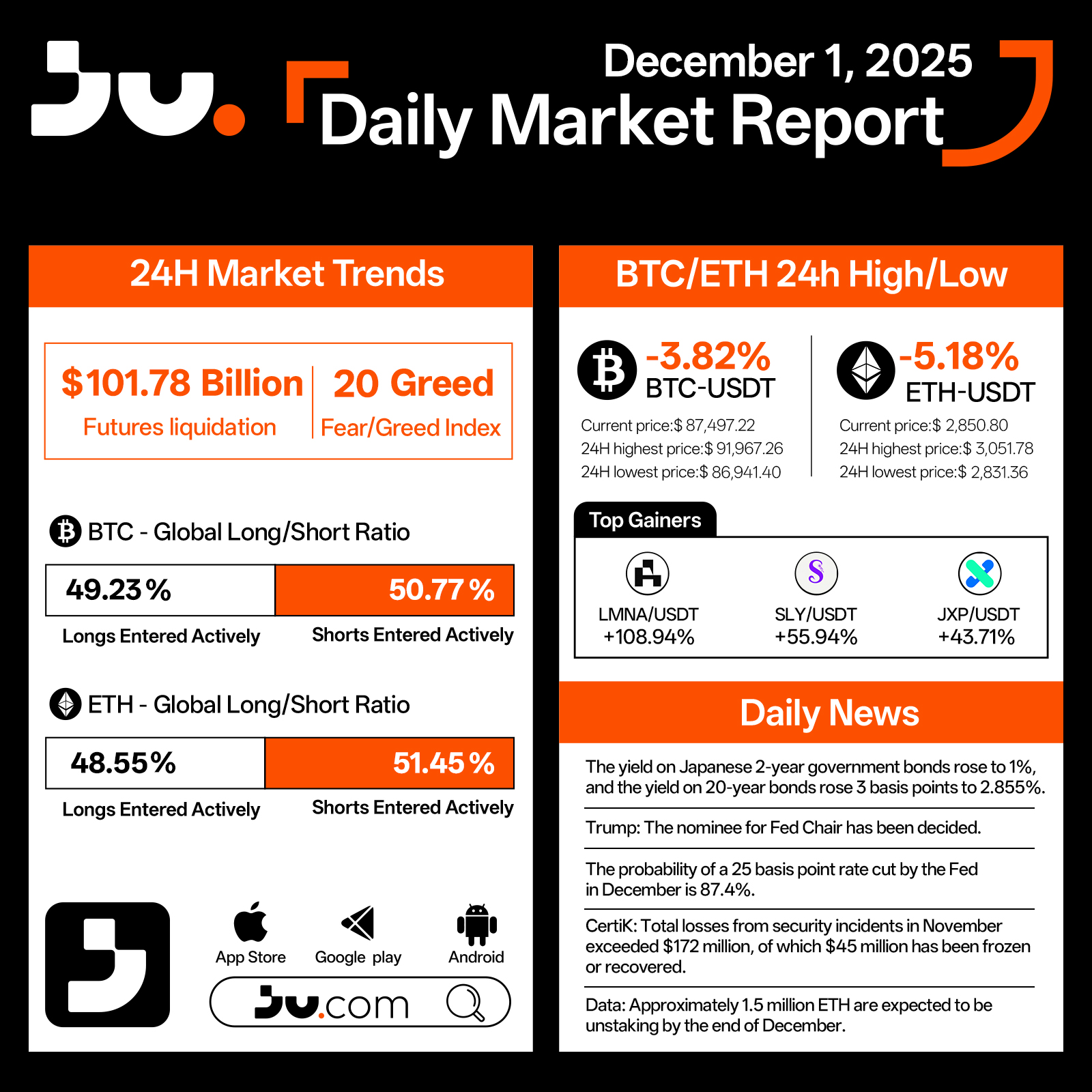
JU Blog
2025-12-01 08:25
BTC and ETH Slide as Market Enters Early December Pullback - December 1, 2025
Disclaimer:Contains third-party content. Not financial advice.
See Terms and Conditions.
What Is Yield Farming in Cryptocurrency?
Yield farming, also known as liquidity mining, is a decentralized finance (DeFi) strategy that allows cryptocurrency holders to earn passive income by providing liquidity to various blockchain-based protocols. Essentially, users deposit their digital assets into DeFi platforms such as lending pools or decentralized exchanges (DEXs). In return, they receive interest payments or rewards in the form of additional tokens or cryptocurrencies. This process leverages the concept of yield—meaning the return on investment (ROI)—to incentivize participation and facilitate more efficient capital allocation within the crypto ecosystem.
Unlike traditional banking where interest rates are relatively stable and regulated, yield farming offers potentially higher returns driven by market dynamics and protocol incentives. It has become a popular way for crypto investors to maximize their holdings while supporting decentralized financial services.
Understanding Yield Farming: How It Works
The mechanics of yield farming revolve around three core activities: depositing assets, earning yields, and managing risks. Users typically start by selecting a platform—such as Compound, Aave, or Uniswap—that offers opportunities for liquidity provision.
Once deposited into a liquidity pool—often comprising stablecoins or other popular cryptocurrencies—the user begins earning interest based on the amount supplied. These earnings can come from transaction fees generated within DEXs or from protocol-specific reward tokens distributed periodically. The annual percentage yield (APY) indicates how much profit an investor can expect over a year; often these rates are significantly higher than traditional savings accounts due to DeFi’s competitive incentives.
Platforms like Compound enable users to lend their assets directly to borrowers who pay interest in return. Similarly, Uniswap allows users to provide token pairs into pools and earn transaction fees proportional to their share of the pool’s liquidity.
Key Platforms Facilitating Yield Farming
- Compound: One of the earliest DeFi protocols that pioneered algorithmic money markets allowing users to lend and borrow digital assets.
- Aave: Known for its flexible borrowing options with variable interest rates tailored according to supply-demand dynamics.
- Uniswap: A leading decentralized exchange where liquidity providers earn fees from swaps involving supported token pairs.
These platforms have contributed significantly toward mainstreaming yield farming by offering accessible interfaces and attractive APYs during peak periods.
Risks Associated With Yield Farming
While yield farming presents lucrative opportunities, it also involves notable risks that investors must understand:
Market Volatility: Cryptocurrency prices are highly volatile; sudden price swings can diminish asset value rapidly—even if yields accrue nominally—potentially leading to losses when withdrawing funds.
Smart Contract Vulnerabilities: Many DeFi protocols rely on complex smart contracts which may contain bugs or security flaws. Exploits like code vulnerabilities have led to significant fund losses across multiple platforms.
Liquidity Risks: If a platform faces low liquidity during market downturns or crises such as flash crashes, users might find it difficult—or impossible—to withdraw their funds without incurring losses.
Regulatory Uncertainty: Governments worldwide are scrutinizing DeFi activities more closely amid concerns about consumer protection and financial stability. Regulatory changes could restrict access or impose compliance requirements that impact yields negatively.
Recent Developments Impacting Yield Farming
The landscape of yield farming is dynamic; recent events underscore both its potential and pitfalls:
Increased regulatory scrutiny has prompted some jurisdictions to consider stricter rules around DeFi operations—a move that could limit certain high-yield strategies but also promote safer practices over time.
Market downturns have affected many projects’ sustainability; notable failures include TerraUSD (UST) collapse followed by issues at Anchor Protocol which heavily relied on stablecoin pegs for high yields.
Several platforms faced security breaches or operational failures due to smart contract exploits—a reminder that despite high returns offered during bullish phases, underlying vulnerabilities pose real threats.
Potential Impacts on Investors & Future Trends
As regulatory environments tighten and market conditions evolve, investor sentiment towards yield farming may shift toward caution rather than aggressive pursuit of high yields alone. This could lead developers in the space focusing more on security enhancements—including audits—and creating more resilient protocols designed for long-term stability rather than short-term gains.
Furthermore, innovations such as insurance mechanisms against smart contract failures are emerging within DeFi ecosystems—aimed at reducing risk exposure for participants engaging in yield strategies.
How To Approach Yield Farming Safely
For those interested in participating responsibly:
- Conduct thorough research into platform credibility through audits and community feedback
- Diversify investments across multiple protocols instead of concentrating funds
- Stay updated with regulatory developments affecting your jurisdiction
- Use hardware wallets or secure custody solutions when possible
By understanding both potential rewards and inherent risks involved with yield farming strategies—and maintaining cautious optimism—you can better navigate this rapidly evolving sector while safeguarding your investments against unforeseen setbacks.
Semantic & LSI Keywords:DeFi staking rewards | cryptocurrency lending | blockchain-based investment | smart contract security | crypto asset management | decentralized exchanges | high-yield crypto investments | protocol risk management
JCUSER-IC8sJL1q
2025-05-22 11:03
What is yield farming, and what are the associated risks?
What Is Yield Farming in Cryptocurrency?
Yield farming, also known as liquidity mining, is a decentralized finance (DeFi) strategy that allows cryptocurrency holders to earn passive income by providing liquidity to various blockchain-based protocols. Essentially, users deposit their digital assets into DeFi platforms such as lending pools or decentralized exchanges (DEXs). In return, they receive interest payments or rewards in the form of additional tokens or cryptocurrencies. This process leverages the concept of yield—meaning the return on investment (ROI)—to incentivize participation and facilitate more efficient capital allocation within the crypto ecosystem.
Unlike traditional banking where interest rates are relatively stable and regulated, yield farming offers potentially higher returns driven by market dynamics and protocol incentives. It has become a popular way for crypto investors to maximize their holdings while supporting decentralized financial services.
Understanding Yield Farming: How It Works
The mechanics of yield farming revolve around three core activities: depositing assets, earning yields, and managing risks. Users typically start by selecting a platform—such as Compound, Aave, or Uniswap—that offers opportunities for liquidity provision.
Once deposited into a liquidity pool—often comprising stablecoins or other popular cryptocurrencies—the user begins earning interest based on the amount supplied. These earnings can come from transaction fees generated within DEXs or from protocol-specific reward tokens distributed periodically. The annual percentage yield (APY) indicates how much profit an investor can expect over a year; often these rates are significantly higher than traditional savings accounts due to DeFi’s competitive incentives.
Platforms like Compound enable users to lend their assets directly to borrowers who pay interest in return. Similarly, Uniswap allows users to provide token pairs into pools and earn transaction fees proportional to their share of the pool’s liquidity.
Key Platforms Facilitating Yield Farming
- Compound: One of the earliest DeFi protocols that pioneered algorithmic money markets allowing users to lend and borrow digital assets.
- Aave: Known for its flexible borrowing options with variable interest rates tailored according to supply-demand dynamics.
- Uniswap: A leading decentralized exchange where liquidity providers earn fees from swaps involving supported token pairs.
These platforms have contributed significantly toward mainstreaming yield farming by offering accessible interfaces and attractive APYs during peak periods.
Risks Associated With Yield Farming
While yield farming presents lucrative opportunities, it also involves notable risks that investors must understand:
Market Volatility: Cryptocurrency prices are highly volatile; sudden price swings can diminish asset value rapidly—even if yields accrue nominally—potentially leading to losses when withdrawing funds.
Smart Contract Vulnerabilities: Many DeFi protocols rely on complex smart contracts which may contain bugs or security flaws. Exploits like code vulnerabilities have led to significant fund losses across multiple platforms.
Liquidity Risks: If a platform faces low liquidity during market downturns or crises such as flash crashes, users might find it difficult—or impossible—to withdraw their funds without incurring losses.
Regulatory Uncertainty: Governments worldwide are scrutinizing DeFi activities more closely amid concerns about consumer protection and financial stability. Regulatory changes could restrict access or impose compliance requirements that impact yields negatively.
Recent Developments Impacting Yield Farming
The landscape of yield farming is dynamic; recent events underscore both its potential and pitfalls:
Increased regulatory scrutiny has prompted some jurisdictions to consider stricter rules around DeFi operations—a move that could limit certain high-yield strategies but also promote safer practices over time.
Market downturns have affected many projects’ sustainability; notable failures include TerraUSD (UST) collapse followed by issues at Anchor Protocol which heavily relied on stablecoin pegs for high yields.
Several platforms faced security breaches or operational failures due to smart contract exploits—a reminder that despite high returns offered during bullish phases, underlying vulnerabilities pose real threats.
Potential Impacts on Investors & Future Trends
As regulatory environments tighten and market conditions evolve, investor sentiment towards yield farming may shift toward caution rather than aggressive pursuit of high yields alone. This could lead developers in the space focusing more on security enhancements—including audits—and creating more resilient protocols designed for long-term stability rather than short-term gains.
Furthermore, innovations such as insurance mechanisms against smart contract failures are emerging within DeFi ecosystems—aimed at reducing risk exposure for participants engaging in yield strategies.
How To Approach Yield Farming Safely
For those interested in participating responsibly:
- Conduct thorough research into platform credibility through audits and community feedback
- Diversify investments across multiple protocols instead of concentrating funds
- Stay updated with regulatory developments affecting your jurisdiction
- Use hardware wallets or secure custody solutions when possible
By understanding both potential rewards and inherent risks involved with yield farming strategies—and maintaining cautious optimism—you can better navigate this rapidly evolving sector while safeguarding your investments against unforeseen setbacks.
Semantic & LSI Keywords:DeFi staking rewards | cryptocurrency lending | blockchain-based investment | smart contract security | crypto asset management | decentralized exchanges | high-yield crypto investments | protocol risk management
Disclaimer:Contains third-party content. Not financial advice.
See Terms and Conditions.
How Do I Set Up and Use a Hardware Wallet?
Setting up and using a hardware wallet is an essential step for anyone serious about securing their cryptocurrency assets. While the process may seem complex at first, understanding each step ensures that your digital investments are protected against hacking, theft, and other security threats. This guide provides a clear, step-by-step approach to help you confidently set up your hardware wallet and start managing your cryptocurrencies securely.
Choosing the Right Hardware Wallet
Before diving into setup procedures, selecting the appropriate hardware wallet is crucial. Popular options include Ledger Nano series, Trezor Model T, and KeepKey. Consider factors such as compatibility with different cryptocurrencies, security features like PIN protection or biometric authentication, user interface ease of use (touchscreen vs. buttons), and integration capabilities with wallets or exchanges.
Research recent reviews and updates to ensure you select a device that aligns with your security needs and usage preferences. Remember that reputable brands adhere to strict security standards—an important aspect when handling valuable digital assets.
Unboxing Your Hardware Wallet Safely
When you receive your hardware wallet, inspect the packaging carefully for tampering signs. Reputable manufacturers ship devices in sealed packages designed to prevent unauthorized access during transit. Avoid purchasing from unofficial sources; always buy directly from authorized sellers or official websites.
Once unboxed, verify that all components are intact: the device itself, USB cable (if applicable), seed phrase card or booklet, and any accessories provided by the manufacturer.
Initial Setup: Connecting Your Device
The first step in setting up involves connecting your hardware wallet to a computer or compatible mobile device via USB or Bluetooth (depending on model). Ensure you're using secure connections—preferably direct USB links rather than shared networks—to minimize potential interception risks during setup.
Follow on-screen instructions provided by the device’s interface—these typically involve powering on the device by pressing specific buttons or following prompts displayed on its screen if it has one.
Creating a New Wallet & Securing Your Seed Phrase
During initial setup:
Choose a PIN Code: You will be prompted to create a PIN code—a critical layer of physical security preventing unauthorized access if someone else gets hold of your device.
Generate Seed Phrase: The device will generate a 12-24 word seed phrase (also called recovery phrase). This phrase is vital because it acts as a master key allowing you to restore access if the hardware is lost or damaged.
Write Down Your Seed Phrase: Carefully record this seed phrase on paper using pen—never store it digitally where hackers could access it—and store it securely offline in multiple safe locations away from thefts or natural disasters.
Confirm Seed Phrase: To ensure accuracy during setup, you'll likely be asked to re-enter some words from your seed phrase as confirmation steps within the interface.
This process establishes an offline backup method for restoring funds without relying solely on proprietary software services—a core principle of cold storage solutions enhancing overall asset safety.
Installing Companion Software & Firmware Updates
Most hardware wallets require companion applications installed onto computers (e.g., Ledger Live for Ledger devices) or mobile apps compatible with their firmware versions:
- Download these applications only from official sources.
- Follow installation instructions carefully.
- Check for firmware updates immediately after setup; manufacturers often release patches addressing vulnerabilities or adding new features.
Keeping firmware updated ensures maximum protection against emerging threats while maintaining compatibility with new cryptocurrencies and smart contract functionalities where supported.
Adding Cryptocurrencies & Managing Assets
Once configured:
- Connect your hardware wallet via its companion app.
- Add supported cryptocurrencies by selecting them within this software interface.
- Transfer funds securely from exchanges into addresses generated directly through your hardware wallet—this process ensures private keys remain offline at all times during transactions.
Always verify transaction details before confirming transfers; many wallets display transaction info directly on their screens for added assurance against phishing scams targeting user interfaces elsewhere online.
Using Your Hardware Wallet Safely During Transactions
When conducting transactions:
- Connect your device only through trusted computers/devices in secure environments.
- Enter PIN codes directly into the physical device rather than third-party terminals whenever possible.
- Confirm transaction details physically on-device screens instead of relying solely on computer displays which could be compromised via malware attacks.4.. Use two-factor authentication methods offered by some models when available—for example biometric verification—to add extra layers of security during operations involving significant amounts of cryptocurrency holdings.
Best Practices for Maintaining Security
To maximize safety over time:
– Regularly update both firmware and companion apps following manufacturer guidelines– Never share seed phrases under any circumstances– Store backup copies securely offline– Be cautious about phishing attempts impersonating support services– Avoid connecting devices in insecure public Wi-Fi environments unless necessary precautions are taken
Troubleshooting Common Setup Issues
If encountering problems such as failure to recognize connected devices:
- Ensure cables are functioning correctly
- Restart both computer/device and hardware wallet
- Verify drivers are installed properly if applicable
- Consult official support resources provided by manufacturers
Final Tips Before Fully Relying On Your Hardware Wallet
While setting up provides robust protection measures initially,
remember that ongoing vigilance remains essential:
- Always keep backups updated separately from primary seeds
- Stay informed about latest cybersecurity threats targeting crypto users
- Consider multi-signature setups if managing large portfolios
By following these comprehensive steps—from choosing an appropriate model through secure management—you can confidently utilize your hardware wallet as part of an effective strategy for safeguarding digital assets in today’s evolving crypto landscape.
Note: For optimal E-A-T principles adherence — expertise comes from understanding technical processes; authority stems from following best practices recommended by reputable brands; trust builds through careful handling of sensitive information like seed phrases—and transparency about potential risks involved at every stage enhances overall credibility among users seeking reliable crypto storage solutions
kai
2025-05-22 17:09
How do I set up and use a hardware wallet?
How Do I Set Up and Use a Hardware Wallet?
Setting up and using a hardware wallet is an essential step for anyone serious about securing their cryptocurrency assets. While the process may seem complex at first, understanding each step ensures that your digital investments are protected against hacking, theft, and other security threats. This guide provides a clear, step-by-step approach to help you confidently set up your hardware wallet and start managing your cryptocurrencies securely.
Choosing the Right Hardware Wallet
Before diving into setup procedures, selecting the appropriate hardware wallet is crucial. Popular options include Ledger Nano series, Trezor Model T, and KeepKey. Consider factors such as compatibility with different cryptocurrencies, security features like PIN protection or biometric authentication, user interface ease of use (touchscreen vs. buttons), and integration capabilities with wallets or exchanges.
Research recent reviews and updates to ensure you select a device that aligns with your security needs and usage preferences. Remember that reputable brands adhere to strict security standards—an important aspect when handling valuable digital assets.
Unboxing Your Hardware Wallet Safely
When you receive your hardware wallet, inspect the packaging carefully for tampering signs. Reputable manufacturers ship devices in sealed packages designed to prevent unauthorized access during transit. Avoid purchasing from unofficial sources; always buy directly from authorized sellers or official websites.
Once unboxed, verify that all components are intact: the device itself, USB cable (if applicable), seed phrase card or booklet, and any accessories provided by the manufacturer.
Initial Setup: Connecting Your Device
The first step in setting up involves connecting your hardware wallet to a computer or compatible mobile device via USB or Bluetooth (depending on model). Ensure you're using secure connections—preferably direct USB links rather than shared networks—to minimize potential interception risks during setup.
Follow on-screen instructions provided by the device’s interface—these typically involve powering on the device by pressing specific buttons or following prompts displayed on its screen if it has one.
Creating a New Wallet & Securing Your Seed Phrase
During initial setup:
Choose a PIN Code: You will be prompted to create a PIN code—a critical layer of physical security preventing unauthorized access if someone else gets hold of your device.
Generate Seed Phrase: The device will generate a 12-24 word seed phrase (also called recovery phrase). This phrase is vital because it acts as a master key allowing you to restore access if the hardware is lost or damaged.
Write Down Your Seed Phrase: Carefully record this seed phrase on paper using pen—never store it digitally where hackers could access it—and store it securely offline in multiple safe locations away from thefts or natural disasters.
Confirm Seed Phrase: To ensure accuracy during setup, you'll likely be asked to re-enter some words from your seed phrase as confirmation steps within the interface.
This process establishes an offline backup method for restoring funds without relying solely on proprietary software services—a core principle of cold storage solutions enhancing overall asset safety.
Installing Companion Software & Firmware Updates
Most hardware wallets require companion applications installed onto computers (e.g., Ledger Live for Ledger devices) or mobile apps compatible with their firmware versions:
- Download these applications only from official sources.
- Follow installation instructions carefully.
- Check for firmware updates immediately after setup; manufacturers often release patches addressing vulnerabilities or adding new features.
Keeping firmware updated ensures maximum protection against emerging threats while maintaining compatibility with new cryptocurrencies and smart contract functionalities where supported.
Adding Cryptocurrencies & Managing Assets
Once configured:
- Connect your hardware wallet via its companion app.
- Add supported cryptocurrencies by selecting them within this software interface.
- Transfer funds securely from exchanges into addresses generated directly through your hardware wallet—this process ensures private keys remain offline at all times during transactions.
Always verify transaction details before confirming transfers; many wallets display transaction info directly on their screens for added assurance against phishing scams targeting user interfaces elsewhere online.
Using Your Hardware Wallet Safely During Transactions
When conducting transactions:
- Connect your device only through trusted computers/devices in secure environments.
- Enter PIN codes directly into the physical device rather than third-party terminals whenever possible.
- Confirm transaction details physically on-device screens instead of relying solely on computer displays which could be compromised via malware attacks.4.. Use two-factor authentication methods offered by some models when available—for example biometric verification—to add extra layers of security during operations involving significant amounts of cryptocurrency holdings.
Best Practices for Maintaining Security
To maximize safety over time:
– Regularly update both firmware and companion apps following manufacturer guidelines– Never share seed phrases under any circumstances– Store backup copies securely offline– Be cautious about phishing attempts impersonating support services– Avoid connecting devices in insecure public Wi-Fi environments unless necessary precautions are taken
Troubleshooting Common Setup Issues
If encountering problems such as failure to recognize connected devices:
- Ensure cables are functioning correctly
- Restart both computer/device and hardware wallet
- Verify drivers are installed properly if applicable
- Consult official support resources provided by manufacturers
Final Tips Before Fully Relying On Your Hardware Wallet
While setting up provides robust protection measures initially,
remember that ongoing vigilance remains essential:
- Always keep backups updated separately from primary seeds
- Stay informed about latest cybersecurity threats targeting crypto users
- Consider multi-signature setups if managing large portfolios
By following these comprehensive steps—from choosing an appropriate model through secure management—you can confidently utilize your hardware wallet as part of an effective strategy for safeguarding digital assets in today’s evolving crypto landscape.
Note: For optimal E-A-T principles adherence — expertise comes from understanding technical processes; authority stems from following best practices recommended by reputable brands; trust builds through careful handling of sensitive information like seed phrases—and transparency about potential risks involved at every stage enhances overall credibility among users seeking reliable crypto storage solutions
Disclaimer:Contains third-party content. Not financial advice.
See Terms and Conditions.
How to Use PCA in Finance: A Practical Guide
Understanding Principal Component Analysis (PCA) in Financial Data
Principal Component Analysis (PCA) is a statistical technique designed to simplify complex datasets by reducing the number of variables while preserving most of the original information. In finance, datasets often contain numerous correlated variables—such as asset returns, trading volumes, or risk factors—that can be challenging to analyze directly. PCA transforms these correlated variables into a smaller set of uncorrelated components called principal components. These components are ordered based on how much variance they explain in the data, with the first capturing the most significant patterns.
For investors and financial analysts, this means PCA can help identify underlying factors influencing market movements or portfolio performance without getting lost in high-dimensional data. It’s particularly valuable for visualizing trends and making sense of large datasets that would otherwise be unwieldy.
Applying PCA for Portfolio Optimization and Risk Management
One of the primary uses of PCA in finance is portfolio optimization. By analyzing historical asset returns through PCA, investors can uncover dominant risk factors affecting their portfolios. For example, instead of examining dozens of individual stocks or assets separately, analysts can focus on a handful of principal components that capture most market variability.
This approach simplifies diversification strategies by highlighting which assets contribute most significantly to overall risk and return profiles. Additionally, it helps identify hidden correlations between assets—crucial for constructing resilient portfolios that are less vulnerable to systemic shocks.
In risk management contexts, PCA assists in pinpointing assets with high volatility or those contributing disproportionately to portfolio risk. By understanding these key drivers via principal components analysis, firms can implement more targeted hedging strategies or adjust their holdings accordingly.
Detecting Market Anomalies Using Dimensionality Reduction Techniques
Market anomalies—unusual patterns or outliers—can signal potential opportunities or risks if identified early. PCA serves as an effective anomaly detection tool because it highlights deviations from typical data structures by revealing unusual variations along certain principal components.
For instance, during periods of market stress or unexpected events like geopolitical crises or economic downturns, asset behaviors often deviate from historical norms. Applying PCA helps detect these shifts quickly by showing which principal components exhibit abnormal variance levels compared to baseline periods.
This capability is especially useful for hedge funds and institutional investors seeking early warnings about emerging risks before they fully materialize into losses.
Leveraging PCA in Cryptocurrency Market Analysis
The rise of cryptocurrencies has introduced new challenges due to their high volatility and complex interdependencies among different digital assets. Researchers have increasingly applied PCA here to analyze large-scale crypto datasets encompassing prices, trading volumes, sentiment scores from social media platforms like Twitter and Reddit—and more recently even blockchain metrics such as transaction counts.
Using PCA allows analysts to identify underlying market trends across multiple cryptocurrencies simultaneously—for example: discovering clusters where certain coins move together due to shared technological features—or detecting shifts indicating upcoming price changes based on emerging patterns within principal components.
Such insights support traders looking for diversification opportunities beyond traditional markets and help institutions develop better models for predicting cryptocurrency price movements amid rapid innovation and regulatory developments.
Recent Trends: Machine Learning Integration & High-Dimensional Data Handling
The integration of machine learning techniques like PCA into financial analysis has gained momentum over recent years owing to advancements in computational power and algorithmic sophistication[2]. This synergy enables more accurate modeling when dealing with vast amounts of high-dimensional data common today—from multi-asset portfolios spanning equities bonds derivatives—to alternative investments such as real estate funds or commodities futures[3].
Dimensionality reduction methods like PCA facilitate visualization by transforming complex datasets into two- or three-dimensional plots that reveal hidden relationships among variables—a critical step toward transparent decision-making processes aligned with regulatory standards[1].
Moreover, applying machine learning-enhanced dimensionality reduction supports developing predictive models capable not only of identifying current market conditions but also anticipating future trends based on historical patterns embedded within transformed features derived from principal component analysis[2].
Challenges When Using Principal Component Analysis
While powerful—and increasingly essential—PCA does come with limitations worth noting:
Overfitting & Underfitting: Selecting too many principal components may cause overfitting where noise influences results; choosing too few might omit important information leading to underfitting.
Interpretability Issues: Although PCAs reduce complexity visually well enough for some applications; interpreting what each component truly represents remains challenging because they are linear combinations rather than tangible financial metrics.
Regulatory Considerations: As machine learning tools become integral parts of financial decision-making processes—including those involving sensitive client data—they must comply with evolving regulations concerning transparency (explainability), fairness (bias mitigation), privacy protections—all crucial aspects aligning with E-A-T principles (Expertise-Authoritativeness-Trustworthiness).
Key Dates Shaping Financial AI Adoption
Historical milestones highlight how technological advances influence finance:
In 2019*, incidents involving advanced spyware highlighted cybersecurity vulnerabilities linked indirectly but importantly emphasizing security considerations when deploying AI tools including PCAs.
Looking ahead towards 2025*, significant public funding initiatives across regions such as Europe (€500 million research grants) aim at fostering innovation—including AI applications—in finance sectors[3]. Similarly; policy adjustments like New York's increased film tax incentives reflect broader investment trends supporting technological growth impacting various industries including fintech innovations driven by machine learning techniques like PCA*.
Implementing Principal Component Analysis Effectively
To maximize benefits while mitigating pitfalls when using PCA:
Preprocess Data Carefully: Standardize variables so they have comparable scales; normalize values if necessary.
Determine Optimal Number Of Components: Use criteria such as explained variance ratio thresholds (>80%) combined with scree plots.
Validate Results: Cross-check findings against known benchmarks; test stability across different time periods.
Interpret Components Thoughtfully: Remember that PCs are linear combinations; invest effort into understanding what underlying factors they represent within your specific context.
Ensure Regulatory Compliance: Document methodologies transparently; adhere strictly to legal standards governing data use.
Why Understanding How To Use PCA Matters
Mastering how-to apply Principal Component Analysis effectively empowers financial professionals—from quantitative analysts designing algorithms—to portfolio managers seeking clearer insights into complex markets.[LSI keywords include "dimensionality reduction," "financial modeling," "risk assessment," "market analysis," "cryptocurrency analytics," "machine learning applications"] Understanding its strengths alongside limitations ensures better decision-making grounded in robust analytical frameworks aligned with industry best practices.[E-A-T principles] As technology continues evolving rapidly within finance sectors worldwide—with increasing emphasis on ethical standards—it’s vital practitioners stay informed about tools like PCA that shape modern investment strategies.
By integrating sound methodology with ongoing developments—and being mindful about interpretability issues—you position yourself at the forefront of innovative yet responsible financial analysis leveraging Principal Component Analysis effectively across diverse applications ranging from traditional equity markets all the way through emerging digital currencies
JCUSER-IC8sJL1q
2025-05-20 07:04
How to use PCA in finance?
How to Use PCA in Finance: A Practical Guide
Understanding Principal Component Analysis (PCA) in Financial Data
Principal Component Analysis (PCA) is a statistical technique designed to simplify complex datasets by reducing the number of variables while preserving most of the original information. In finance, datasets often contain numerous correlated variables—such as asset returns, trading volumes, or risk factors—that can be challenging to analyze directly. PCA transforms these correlated variables into a smaller set of uncorrelated components called principal components. These components are ordered based on how much variance they explain in the data, with the first capturing the most significant patterns.
For investors and financial analysts, this means PCA can help identify underlying factors influencing market movements or portfolio performance without getting lost in high-dimensional data. It’s particularly valuable for visualizing trends and making sense of large datasets that would otherwise be unwieldy.
Applying PCA for Portfolio Optimization and Risk Management
One of the primary uses of PCA in finance is portfolio optimization. By analyzing historical asset returns through PCA, investors can uncover dominant risk factors affecting their portfolios. For example, instead of examining dozens of individual stocks or assets separately, analysts can focus on a handful of principal components that capture most market variability.
This approach simplifies diversification strategies by highlighting which assets contribute most significantly to overall risk and return profiles. Additionally, it helps identify hidden correlations between assets—crucial for constructing resilient portfolios that are less vulnerable to systemic shocks.
In risk management contexts, PCA assists in pinpointing assets with high volatility or those contributing disproportionately to portfolio risk. By understanding these key drivers via principal components analysis, firms can implement more targeted hedging strategies or adjust their holdings accordingly.
Detecting Market Anomalies Using Dimensionality Reduction Techniques
Market anomalies—unusual patterns or outliers—can signal potential opportunities or risks if identified early. PCA serves as an effective anomaly detection tool because it highlights deviations from typical data structures by revealing unusual variations along certain principal components.
For instance, during periods of market stress or unexpected events like geopolitical crises or economic downturns, asset behaviors often deviate from historical norms. Applying PCA helps detect these shifts quickly by showing which principal components exhibit abnormal variance levels compared to baseline periods.
This capability is especially useful for hedge funds and institutional investors seeking early warnings about emerging risks before they fully materialize into losses.
Leveraging PCA in Cryptocurrency Market Analysis
The rise of cryptocurrencies has introduced new challenges due to their high volatility and complex interdependencies among different digital assets. Researchers have increasingly applied PCA here to analyze large-scale crypto datasets encompassing prices, trading volumes, sentiment scores from social media platforms like Twitter and Reddit—and more recently even blockchain metrics such as transaction counts.
Using PCA allows analysts to identify underlying market trends across multiple cryptocurrencies simultaneously—for example: discovering clusters where certain coins move together due to shared technological features—or detecting shifts indicating upcoming price changes based on emerging patterns within principal components.
Such insights support traders looking for diversification opportunities beyond traditional markets and help institutions develop better models for predicting cryptocurrency price movements amid rapid innovation and regulatory developments.
Recent Trends: Machine Learning Integration & High-Dimensional Data Handling
The integration of machine learning techniques like PCA into financial analysis has gained momentum over recent years owing to advancements in computational power and algorithmic sophistication[2]. This synergy enables more accurate modeling when dealing with vast amounts of high-dimensional data common today—from multi-asset portfolios spanning equities bonds derivatives—to alternative investments such as real estate funds or commodities futures[3].
Dimensionality reduction methods like PCA facilitate visualization by transforming complex datasets into two- or three-dimensional plots that reveal hidden relationships among variables—a critical step toward transparent decision-making processes aligned with regulatory standards[1].
Moreover, applying machine learning-enhanced dimensionality reduction supports developing predictive models capable not only of identifying current market conditions but also anticipating future trends based on historical patterns embedded within transformed features derived from principal component analysis[2].
Challenges When Using Principal Component Analysis
While powerful—and increasingly essential—PCA does come with limitations worth noting:
Overfitting & Underfitting: Selecting too many principal components may cause overfitting where noise influences results; choosing too few might omit important information leading to underfitting.
Interpretability Issues: Although PCAs reduce complexity visually well enough for some applications; interpreting what each component truly represents remains challenging because they are linear combinations rather than tangible financial metrics.
Regulatory Considerations: As machine learning tools become integral parts of financial decision-making processes—including those involving sensitive client data—they must comply with evolving regulations concerning transparency (explainability), fairness (bias mitigation), privacy protections—all crucial aspects aligning with E-A-T principles (Expertise-Authoritativeness-Trustworthiness).
Key Dates Shaping Financial AI Adoption
Historical milestones highlight how technological advances influence finance:
In 2019*, incidents involving advanced spyware highlighted cybersecurity vulnerabilities linked indirectly but importantly emphasizing security considerations when deploying AI tools including PCAs.
Looking ahead towards 2025*, significant public funding initiatives across regions such as Europe (€500 million research grants) aim at fostering innovation—including AI applications—in finance sectors[3]. Similarly; policy adjustments like New York's increased film tax incentives reflect broader investment trends supporting technological growth impacting various industries including fintech innovations driven by machine learning techniques like PCA*.
Implementing Principal Component Analysis Effectively
To maximize benefits while mitigating pitfalls when using PCA:
Preprocess Data Carefully: Standardize variables so they have comparable scales; normalize values if necessary.
Determine Optimal Number Of Components: Use criteria such as explained variance ratio thresholds (>80%) combined with scree plots.
Validate Results: Cross-check findings against known benchmarks; test stability across different time periods.
Interpret Components Thoughtfully: Remember that PCs are linear combinations; invest effort into understanding what underlying factors they represent within your specific context.
Ensure Regulatory Compliance: Document methodologies transparently; adhere strictly to legal standards governing data use.
Why Understanding How To Use PCA Matters
Mastering how-to apply Principal Component Analysis effectively empowers financial professionals—from quantitative analysts designing algorithms—to portfolio managers seeking clearer insights into complex markets.[LSI keywords include "dimensionality reduction," "financial modeling," "risk assessment," "market analysis," "cryptocurrency analytics," "machine learning applications"] Understanding its strengths alongside limitations ensures better decision-making grounded in robust analytical frameworks aligned with industry best practices.[E-A-T principles] As technology continues evolving rapidly within finance sectors worldwide—with increasing emphasis on ethical standards—it’s vital practitioners stay informed about tools like PCA that shape modern investment strategies.
By integrating sound methodology with ongoing developments—and being mindful about interpretability issues—you position yourself at the forefront of innovative yet responsible financial analysis leveraging Principal Component Analysis effectively across diverse applications ranging from traditional equity markets all the way through emerging digital currencies
Disclaimer:Contains third-party content. Not financial advice.
See Terms and Conditions.
What Are Typical, Median, and Weighted Close Prices in Finance and Cryptocurrency?
Understanding the different types of close prices is essential for investors, traders, and analysts aiming to make informed decisions in both traditional finance and the rapidly evolving cryptocurrency markets. These metrics—typical, median, and weighted close prices—offer unique insights into market behavior by summarizing price data over specific periods. This article explores each of these concepts in detail, explaining their calculation methods, significance, recent developments, and how they influence investment strategies.
Defining Typical Close Price
The typical close price is a straightforward metric that provides an average snapshot of a security’s closing prices over a designated period. It is often used as a benchmark to assess overall performance or trend direction. To calculate it accurately, you take all closing prices within the chosen timeframe—such as daily closes over a week or month—and compute their mean (average).
For example:
If Bitcoin’s closing prices over five days are $45,000; $46,500; $44,800; $47,200; and $45,900 — the typical close price would be calculated as:
(45k + 46.5k + 44.8k + 47.2k + 45.9k) / 5 = approximately 45.88k.
This measure smooths out short-term fluctuations but can be influenced by extreme values if outliers are present.
Understanding Median Close Price
Unlike the typical close price that averages all data points equally regardless of their value magnitude (which can be skewed by outliers), the median close price identifies the middle value when all closing prices are ordered from lowest to highest within a specific period.
Suppose we have these daily closes:
$42K; $44K; $46K; $48K; $50K — here the median is $46K, which sits exactly in the middle when sorted ascendingly.
In cases with an even number of observations—for example:
$42K; $44K; $46K; $48K — then you take the average of two middle values ($44K & $46K), resulting in $45K as median.
The median offers robustness against outliers or sudden spikes/drops that might distort average-based metrics—a valuable trait especially during volatile market conditions like those seen in cryptocurrencies.
Calculating Weighted Close Price
The weighted close price incorporates trading volume into its calculation to reflect not just where prices closed but also how much trading activity occurred at each level. This metric assigns more importance to closing prices associated with higher volumes since they represent stronger market consensus at those levels.
To compute it:
- Multiply each closing price by its corresponding trading volume.
- Sum all these products.
- Divide this sum by total trading volume across all periods considered.
For instance:
If on Day 1 Bitcoin closed at $45k with volume 10 BTC and on Day 2 at $47k with volume 20 BTC:
Weighted Close Price = [($45k *10) + ($47k *20)] / (10+20) = ($450k + $940k)/30 ≈ $43.67k
This approach emphasizes significant trades rather than just raw pricing data alone—making it particularly useful for assessing true market sentiment during high-volatility phases common in crypto markets.
Why These Metrics Matter for Investors
Each type of close price serves distinct analytical purposes:
- The typical close provides an overall average view useful for tracking general trends.
- The median offers resilience against anomalies or sudden spikes/dips caused by news events or manipulation.
- The weighted close reflects actual market activity levels through trade volumes—crucial for understanding liquidity and genuine investor interest.
By combining insights from these metrics alongside other technical indicators like moving averages or RSI (Relative Strength Index), investors can develop more nuanced strategies tailored to current market conditions while managing risk effectively.
Recent Trends & Developments Impacting Market Analysis
In recent years—including during notable events such as Bitcoin's surge past $60 thousand—the application of these metrics has gained prominence due to increased volatility across financial assets and cryptocurrencies alike. For instance:
- During crypto booms like that seen in late 2020/early 2021—which saw rapid gains followed by sharp corrections—the weighted close provided clearer signals about where most trades were happening amidst wild swings.
- Regulatory changes introduced around mid-2023 affected reporting standards on trade volumes across various platforms—a factor influencing weighted calculations' accuracy.
- Technological advancements now enable real-time computation using sophisticated algorithms integrated into trading platforms—enhancing traders’ ability to react swiftly based on live data analysis involving typical/median/weighted closes.
Key Data Sources & Tools
Reliable calculation depends heavily on accurate data collection from sources such as:
- Stock exchanges
- Cryptocurrency platforms
- Financial databases like Bloomberg Terminal or CoinMarketCap
- Trading software offering built-in analytics tools
Popular tools include spreadsheet programs (Excel/Google Sheets), specialized financial software like MetaTrader or TradingView dashboards—all capable of processing large datasets efficiently.
Interpreting Market Signals Through These Metrics
High weighted-close values combined with elevated trading volumes often indicate strong bullish sentiment—or vice versa if accompanied by declining volumes suggesting waning interest. Meanwhile:
- A rising median might signal consistent buying pressure unaffected by temporary anomalies,
- A stable typical-close suggests steady performance without abrupt shifts,
Investors should interpret these signals contextually alongside broader macroeconomic factors such as regulatory news cycles or technological developments affecting asset classes.
Challenges & Risks Associated With Using Close Prices Metrics
While invaluable tools for analysis—they do come with limitations:
- Market Volatility: Cryptocurrencies' notorious volatility can cause significant discrepancies between different measures within short timeframes.
- Data Integrity Issues: Inconsistent reporting standards across exchanges may lead to inaccuracies—especially relevant when calculating weighted closes reliant on precise volume figures.
- Technological Risks: Cybersecurity threats targeting exchanges could disrupt access to reliable data streams necessary for accurate calculations.
How Investors Can Mitigate Risks
To navigate potential pitfalls:
- Cross-reference multiple sources before making decisions
- Use comprehensive analysis combining various metrics rather than relying solely on one indicator
- Stay updated about regulatory changes impacting reporting standards
Future Outlook
As blockchain technology advances further—with innovations enabling decentralized verification—and regulatory frameworks become clearer globally—the accuracy and reliability of calculating these key metrics will improve significantly worldwide.
By understanding what typical-, median-, and weighted-close prices reveal about asset behavior—and staying aware of recent trends—you'll be better equipped to interpret market signals accurately whether you're investing traditionally or exploring opportunities within cryptocurrencies.
Keywords & Semantic Terms Used:
financial analysis | cryptocurrency markets | trade volume | volatility | technical indicators | investment decision-making | liquidity assessment | real-time data analytics
JCUSER-IC8sJL1q
2025-05-09 07:33
What are typical, median, and weighted close prices?
What Are Typical, Median, and Weighted Close Prices in Finance and Cryptocurrency?
Understanding the different types of close prices is essential for investors, traders, and analysts aiming to make informed decisions in both traditional finance and the rapidly evolving cryptocurrency markets. These metrics—typical, median, and weighted close prices—offer unique insights into market behavior by summarizing price data over specific periods. This article explores each of these concepts in detail, explaining their calculation methods, significance, recent developments, and how they influence investment strategies.
Defining Typical Close Price
The typical close price is a straightforward metric that provides an average snapshot of a security’s closing prices over a designated period. It is often used as a benchmark to assess overall performance or trend direction. To calculate it accurately, you take all closing prices within the chosen timeframe—such as daily closes over a week or month—and compute their mean (average).
For example:
If Bitcoin’s closing prices over five days are $45,000; $46,500; $44,800; $47,200; and $45,900 — the typical close price would be calculated as:
(45k + 46.5k + 44.8k + 47.2k + 45.9k) / 5 = approximately 45.88k.
This measure smooths out short-term fluctuations but can be influenced by extreme values if outliers are present.
Understanding Median Close Price
Unlike the typical close price that averages all data points equally regardless of their value magnitude (which can be skewed by outliers), the median close price identifies the middle value when all closing prices are ordered from lowest to highest within a specific period.
Suppose we have these daily closes:
$42K; $44K; $46K; $48K; $50K — here the median is $46K, which sits exactly in the middle when sorted ascendingly.
In cases with an even number of observations—for example:
$42K; $44K; $46K; $48K — then you take the average of two middle values ($44K & $46K), resulting in $45K as median.
The median offers robustness against outliers or sudden spikes/drops that might distort average-based metrics—a valuable trait especially during volatile market conditions like those seen in cryptocurrencies.
Calculating Weighted Close Price
The weighted close price incorporates trading volume into its calculation to reflect not just where prices closed but also how much trading activity occurred at each level. This metric assigns more importance to closing prices associated with higher volumes since they represent stronger market consensus at those levels.
To compute it:
- Multiply each closing price by its corresponding trading volume.
- Sum all these products.
- Divide this sum by total trading volume across all periods considered.
For instance:
If on Day 1 Bitcoin closed at $45k with volume 10 BTC and on Day 2 at $47k with volume 20 BTC:
Weighted Close Price = [($45k *10) + ($47k *20)] / (10+20) = ($450k + $940k)/30 ≈ $43.67k
This approach emphasizes significant trades rather than just raw pricing data alone—making it particularly useful for assessing true market sentiment during high-volatility phases common in crypto markets.
Why These Metrics Matter for Investors
Each type of close price serves distinct analytical purposes:
- The typical close provides an overall average view useful for tracking general trends.
- The median offers resilience against anomalies or sudden spikes/dips caused by news events or manipulation.
- The weighted close reflects actual market activity levels through trade volumes—crucial for understanding liquidity and genuine investor interest.
By combining insights from these metrics alongside other technical indicators like moving averages or RSI (Relative Strength Index), investors can develop more nuanced strategies tailored to current market conditions while managing risk effectively.
Recent Trends & Developments Impacting Market Analysis
In recent years—including during notable events such as Bitcoin's surge past $60 thousand—the application of these metrics has gained prominence due to increased volatility across financial assets and cryptocurrencies alike. For instance:
- During crypto booms like that seen in late 2020/early 2021—which saw rapid gains followed by sharp corrections—the weighted close provided clearer signals about where most trades were happening amidst wild swings.
- Regulatory changes introduced around mid-2023 affected reporting standards on trade volumes across various platforms—a factor influencing weighted calculations' accuracy.
- Technological advancements now enable real-time computation using sophisticated algorithms integrated into trading platforms—enhancing traders’ ability to react swiftly based on live data analysis involving typical/median/weighted closes.
Key Data Sources & Tools
Reliable calculation depends heavily on accurate data collection from sources such as:
- Stock exchanges
- Cryptocurrency platforms
- Financial databases like Bloomberg Terminal or CoinMarketCap
- Trading software offering built-in analytics tools
Popular tools include spreadsheet programs (Excel/Google Sheets), specialized financial software like MetaTrader or TradingView dashboards—all capable of processing large datasets efficiently.
Interpreting Market Signals Through These Metrics
High weighted-close values combined with elevated trading volumes often indicate strong bullish sentiment—or vice versa if accompanied by declining volumes suggesting waning interest. Meanwhile:
- A rising median might signal consistent buying pressure unaffected by temporary anomalies,
- A stable typical-close suggests steady performance without abrupt shifts,
Investors should interpret these signals contextually alongside broader macroeconomic factors such as regulatory news cycles or technological developments affecting asset classes.
Challenges & Risks Associated With Using Close Prices Metrics
While invaluable tools for analysis—they do come with limitations:
- Market Volatility: Cryptocurrencies' notorious volatility can cause significant discrepancies between different measures within short timeframes.
- Data Integrity Issues: Inconsistent reporting standards across exchanges may lead to inaccuracies—especially relevant when calculating weighted closes reliant on precise volume figures.
- Technological Risks: Cybersecurity threats targeting exchanges could disrupt access to reliable data streams necessary for accurate calculations.
How Investors Can Mitigate Risks
To navigate potential pitfalls:
- Cross-reference multiple sources before making decisions
- Use comprehensive analysis combining various metrics rather than relying solely on one indicator
- Stay updated about regulatory changes impacting reporting standards
Future Outlook
As blockchain technology advances further—with innovations enabling decentralized verification—and regulatory frameworks become clearer globally—the accuracy and reliability of calculating these key metrics will improve significantly worldwide.
By understanding what typical-, median-, and weighted-close prices reveal about asset behavior—and staying aware of recent trends—you'll be better equipped to interpret market signals accurately whether you're investing traditionally or exploring opportunities within cryptocurrencies.
Keywords & Semantic Terms Used:
financial analysis | cryptocurrency markets | trade volume | volatility | technical indicators | investment decision-making | liquidity assessment | real-time data analytics
Disclaimer:Contains third-party content. Not financial advice.
See Terms and Conditions.
What Are Tokenized Real-World Assets and Why Do They Matter?
Tokenized real-world assets (RWA) are transforming the way traditional assets are bought, sold, and managed by leveraging blockchain technology. Essentially, tokenization involves converting physical or financial assets—such as real estate, commodities, securities, or intellectual property—into digital tokens that can be traded on blockchain platforms. This process creates a digital representation of an asset that can be divided into smaller units through fractional ownership. For example, instead of purchasing an entire property worth millions of dollars, investors can buy a fraction of it via tokens.
This innovation is significant because it bridges the gap between traditional markets and the decentralized finance (DeFi) ecosystem. By digitizing tangible assets, tokenization offers increased liquidity for traditionally illiquid markets like real estate or art. It also enables 24/7 trading on various exchanges worldwide while providing enhanced transparency and security through blockchain’s immutable ledger.
The potential impact extends beyond just making investments more accessible; it could fundamentally reshape how assets are owned and transferred across borders with reduced transaction costs and intermediaries.
The Growing Significance of Asset Tokenization in Financial Markets
While the concept has been around since at least 2017—with early platforms like Polymath pioneering security tokens—the recent surge in interest reflects broader adoption driven by technological advancements and regulatory clarity. As blockchain technology matures, more sectors recognize its capacity to democratize access to high-value assets.
One key driver behind this trend is the demand for fractional ownership solutions that lower entry barriers for retail investors who previously faced high capital requirements. For instance, investing directly in commercial real estate often required substantial capital outlay; tokenization allows investors to buy small fractions represented by digital tokens instead.
Moreover, transparency plays a crucial role: blockchain’s transparent transaction records reduce fraud risks while increasing trust among participants. Additionally, digital tokens facilitate faster settlement times compared to traditional methods—often happening instantly or within minutes rather than days—which enhances market efficiency.
Regulatory developments have also contributed significantly to legitimizing this space. In 2020-2023 alone, authorities such as the U.S Securities and Exchange Commission (SEC) issued guidelines clarifying what constitutes security tokens versus utility tokens—a move that encourages compliant issuance processes while safeguarding investor interests.
Key Sectors Benefiting from Asset Tokenization
Several industries stand to benefit substantially from tokenized assets:
Real Estate: Platforms like Propellr and Fundrise enable individuals worldwide to invest in properties without needing full ownership rights upfront. This approach increases liquidity in a traditionally illiquid market.
Commodities: Companies such as Komgo explore tokenizing natural resources like oil or metals—making these commodities easier to trade globally with greater transparency.
Art & Collectibles: Digital art platforms like Rarible allow artists to tokenize their work into unique NFTs (non-fungible tokens), opening new revenue streams while enabling collectors worldwide access.
Financial Securities: The issuance of security tokens representing shares or bonds provides companies with alternative fundraising avenues outside conventional stock exchanges.
Recent developments highlight rapid progress across these sectors—for example:
- In March 2023, the SEC approved its first Security Token Offering (STO), signaling regulatory acceptance.
- The European Union introduced comprehensive crypto regulations under MiCA in June 2022.
- Several real estate projects successfully raised capital via token sales during 2021–22.
These advances demonstrate growing institutional confidence alongside increasing investor interest globally.
Opportunities Created by Tokenized Assets
Tokenization unlocks numerous opportunities for both individual investors and large institutions:
Increased Accessibility
Fractional ownership means anyone with internet access can participate regardless of wealth level—a stark contrast from traditional investment barriers requiring significant upfront capital.
Enhanced Liquidity
Assets previously considered illiquid—like commercial properties or fine art—can now be traded easily on secondary markets at any time during operational hours without lengthy settlement periods typical in conventional systems.
Global Market Reach
Blockchain-based trading removes geographical boundaries; investors from different countries can seamlessly buy/sell fractions without currency conversions or complex legal procedures involved in cross-border transactions.
Cost Efficiency
Reduced reliance on intermediaries lowers transaction fees significantly compared to traditional brokerage services or bank transfers involving multiple layers of verification processes.
Transparency & Security
Blockchain’s immutable ledger ensures all transactions are recorded transparently; this reduces fraud risk while providing clear provenance data especially important for high-value items such as artwork or luxury goods.
Challenges & Risks Associated With Asset Tokenization
Despite its promising outlooks—and many benefits—the industry faces notable hurdles:
Regulatory Uncertainty: While some jurisdictions have begun establishing frameworks—for instance SEC guidelines—the global landscape remains fragmented with inconsistent rules which could hinder widespread adoption if not harmonized effectively.
Market Volatility: Many cryptocurrencies underpinning these platforms exhibit volatility that might affect asset valuation stability over short periods.
Scalability Concerns: As more assets get tokenized daily—from small-scale collectibles up to large infrastructure projects—the underlying blockchains may face scalability issues impacting transaction speed and cost-efficiency.
Legal Ownership & Rights: Clarifying legal rights associated with fractional ownership remains complex; questions about voting rights for securities-like tokens need clear resolution within existing legal systems.
Future Outlook for Tokenized Real Assets
The trajectory suggests continued growth driven by technological innovation coupled with evolving regulation frameworks worldwide:
- Regulatory bodies such as SEC approving STOs indicate increasing legitimacy which will encourage institutional participation.
- Developments like Europe’s MiCA regulation aim at creating unified standards facilitating cross-border trading activities involving RWAs.
- Increasing mainstream acceptance among financial institutions hints at integration possibilities within existing banking infrastructure—including custody solutions tailored specifically for digital assets.
In addition:
- More industries will likely adopt asset tokenization—from agriculture commodities to intellectual property rights—to diversify investment options further,
- Innovations around smart contracts will automate compliance processes,
- Advances in interoperability protocols will enable seamless transfer between different blockchains enhancing liquidity pools.
By addressing current challenges proactively through regulation harmonization and technological improvements—and emphasizing investor protection—the industry is poised not only for growth but also sustainable development aligned with best practices.
Final Thoughts on Potential Impact
Tokenized real-world assets represent a paradigm shift towards democratizing investment opportunities across global markets using blockchain technology's inherent advantages — transparency, efficiency,and accessibility . While challenges remain—including regulatory uncertaintiesand scalability issues—the momentum indicates strong future prospects . As stakeholders continue refining frameworksand expanding use cases , RWAs could become integral componentsof modern financial ecosystems , unlocking new value streamsfor both individualinvestorsand large institutions alike .
JCUSER-WVMdslBw
2025-05-22 03:34
What potential do tokenized real-world assets hold?
What Are Tokenized Real-World Assets and Why Do They Matter?
Tokenized real-world assets (RWA) are transforming the way traditional assets are bought, sold, and managed by leveraging blockchain technology. Essentially, tokenization involves converting physical or financial assets—such as real estate, commodities, securities, or intellectual property—into digital tokens that can be traded on blockchain platforms. This process creates a digital representation of an asset that can be divided into smaller units through fractional ownership. For example, instead of purchasing an entire property worth millions of dollars, investors can buy a fraction of it via tokens.
This innovation is significant because it bridges the gap between traditional markets and the decentralized finance (DeFi) ecosystem. By digitizing tangible assets, tokenization offers increased liquidity for traditionally illiquid markets like real estate or art. It also enables 24/7 trading on various exchanges worldwide while providing enhanced transparency and security through blockchain’s immutable ledger.
The potential impact extends beyond just making investments more accessible; it could fundamentally reshape how assets are owned and transferred across borders with reduced transaction costs and intermediaries.
The Growing Significance of Asset Tokenization in Financial Markets
While the concept has been around since at least 2017—with early platforms like Polymath pioneering security tokens—the recent surge in interest reflects broader adoption driven by technological advancements and regulatory clarity. As blockchain technology matures, more sectors recognize its capacity to democratize access to high-value assets.
One key driver behind this trend is the demand for fractional ownership solutions that lower entry barriers for retail investors who previously faced high capital requirements. For instance, investing directly in commercial real estate often required substantial capital outlay; tokenization allows investors to buy small fractions represented by digital tokens instead.
Moreover, transparency plays a crucial role: blockchain’s transparent transaction records reduce fraud risks while increasing trust among participants. Additionally, digital tokens facilitate faster settlement times compared to traditional methods—often happening instantly or within minutes rather than days—which enhances market efficiency.
Regulatory developments have also contributed significantly to legitimizing this space. In 2020-2023 alone, authorities such as the U.S Securities and Exchange Commission (SEC) issued guidelines clarifying what constitutes security tokens versus utility tokens—a move that encourages compliant issuance processes while safeguarding investor interests.
Key Sectors Benefiting from Asset Tokenization
Several industries stand to benefit substantially from tokenized assets:
Real Estate: Platforms like Propellr and Fundrise enable individuals worldwide to invest in properties without needing full ownership rights upfront. This approach increases liquidity in a traditionally illiquid market.
Commodities: Companies such as Komgo explore tokenizing natural resources like oil or metals—making these commodities easier to trade globally with greater transparency.
Art & Collectibles: Digital art platforms like Rarible allow artists to tokenize their work into unique NFTs (non-fungible tokens), opening new revenue streams while enabling collectors worldwide access.
Financial Securities: The issuance of security tokens representing shares or bonds provides companies with alternative fundraising avenues outside conventional stock exchanges.
Recent developments highlight rapid progress across these sectors—for example:
- In March 2023, the SEC approved its first Security Token Offering (STO), signaling regulatory acceptance.
- The European Union introduced comprehensive crypto regulations under MiCA in June 2022.
- Several real estate projects successfully raised capital via token sales during 2021–22.
These advances demonstrate growing institutional confidence alongside increasing investor interest globally.
Opportunities Created by Tokenized Assets
Tokenization unlocks numerous opportunities for both individual investors and large institutions:
Increased Accessibility
Fractional ownership means anyone with internet access can participate regardless of wealth level—a stark contrast from traditional investment barriers requiring significant upfront capital.
Enhanced Liquidity
Assets previously considered illiquid—like commercial properties or fine art—can now be traded easily on secondary markets at any time during operational hours without lengthy settlement periods typical in conventional systems.
Global Market Reach
Blockchain-based trading removes geographical boundaries; investors from different countries can seamlessly buy/sell fractions without currency conversions or complex legal procedures involved in cross-border transactions.
Cost Efficiency
Reduced reliance on intermediaries lowers transaction fees significantly compared to traditional brokerage services or bank transfers involving multiple layers of verification processes.
Transparency & Security
Blockchain’s immutable ledger ensures all transactions are recorded transparently; this reduces fraud risk while providing clear provenance data especially important for high-value items such as artwork or luxury goods.
Challenges & Risks Associated With Asset Tokenization
Despite its promising outlooks—and many benefits—the industry faces notable hurdles:
Regulatory Uncertainty: While some jurisdictions have begun establishing frameworks—for instance SEC guidelines—the global landscape remains fragmented with inconsistent rules which could hinder widespread adoption if not harmonized effectively.
Market Volatility: Many cryptocurrencies underpinning these platforms exhibit volatility that might affect asset valuation stability over short periods.
Scalability Concerns: As more assets get tokenized daily—from small-scale collectibles up to large infrastructure projects—the underlying blockchains may face scalability issues impacting transaction speed and cost-efficiency.
Legal Ownership & Rights: Clarifying legal rights associated with fractional ownership remains complex; questions about voting rights for securities-like tokens need clear resolution within existing legal systems.
Future Outlook for Tokenized Real Assets
The trajectory suggests continued growth driven by technological innovation coupled with evolving regulation frameworks worldwide:
- Regulatory bodies such as SEC approving STOs indicate increasing legitimacy which will encourage institutional participation.
- Developments like Europe’s MiCA regulation aim at creating unified standards facilitating cross-border trading activities involving RWAs.
- Increasing mainstream acceptance among financial institutions hints at integration possibilities within existing banking infrastructure—including custody solutions tailored specifically for digital assets.
In addition:
- More industries will likely adopt asset tokenization—from agriculture commodities to intellectual property rights—to diversify investment options further,
- Innovations around smart contracts will automate compliance processes,
- Advances in interoperability protocols will enable seamless transfer between different blockchains enhancing liquidity pools.
By addressing current challenges proactively through regulation harmonization and technological improvements—and emphasizing investor protection—the industry is poised not only for growth but also sustainable development aligned with best practices.
Final Thoughts on Potential Impact
Tokenized real-world assets represent a paradigm shift towards democratizing investment opportunities across global markets using blockchain technology's inherent advantages — transparency, efficiency,and accessibility . While challenges remain—including regulatory uncertaintiesand scalability issues—the momentum indicates strong future prospects . As stakeholders continue refining frameworksand expanding use cases , RWAs could become integral componentsof modern financial ecosystems , unlocking new value streamsfor both individualinvestorsand large institutions alike .
Disclaimer:Contains third-party content. Not financial advice.
See Terms and Conditions.
What Is Rolling Correlation and Why Is It Important in Finance?
Rolling correlation is a statistical technique used to measure how two or more time series relate to each other over a specific period. Unlike traditional correlation, which provides a single snapshot of the relationship at one point in time, rolling correlation updates continuously as new data becomes available. This dynamic approach allows analysts and investors to observe how relationships between assets evolve, offering deeper insights into market behavior.
In finance, understanding these changing relationships is crucial for effective risk management, portfolio diversification, and predictive modeling. For example, during periods of market stress or volatility, correlations between assets can shift dramatically. Recognizing these shifts early helps investors adjust their strategies proactively rather than reactively.
How Does Rolling Correlation Differ from Static Correlation?
Static correlation calculates the relationship between two variables based on all available data up to a certain point—essentially providing an average measure over the entire period. While useful for general analysis, it fails to capture short-term fluctuations or sudden changes in asset relationships.
In contrast, rolling correlation involves selecting a fixed window (e.g., 30 days or 90 days) and calculating the correlation within that window as it "rolls" forward through time. This process produces a series of correlation values that reflect recent dynamics rather than historical averages alone. As such, rolling correlations are particularly valuable for identifying emerging trends or shifts in market conditions.
Applications of Rolling Correlation in Financial Markets
Portfolio Management: Investors use rolling correlations to monitor how different assets interact over time within their portfolios. When correlations increase unexpectedly—such as during financial crises—it may signal rising systemic risk and prompt rebalancing efforts aimed at reducing exposure to correlated losses.
Cryptocurrency Analysis: The crypto markets are known for their high volatility and rapid price movements. Analysts employ rolling correlation metrics here to understand how digital assets like Bitcoin and Ethereum move relative to each other across different periods—helping traders identify diversification opportunities or potential contagion effects during turbulent times.
Financial Modeling & Forecasting: Dynamic models incorporate rolling correlations to improve predictions about future asset returns or risks by accounting for changing relationships rather than relying solely on static measures. This adaptability enhances model robustness amid shifting market landscapes.
Recent Trends Enhancing the Use of Rolling Correlation
Advancements in Data Analytics Tools: Modern software libraries such as Python’s Pandas and NumPy have simplified implementing rolling calculations with built-in functions that handle large datasets efficiently. These tools enable analysts with varying levels of expertise to perform complex analyses quickly.
Growing Interest in Crypto Markets: Since around 2017’s crypto boom, there has been increased focus on applying rolling correlations within digital asset markets due to their extreme volatility patterns—a feature that static measures often miss entirely.
Risk Management Strategies: Financial institutions increasingly leverage real-time monitoring of dynamic asset relationships via rolling correlations when developing risk mitigation frameworks—especially important during unpredictable events like economic shocks or regulatory changes affecting liquidity conditions.
Challenges & Limitations
While powerful, relying solely on rolling correlation comes with caveats:
Market Volatility Impact: During highly volatile periods—for instance when sudden news triggers sharp price swings—the calculated correlations can fluctuate wildly from one window to another. This variability might lead investors astray if not interpreted carefully.
Liquidity Constraints: In less liquid markets such as certain cryptocurrencies or emerging stocks sectors, low trading volume can distort calculations because missing data points skew results temporarily until sufficient activity resumes.
Regulatory Changes & Data Quality Issues: Evolving regulations may influence reporting standards; additionally, poor data quality can impair accuracy—highlighting the importance of using reliable sources when performing these analyses.
Historical Context & Technological Evolution
The concept behind moving-window analysis dates back several decades but gained prominence with advancements in computational power during the early 2000s—and especially after popular Python libraries like Pandas emerged around 2010—that made real-time calculation feasible even for large datasets.
The rise of cryptocurrencies starting around 2017 further accelerated interest because traditional financial models struggled with crypto's unique characteristics—including high volatility and fragmented liquidity—which made dynamic measures like rolling correlation indispensable tools for modern traders and researchers alike.
Why Understanding Rolling Correlation Matters Today
For investors aiming at informed decision-making amidst complex markets characterized by rapid change — whether traditional equities or digital currencies — grasping how asset relationships evolve over time is essential. Incorporating techniques like rolling correlation enables better risk assessment by revealing hidden patterns not visible through static analysis alone; this insight supports more resilient portfolio construction strategies tailored toward current market realities.
By staying aware of recent developments—including technological innovations facilitating easier computation—and recognizing potential pitfalls related to volatile environments and data integrity users can leverage this powerful tool effectively while maintaining robust analytical standards suited for today’s fast-paced financial landscape
JCUSER-WVMdslBw
2025-05-20 05:00
What’s rolling correlation?
What Is Rolling Correlation and Why Is It Important in Finance?
Rolling correlation is a statistical technique used to measure how two or more time series relate to each other over a specific period. Unlike traditional correlation, which provides a single snapshot of the relationship at one point in time, rolling correlation updates continuously as new data becomes available. This dynamic approach allows analysts and investors to observe how relationships between assets evolve, offering deeper insights into market behavior.
In finance, understanding these changing relationships is crucial for effective risk management, portfolio diversification, and predictive modeling. For example, during periods of market stress or volatility, correlations between assets can shift dramatically. Recognizing these shifts early helps investors adjust their strategies proactively rather than reactively.
How Does Rolling Correlation Differ from Static Correlation?
Static correlation calculates the relationship between two variables based on all available data up to a certain point—essentially providing an average measure over the entire period. While useful for general analysis, it fails to capture short-term fluctuations or sudden changes in asset relationships.
In contrast, rolling correlation involves selecting a fixed window (e.g., 30 days or 90 days) and calculating the correlation within that window as it "rolls" forward through time. This process produces a series of correlation values that reflect recent dynamics rather than historical averages alone. As such, rolling correlations are particularly valuable for identifying emerging trends or shifts in market conditions.
Applications of Rolling Correlation in Financial Markets
Portfolio Management: Investors use rolling correlations to monitor how different assets interact over time within their portfolios. When correlations increase unexpectedly—such as during financial crises—it may signal rising systemic risk and prompt rebalancing efforts aimed at reducing exposure to correlated losses.
Cryptocurrency Analysis: The crypto markets are known for their high volatility and rapid price movements. Analysts employ rolling correlation metrics here to understand how digital assets like Bitcoin and Ethereum move relative to each other across different periods—helping traders identify diversification opportunities or potential contagion effects during turbulent times.
Financial Modeling & Forecasting: Dynamic models incorporate rolling correlations to improve predictions about future asset returns or risks by accounting for changing relationships rather than relying solely on static measures. This adaptability enhances model robustness amid shifting market landscapes.
Recent Trends Enhancing the Use of Rolling Correlation
Advancements in Data Analytics Tools: Modern software libraries such as Python’s Pandas and NumPy have simplified implementing rolling calculations with built-in functions that handle large datasets efficiently. These tools enable analysts with varying levels of expertise to perform complex analyses quickly.
Growing Interest in Crypto Markets: Since around 2017’s crypto boom, there has been increased focus on applying rolling correlations within digital asset markets due to their extreme volatility patterns—a feature that static measures often miss entirely.
Risk Management Strategies: Financial institutions increasingly leverage real-time monitoring of dynamic asset relationships via rolling correlations when developing risk mitigation frameworks—especially important during unpredictable events like economic shocks or regulatory changes affecting liquidity conditions.
Challenges & Limitations
While powerful, relying solely on rolling correlation comes with caveats:
Market Volatility Impact: During highly volatile periods—for instance when sudden news triggers sharp price swings—the calculated correlations can fluctuate wildly from one window to another. This variability might lead investors astray if not interpreted carefully.
Liquidity Constraints: In less liquid markets such as certain cryptocurrencies or emerging stocks sectors, low trading volume can distort calculations because missing data points skew results temporarily until sufficient activity resumes.
Regulatory Changes & Data Quality Issues: Evolving regulations may influence reporting standards; additionally, poor data quality can impair accuracy—highlighting the importance of using reliable sources when performing these analyses.
Historical Context & Technological Evolution
The concept behind moving-window analysis dates back several decades but gained prominence with advancements in computational power during the early 2000s—and especially after popular Python libraries like Pandas emerged around 2010—that made real-time calculation feasible even for large datasets.
The rise of cryptocurrencies starting around 2017 further accelerated interest because traditional financial models struggled with crypto's unique characteristics—including high volatility and fragmented liquidity—which made dynamic measures like rolling correlation indispensable tools for modern traders and researchers alike.
Why Understanding Rolling Correlation Matters Today
For investors aiming at informed decision-making amidst complex markets characterized by rapid change — whether traditional equities or digital currencies — grasping how asset relationships evolve over time is essential. Incorporating techniques like rolling correlation enables better risk assessment by revealing hidden patterns not visible through static analysis alone; this insight supports more resilient portfolio construction strategies tailored toward current market realities.
By staying aware of recent developments—including technological innovations facilitating easier computation—and recognizing potential pitfalls related to volatile environments and data integrity users can leverage this powerful tool effectively while maintaining robust analytical standards suited for today’s fast-paced financial landscape
Disclaimer:Contains third-party content. Not financial advice.
See Terms and Conditions.
How to Implement Walk-Forward Backtesting in Python
Walk-forward backtesting is an essential technique for traders and quantitative analysts aiming to evaluate the robustness of trading strategies. Unlike traditional backtests, which often rely on a static dataset, walk-forward backtesting simulates real-world trading by iteratively training and testing strategies over sequential data segments. This approach helps prevent overfitting and provides a more realistic assessment of how a strategy might perform in live markets.
Understanding the Fundamentals of Walk-Forward Backtesting
At its core, walk-forward backtesting involves dividing historical market data into multiple segments: an in-sample (training) period and an out-of-sample (testing) period. The process begins with training your model or strategy on the initial in-sample data. Once trained, you test its performance on the subsequent out-of-sample data. After this step, both periods shift forward—meaning you move ahead in time—and repeat the process.
This iterative rolling window approach allows traders to observe how their strategies adapt to changing market conditions over time. It also offers insights into potential overfitting issues—where a model performs well on historical data but poorly on unseen future data—by continuously validating performance across different periods.
Setting Up Data Segmentation for Walk-Forward Testing
Effective implementation hinges on proper segmentation of your dataset:
- In-Sample Period: Used for parameter tuning or model training.
- Out-of-Sample Period: Used solely for testing strategy performance without influencing model parameters.
The size of these segments depends largely on your trading horizon and asset volatility. For example, day traders might use daily or hourly intervals, while long-term investors may prefer monthly or quarterly segments.
When preparing your dataset with pandas DataFrames, ensure that date indices are sorted chronologically to facilitate seamless shifting during each iteration.
Step-by-Step Guide to Implementing Walk-Forward Backtest in Python
Implementing walk-forward backtesting involves several key steps:
Data Preparation
Load historical market data using pandas:import pandas as pddf = pd.read_csv('market_data.csv', parse_dates=['Date'], index_col='Date')df.sort_index(inplace=True)Define Segment Lengths
Decide durations for in-sample (train_window) and out-of-sample (test_window) periods:train_window = pd.DateOffset(months=6)test_window = pd.DateOffset(months=1)Create Iterative Loop
Loop through the dataset with moving windows:start_date = df.index[0]end_date = df.index[-1]current_train_end = start_date + train_windowwhile current_train_end + test_window <= end_date: train_data = df.loc[start_date:current_train_end] test_start = current_train_end + pd.Timedelta(days=1) test_end = test_start + test_window - pd.Timedelta(days=1) test_data = df.loc[test_start:test_end] # Train your strategy here using train_data # Test your strategy here using test_data # Shift window forward start_date += test_window current_train_end += test_windowStrategy Development & Evaluation
Use libraries like backtrader, zipline, or custom code to develop trading signals based on train_data. After generating signals during training, apply them directly during testing without further parameter adjustments.
- Performance Metrics Calculation
Evaluate each out-of-sample period's results using metrics such as Sharpe Ratio, maximum drawdown, cumulative return, etc., which provide insights into risk-adjusted returns.
Leveraging Python Libraries for Efficient Implementation
Python offers several libraries that streamline walk-forward backtesting:
Backtrader: A flexible framework supporting complex strategies with built-in support for rolling windows.
import backtrader as btclass MyStrategy(bt.Strategy): def next(self): pass # Define logic herecerebro = bt.Cerebro()cerebro.addstrategy(MyStrategy)Zipline: An open-source algorithmic trading library suitable for research purposes; supports custom pipeline development.
Pandas & Numpy: For handling datasets efficiently; essential tools for slicing datasets dynamically within loops.
Incorporating Machine Learning Models into Walk-Forward Testing
Recent advances have integrated machine learning (ML) models into walk-forward frameworks — especially relevant given cryptocurrency markets' high volatility and non-stationary nature.
To do this effectively:
- Use features derived from price action or technical indicators during the in-sample phase.
- Train ML models (e.g., Random Forests, Gradient Boosting Machines).
- Validate models strictly within out-of-sample periods without retraining until after each iteration completes.
- Track metrics like accuracy scores alongside financial metrics like profit factor or drawdowns.
This methodology enhances adaptability but requires careful cross-validation techniques tailored specifically to time-series data.
Addressing Common Challenges During Implementation
While implementing walk-forward backtests can be straightforward conceptually, practical challenges often arise:
Data Quality Issues: Missing values or inconsistent timestamps can distort results; always clean datasets thoroughly before starting.
Overfitting Risks: Using overly large in-sample windows may lead strategies to fit noise rather than signal; balance window sizes appropriately based on asset volatility and market regime changes.
Computational Load: Large datasets combined with complex models increase processing times; leverage cloud computing resources such as AWS Lambda or Google Cloud Platform when necessary.
Best Practices To Maximize Reliability
To ensure robust outcomes from your walk-forward analysis:
- Maintain consistency across all iterations by fixing hyperparameters unless intentionally optimizing them per segment.*
- Use multiple evaluation metrics rather than relying solely on cumulative returns.*
- Visualize performance trends across different periods — plotting equity curves helps identify stability issues.*
- Regularly update datasets with recent market information before rerunning tests.*
By adhering to these practices rooted in sound quantitative analysis principles—aligned with E-A-T standards—you enhance confidence that results reflect genuine strategic robustness rather than artifacts of specific sample periods.
Exploring Recent Trends & Future Directions
The landscape of algorithmic trading continues evolving rapidly thanks to technological advancements:
• Integration of machine learning techniques has made walk-forward validation more sophisticated — enabling adaptive models that learn from changing patterns dynamically.
• Cloud computing platforms now facilitate large-scale simulations at reduced costs—a boon especially relevant amidst increasing crypto-market activity where high-frequency updates are common.
• Growing interest surrounds applying these methods specifically within cryptocurrency markets due to their unique characteristics like extreme volatility and fragmented liquidity profiles.
Final Thoughts: Building Reliable Trading Strategies Using Walk-Foward Backtestings
Implementing walk-forward backtesting effectively requires meticulous planning—from choosing appropriate segment lengths through rigorous evaluation—to produce trustworthy insights about potential real-world performance levels of trading algorithms . By leveraging powerful Python tools such as pandas combined with specialized frameworks like Backtrader—and integrating modern approaches including machine learning—you can develop resilient strategies capable of adapting amid dynamic markets .
Always remember that no method guarantees success; continuous refinement backed by thorough validation remains key toward sustainable profitability—and ultimately building trustworthiness around quantitative investment decisions grounded firmly within proven scientific principles
JCUSER-F1IIaxXA
2025-05-09 21:49
How do you implement walk-forward backtesting in Python?
How to Implement Walk-Forward Backtesting in Python
Walk-forward backtesting is an essential technique for traders and quantitative analysts aiming to evaluate the robustness of trading strategies. Unlike traditional backtests, which often rely on a static dataset, walk-forward backtesting simulates real-world trading by iteratively training and testing strategies over sequential data segments. This approach helps prevent overfitting and provides a more realistic assessment of how a strategy might perform in live markets.
Understanding the Fundamentals of Walk-Forward Backtesting
At its core, walk-forward backtesting involves dividing historical market data into multiple segments: an in-sample (training) period and an out-of-sample (testing) period. The process begins with training your model or strategy on the initial in-sample data. Once trained, you test its performance on the subsequent out-of-sample data. After this step, both periods shift forward—meaning you move ahead in time—and repeat the process.
This iterative rolling window approach allows traders to observe how their strategies adapt to changing market conditions over time. It also offers insights into potential overfitting issues—where a model performs well on historical data but poorly on unseen future data—by continuously validating performance across different periods.
Setting Up Data Segmentation for Walk-Forward Testing
Effective implementation hinges on proper segmentation of your dataset:
- In-Sample Period: Used for parameter tuning or model training.
- Out-of-Sample Period: Used solely for testing strategy performance without influencing model parameters.
The size of these segments depends largely on your trading horizon and asset volatility. For example, day traders might use daily or hourly intervals, while long-term investors may prefer monthly or quarterly segments.
When preparing your dataset with pandas DataFrames, ensure that date indices are sorted chronologically to facilitate seamless shifting during each iteration.
Step-by-Step Guide to Implementing Walk-Forward Backtest in Python
Implementing walk-forward backtesting involves several key steps:
Data Preparation
Load historical market data using pandas:import pandas as pddf = pd.read_csv('market_data.csv', parse_dates=['Date'], index_col='Date')df.sort_index(inplace=True)Define Segment Lengths
Decide durations for in-sample (train_window) and out-of-sample (test_window) periods:train_window = pd.DateOffset(months=6)test_window = pd.DateOffset(months=1)Create Iterative Loop
Loop through the dataset with moving windows:start_date = df.index[0]end_date = df.index[-1]current_train_end = start_date + train_windowwhile current_train_end + test_window <= end_date: train_data = df.loc[start_date:current_train_end] test_start = current_train_end + pd.Timedelta(days=1) test_end = test_start + test_window - pd.Timedelta(days=1) test_data = df.loc[test_start:test_end] # Train your strategy here using train_data # Test your strategy here using test_data # Shift window forward start_date += test_window current_train_end += test_windowStrategy Development & Evaluation
Use libraries like backtrader, zipline, or custom code to develop trading signals based on train_data. After generating signals during training, apply them directly during testing without further parameter adjustments.
- Performance Metrics Calculation
Evaluate each out-of-sample period's results using metrics such as Sharpe Ratio, maximum drawdown, cumulative return, etc., which provide insights into risk-adjusted returns.
Leveraging Python Libraries for Efficient Implementation
Python offers several libraries that streamline walk-forward backtesting:
Backtrader: A flexible framework supporting complex strategies with built-in support for rolling windows.
import backtrader as btclass MyStrategy(bt.Strategy): def next(self): pass # Define logic herecerebro = bt.Cerebro()cerebro.addstrategy(MyStrategy)Zipline: An open-source algorithmic trading library suitable for research purposes; supports custom pipeline development.
Pandas & Numpy: For handling datasets efficiently; essential tools for slicing datasets dynamically within loops.
Incorporating Machine Learning Models into Walk-Forward Testing
Recent advances have integrated machine learning (ML) models into walk-forward frameworks — especially relevant given cryptocurrency markets' high volatility and non-stationary nature.
To do this effectively:
- Use features derived from price action or technical indicators during the in-sample phase.
- Train ML models (e.g., Random Forests, Gradient Boosting Machines).
- Validate models strictly within out-of-sample periods without retraining until after each iteration completes.
- Track metrics like accuracy scores alongside financial metrics like profit factor or drawdowns.
This methodology enhances adaptability but requires careful cross-validation techniques tailored specifically to time-series data.
Addressing Common Challenges During Implementation
While implementing walk-forward backtests can be straightforward conceptually, practical challenges often arise:
Data Quality Issues: Missing values or inconsistent timestamps can distort results; always clean datasets thoroughly before starting.
Overfitting Risks: Using overly large in-sample windows may lead strategies to fit noise rather than signal; balance window sizes appropriately based on asset volatility and market regime changes.
Computational Load: Large datasets combined with complex models increase processing times; leverage cloud computing resources such as AWS Lambda or Google Cloud Platform when necessary.
Best Practices To Maximize Reliability
To ensure robust outcomes from your walk-forward analysis:
- Maintain consistency across all iterations by fixing hyperparameters unless intentionally optimizing them per segment.*
- Use multiple evaluation metrics rather than relying solely on cumulative returns.*
- Visualize performance trends across different periods — plotting equity curves helps identify stability issues.*
- Regularly update datasets with recent market information before rerunning tests.*
By adhering to these practices rooted in sound quantitative analysis principles—aligned with E-A-T standards—you enhance confidence that results reflect genuine strategic robustness rather than artifacts of specific sample periods.
Exploring Recent Trends & Future Directions
The landscape of algorithmic trading continues evolving rapidly thanks to technological advancements:
• Integration of machine learning techniques has made walk-forward validation more sophisticated — enabling adaptive models that learn from changing patterns dynamically.
• Cloud computing platforms now facilitate large-scale simulations at reduced costs—a boon especially relevant amidst increasing crypto-market activity where high-frequency updates are common.
• Growing interest surrounds applying these methods specifically within cryptocurrency markets due to their unique characteristics like extreme volatility and fragmented liquidity profiles.
Final Thoughts: Building Reliable Trading Strategies Using Walk-Foward Backtestings
Implementing walk-forward backtesting effectively requires meticulous planning—from choosing appropriate segment lengths through rigorous evaluation—to produce trustworthy insights about potential real-world performance levels of trading algorithms . By leveraging powerful Python tools such as pandas combined with specialized frameworks like Backtrader—and integrating modern approaches including machine learning—you can develop resilient strategies capable of adapting amid dynamic markets .
Always remember that no method guarantees success; continuous refinement backed by thorough validation remains key toward sustainable profitability—and ultimately building trustworthiness around quantitative investment decisions grounded firmly within proven scientific principles
Disclaimer:Contains third-party content. Not financial advice.
See Terms and Conditions.
The Future of Privacy-Focused Coins in an Increasingly Regulated Cryptocurrency Environment
As the popularity of cryptocurrencies continues to grow, so does the scrutiny from regulatory authorities worldwide. Governments and financial institutions are implementing stricter rules to combat illicit activities such as money laundering and tax evasion. In this context, privacy-focused coins—also known as privacy coins—are gaining prominence due to their ability to offer enhanced anonymity and security for users. Understanding their role amid rising regulation is essential for investors, developers, and users navigating the evolving crypto landscape.
What Are Privacy Coins and How Do They Work?
Privacy coins are a category of cryptocurrencies designed specifically to protect user identities and transaction details. Unlike Bitcoin or Ethereum, which have transparent blockchains where transaction data is publicly accessible, privacy coins employ advanced cryptographic techniques that obscure sensitive information.
Key Technologies Behind Privacy Coins
Zero-Knowledge Proofs (ZKPs): These allow one party to prove possession of certain information without revealing the actual data. For example, a user can demonstrate they have sufficient funds without exposing their balance or transaction history.
Ring Signatures: This technique involves multiple users signing a transaction collectively, making it difficult to identify who actually initiated it. It enhances sender anonymity by blending real signatures with decoys.
Stealth Addresses: These are temporary addresses generated for each transaction that make it challenging to link transactions back to specific wallets or individuals.
These technologies work together to create a high level of privacy that appeals both in legitimate use cases—such as protecting personal financial data—and in illicit activities.
Regulatory Challenges Facing Privacy-Focused Cryptocurrencies
The very features that make privacy coins attractive also attract regulatory concern. Governments worry about these currencies being exploited for illegal purposes like money laundering or terrorist financing because their transactions are difficult—or impossible—to trace.
Global Regulatory Trends
Countries such as Germany and Spain have taken steps against technologies like iris-scanning used in some biometric identification systems, raising broader questions about digital privacy rights[1]. Similarly, regulators are scrutinizing how cryptocurrencies can be used anonymously within financial systems. Some jurisdictions have already imposed bans or restrictions on certain privacy coins like Monero (XMR) and Zcash (ZEC), citing concerns over transparency requirements mandated by anti-money laundering (AML) laws.
Impact on Blockchain Regulations
As governments tighten regulations around digital assets—including Know Your Customer (KYC) protocols—privacy coins face increased legal hurdles. While these measures aim at preventing criminal activity, they may inadvertently push users toward more anonymous options if compliance becomes too burdensome or intrusive.
Recent Developments Indicating Growing Interest in Blockchain Privacy
Despite regulatory pressures, interest in blockchain technology’s potential remains high globally:
The Maldives has announced plans for an $8.8 billion blockchain hub aimed at positioning itself as a regional crypto center[2]. Such initiatives suggest continued investment into blockchain infrastructure despite regulatory challenges.
In the United States, Sam Altman’s World Iris project has launched iris-scanning ID systems designed for secure identification but raising significant concerns over personal data protection[1].
These developments highlight both growing governmental interest in adopting blockchain solutions and ongoing debates about balancing innovation with individual rights.
Potential Impacts of Increased Regulation on Privacy Coins
The future landscape for privacy-focused cryptocurrencies hinges on several factors:
Rising Adoption Due To User Demand
As regulations become more stringent elsewhere—such as restrictions on traditional banking services—users seeking financial sovereignty may turn increasingly toward private cryptocurrencies that safeguard their transactions from surveillance.
Legal Risks And Possible Bans
Governments might classify certain privacy tokens as tools facilitating illegal activities rather than legitimate means of securing personal finance; this could lead to outright bans or heavy restrictions similar to those seen with other anonymizing tools like VPNs or encrypted messaging apps.
Security Concerns And Malicious Use
While offering strong protections against surveillance when used legitimately, these same features can attract malicious actors involved in cybercrime operations such as ransomware attacks or black market dealings—a challenge law enforcement agencies will need innovative solutions to address without compromising user rights entirely.
Market Trends And Investment Outlook
Investor interest remains robust despite volatility driven by regulatory news cycles:
Many see privacy tokens as long-term assets due to increasing demand for secure transactions.
However, market prices tend often fluctuate sharply based on legal developments; bans tend to depress prices temporarily while positive adoption stories can cause surges.
Investors should approach this segment cautiously but recognize its potential role within diversified cryptocurrency portfolios focused on security-oriented assets.
Navigating the future of privacy-focused coins requires understanding both technological innovations driving anonymity—and the evolving legal environment shaping how these tools will be integrated into mainstream finance. As regulators seek greater oversight while users demand greater control over their digital identities, these currencies stand at a crossroads: balancing innovation with compliance will determine whether they become mainstream solutions or remain niche instruments primarily serving specific communities seeking enhanced confidentiality amidst increasing regulation efforts worldwide.[1]: https://www.perplexity.ai/page/sam-altman-s-world-launches-ir-Qroilnh5SDW85c7P9MikXw [2]: https://www.perplexity.ai/page/maldives-to-build-8-8b-blockch-PuvIpIuYStq44xKDliKFLA
JCUSER-IC8sJL1q
2025-05-22 14:08
What role will privacy-focused coins play amid increasing regulation?
The Future of Privacy-Focused Coins in an Increasingly Regulated Cryptocurrency Environment
As the popularity of cryptocurrencies continues to grow, so does the scrutiny from regulatory authorities worldwide. Governments and financial institutions are implementing stricter rules to combat illicit activities such as money laundering and tax evasion. In this context, privacy-focused coins—also known as privacy coins—are gaining prominence due to their ability to offer enhanced anonymity and security for users. Understanding their role amid rising regulation is essential for investors, developers, and users navigating the evolving crypto landscape.
What Are Privacy Coins and How Do They Work?
Privacy coins are a category of cryptocurrencies designed specifically to protect user identities and transaction details. Unlike Bitcoin or Ethereum, which have transparent blockchains where transaction data is publicly accessible, privacy coins employ advanced cryptographic techniques that obscure sensitive information.
Key Technologies Behind Privacy Coins
Zero-Knowledge Proofs (ZKPs): These allow one party to prove possession of certain information without revealing the actual data. For example, a user can demonstrate they have sufficient funds without exposing their balance or transaction history.
Ring Signatures: This technique involves multiple users signing a transaction collectively, making it difficult to identify who actually initiated it. It enhances sender anonymity by blending real signatures with decoys.
Stealth Addresses: These are temporary addresses generated for each transaction that make it challenging to link transactions back to specific wallets or individuals.
These technologies work together to create a high level of privacy that appeals both in legitimate use cases—such as protecting personal financial data—and in illicit activities.
Regulatory Challenges Facing Privacy-Focused Cryptocurrencies
The very features that make privacy coins attractive also attract regulatory concern. Governments worry about these currencies being exploited for illegal purposes like money laundering or terrorist financing because their transactions are difficult—or impossible—to trace.
Global Regulatory Trends
Countries such as Germany and Spain have taken steps against technologies like iris-scanning used in some biometric identification systems, raising broader questions about digital privacy rights[1]. Similarly, regulators are scrutinizing how cryptocurrencies can be used anonymously within financial systems. Some jurisdictions have already imposed bans or restrictions on certain privacy coins like Monero (XMR) and Zcash (ZEC), citing concerns over transparency requirements mandated by anti-money laundering (AML) laws.
Impact on Blockchain Regulations
As governments tighten regulations around digital assets—including Know Your Customer (KYC) protocols—privacy coins face increased legal hurdles. While these measures aim at preventing criminal activity, they may inadvertently push users toward more anonymous options if compliance becomes too burdensome or intrusive.
Recent Developments Indicating Growing Interest in Blockchain Privacy
Despite regulatory pressures, interest in blockchain technology’s potential remains high globally:
The Maldives has announced plans for an $8.8 billion blockchain hub aimed at positioning itself as a regional crypto center[2]. Such initiatives suggest continued investment into blockchain infrastructure despite regulatory challenges.
In the United States, Sam Altman’s World Iris project has launched iris-scanning ID systems designed for secure identification but raising significant concerns over personal data protection[1].
These developments highlight both growing governmental interest in adopting blockchain solutions and ongoing debates about balancing innovation with individual rights.
Potential Impacts of Increased Regulation on Privacy Coins
The future landscape for privacy-focused cryptocurrencies hinges on several factors:
Rising Adoption Due To User Demand
As regulations become more stringent elsewhere—such as restrictions on traditional banking services—users seeking financial sovereignty may turn increasingly toward private cryptocurrencies that safeguard their transactions from surveillance.
Legal Risks And Possible Bans
Governments might classify certain privacy tokens as tools facilitating illegal activities rather than legitimate means of securing personal finance; this could lead to outright bans or heavy restrictions similar to those seen with other anonymizing tools like VPNs or encrypted messaging apps.
Security Concerns And Malicious Use
While offering strong protections against surveillance when used legitimately, these same features can attract malicious actors involved in cybercrime operations such as ransomware attacks or black market dealings—a challenge law enforcement agencies will need innovative solutions to address without compromising user rights entirely.
Market Trends And Investment Outlook
Investor interest remains robust despite volatility driven by regulatory news cycles:
Many see privacy tokens as long-term assets due to increasing demand for secure transactions.
However, market prices tend often fluctuate sharply based on legal developments; bans tend to depress prices temporarily while positive adoption stories can cause surges.
Investors should approach this segment cautiously but recognize its potential role within diversified cryptocurrency portfolios focused on security-oriented assets.
Navigating the future of privacy-focused coins requires understanding both technological innovations driving anonymity—and the evolving legal environment shaping how these tools will be integrated into mainstream finance. As regulators seek greater oversight while users demand greater control over their digital identities, these currencies stand at a crossroads: balancing innovation with compliance will determine whether they become mainstream solutions or remain niche instruments primarily serving specific communities seeking enhanced confidentiality amidst increasing regulation efforts worldwide.[1]: https://www.perplexity.ai/page/sam-altman-s-world-launches-ir-Qroilnh5SDW85c7P9MikXw [2]: https://www.perplexity.ai/page/maldives-to-build-8-8b-blockch-PuvIpIuYStq44xKDliKFLA
Disclaimer:Contains third-party content. Not financial advice.
See Terms and Conditions.

How Are Transaction Fees Determined in the Crypto Space and How Do They Work?
Understanding transaction fees in the cryptocurrency ecosystem is essential for both new users and seasoned investors. These fees are not just a cost of using blockchain networks; they play a vital role in maintaining network security, prioritizing transactions, and managing congestion. This article provides a comprehensive overview of how transaction fees are determined, how they function across different blockchain platforms, and recent developments influencing their dynamics.
What Are Cryptocurrency Transaction Fees?
Cryptocurrency transaction fees are charges paid by users to process their transactions on a blockchain network. Unlike traditional banking systems where third-party institutions handle processing costs, crypto networks rely on miners or validators who confirm transactions. These fees incentivize participants to include transactions in blocks and ensure the network remains secure and operational.
Transaction fees serve multiple purposes:
- Compensating miners/validators for their work
- Preventing spam attacks that could clog the network
- Prioritizing urgent transactions over less critical ones
Without appropriate fee structures, networks could become congested or vulnerable to malicious activities.
Factors Influencing Transaction Fee Calculation
The amount users pay as a fee depends on several key factors:
1. Network Congestion
When many users attempt to send transactions simultaneously—such as during market surges—network congestion occurs. This leads to longer confirmation times unless higher fees are paid to prioritize processing.
2. Transaction Complexity
More complex transactions require more computational resources:
- Larger data size (more bytes)
- Multiple inputs/outputs
- Use of advanced scripting techniques (e.g., multi-signature wallets)
These factors increase the required fee because they demand more processing power from validators.
3. Blockchain Protocols
Different blockchains have unique mechanisms for calculating and applying transaction fees:
- Bitcoin: Uses a fee per byte model; higher data size means higher fee.
- Ethereum: Employs "gas," which measures computational effort needed; gas price fluctuates based on demand.
Each protocol's design influences how users estimate costs before submitting transactions.
How Do Different Blockchains Determine Fees?
Understanding specific blockchain models helps clarify how transaction costs work:
Bitcoin’s Fee Model
Bitcoin operates on a first-in, first-out basis where miners select unconfirmed transactions with the highest attached fee per byte (sat/vB). Users can set their own fee rates; paying more increases chances of faster confirmation during high traffic periods.
Ethereum’s Gas System
Ethereum uses "gas" units representing computational steps required for executing smart contracts or simple transfers. Users specify a gas limit (maximum units willing to spend) and gas price (amount willing to pay per unit). The total fee equals gas used × gas price. During busy times, gas prices tend to spike due to increased demand for block space.
Other Networks’ Approaches
Some newer blockchains adopt dynamic pricing algorithms or tiered models designed for scalability while maintaining decentralization principles—examples include Binance Smart Chain or Solana with lower average fees but different prioritization mechanisms.
The Role of User Behavior in Fee Dynamics
User behavior significantly impacts overall network activity:
- During bullish markets or major events like token launches, increased trading volume raises congestion.
- DeFi applications often require multiple sequential transactions—for example, borrowing collateral or swapping tokens—which cumulatively increase total transaction volume.
This surge can cause temporary spikes in average transaction fees as users compete for limited block space.
Recent Developments Affecting Transaction Fees
Recent news highlights some notable trends impacting crypto transaction costs:
Regulatory Changes & Market Events
Legislation such as New Hampshire's Bitcoin reserve cap may influence trading activity levels by restricting certain investments—potentially reducing congestion temporarily but also affecting overall market liquidity which indirectly impacts fee levels over time.
High-profile Incidents & Market Volatility
Events like investigations into meme coins linked with political figures reveal vulnerabilities related to insider trading profits through trading strategies that involve high-frequency trades—these activities often lead to increased network load due to rapid trade execution demands resulting in higher transactional costs across platforms like Ethereum or Bitcoin when markets react sharply.
Similarly, large corporate holdings such as MicroStrategy's significant Bitcoin losses reflect broader market volatility that can ripple into increased transactional activity driven by traders adjusting positions rapidly—a phenomenon known as “volatility-driven congestion.”
Impact of Regulation & Market Trends on Future Fees
As governments scrutinize cryptocurrencies further through regulations aimed at preventing illicit activities while promoting transparency:
- We may see stricter rules around minimum acceptable fees,
- Implementation of layer-two solutions like Lightning Network (Bitcoin) or rollups (Ethereum) designed specifically for reducing mainnet load,which could stabilize long-term costs but might introduce new complexities regarding user experience and security considerations.
Additionally, growing adoption within decentralized finance ecosystems continues pushing up overall throughput requirements—and consequently increasing average transaction costs unless scaling solutions mature sufficiently.
Practical Tips For Managing Cryptocurrency Transaction Costs
To optimize your experience when sending crypto assets:
- Monitor current network conditions via tools like mempool explorers before initiating large transfers.
- Adjust your offered fee based on urgency: choose lower rates during off-hours when traffic is lighter.
- Consider using layer-two solutions if available—they often provide faster confirmations at reduced costs compared with mainnet operations.
- Stay informed about protocol upgrades aimed at improving scalability without compromising decentralization standards.
By understanding how various factors influence cryptocurrency transaction fees—from protocol designs through user behaviors—you can better navigate this evolving landscape. As markets grow more active amid regulatory shifts and technological innovations, staying aware will help you manage costs effectively while contributing positively toward maintaining healthy decentralized networks capable of supporting future growth.
Keywords: cryptocurrency transaction fees | blockchain confirmation times | gas system Ethereum | Bitcoin mining rewards | network congestion | Layer 2 scaling solutions | DeFi impact onFees
Lo
2025-05-22 05:22
How are transaction fees determined in the crypto space, and how do they work?
How Are Transaction Fees Determined in the Crypto Space and How Do They Work?
Understanding transaction fees in the cryptocurrency ecosystem is essential for both new users and seasoned investors. These fees are not just a cost of using blockchain networks; they play a vital role in maintaining network security, prioritizing transactions, and managing congestion. This article provides a comprehensive overview of how transaction fees are determined, how they function across different blockchain platforms, and recent developments influencing their dynamics.
What Are Cryptocurrency Transaction Fees?
Cryptocurrency transaction fees are charges paid by users to process their transactions on a blockchain network. Unlike traditional banking systems where third-party institutions handle processing costs, crypto networks rely on miners or validators who confirm transactions. These fees incentivize participants to include transactions in blocks and ensure the network remains secure and operational.
Transaction fees serve multiple purposes:
- Compensating miners/validators for their work
- Preventing spam attacks that could clog the network
- Prioritizing urgent transactions over less critical ones
Without appropriate fee structures, networks could become congested or vulnerable to malicious activities.
Factors Influencing Transaction Fee Calculation
The amount users pay as a fee depends on several key factors:
1. Network Congestion
When many users attempt to send transactions simultaneously—such as during market surges—network congestion occurs. This leads to longer confirmation times unless higher fees are paid to prioritize processing.
2. Transaction Complexity
More complex transactions require more computational resources:
- Larger data size (more bytes)
- Multiple inputs/outputs
- Use of advanced scripting techniques (e.g., multi-signature wallets)
These factors increase the required fee because they demand more processing power from validators.
3. Blockchain Protocols
Different blockchains have unique mechanisms for calculating and applying transaction fees:
- Bitcoin: Uses a fee per byte model; higher data size means higher fee.
- Ethereum: Employs "gas," which measures computational effort needed; gas price fluctuates based on demand.
Each protocol's design influences how users estimate costs before submitting transactions.
How Do Different Blockchains Determine Fees?
Understanding specific blockchain models helps clarify how transaction costs work:
Bitcoin’s Fee Model
Bitcoin operates on a first-in, first-out basis where miners select unconfirmed transactions with the highest attached fee per byte (sat/vB). Users can set their own fee rates; paying more increases chances of faster confirmation during high traffic periods.
Ethereum’s Gas System
Ethereum uses "gas" units representing computational steps required for executing smart contracts or simple transfers. Users specify a gas limit (maximum units willing to spend) and gas price (amount willing to pay per unit). The total fee equals gas used × gas price. During busy times, gas prices tend to spike due to increased demand for block space.
Other Networks’ Approaches
Some newer blockchains adopt dynamic pricing algorithms or tiered models designed for scalability while maintaining decentralization principles—examples include Binance Smart Chain or Solana with lower average fees but different prioritization mechanisms.
The Role of User Behavior in Fee Dynamics
User behavior significantly impacts overall network activity:
- During bullish markets or major events like token launches, increased trading volume raises congestion.
- DeFi applications often require multiple sequential transactions—for example, borrowing collateral or swapping tokens—which cumulatively increase total transaction volume.
This surge can cause temporary spikes in average transaction fees as users compete for limited block space.
Recent Developments Affecting Transaction Fees
Recent news highlights some notable trends impacting crypto transaction costs:
Regulatory Changes & Market Events
Legislation such as New Hampshire's Bitcoin reserve cap may influence trading activity levels by restricting certain investments—potentially reducing congestion temporarily but also affecting overall market liquidity which indirectly impacts fee levels over time.
High-profile Incidents & Market Volatility
Events like investigations into meme coins linked with political figures reveal vulnerabilities related to insider trading profits through trading strategies that involve high-frequency trades—these activities often lead to increased network load due to rapid trade execution demands resulting in higher transactional costs across platforms like Ethereum or Bitcoin when markets react sharply.
Similarly, large corporate holdings such as MicroStrategy's significant Bitcoin losses reflect broader market volatility that can ripple into increased transactional activity driven by traders adjusting positions rapidly—a phenomenon known as “volatility-driven congestion.”
Impact of Regulation & Market Trends on Future Fees
As governments scrutinize cryptocurrencies further through regulations aimed at preventing illicit activities while promoting transparency:
- We may see stricter rules around minimum acceptable fees,
- Implementation of layer-two solutions like Lightning Network (Bitcoin) or rollups (Ethereum) designed specifically for reducing mainnet load,which could stabilize long-term costs but might introduce new complexities regarding user experience and security considerations.
Additionally, growing adoption within decentralized finance ecosystems continues pushing up overall throughput requirements—and consequently increasing average transaction costs unless scaling solutions mature sufficiently.
Practical Tips For Managing Cryptocurrency Transaction Costs
To optimize your experience when sending crypto assets:
- Monitor current network conditions via tools like mempool explorers before initiating large transfers.
- Adjust your offered fee based on urgency: choose lower rates during off-hours when traffic is lighter.
- Consider using layer-two solutions if available—they often provide faster confirmations at reduced costs compared with mainnet operations.
- Stay informed about protocol upgrades aimed at improving scalability without compromising decentralization standards.
By understanding how various factors influence cryptocurrency transaction fees—from protocol designs through user behaviors—you can better navigate this evolving landscape. As markets grow more active amid regulatory shifts and technological innovations, staying aware will help you manage costs effectively while contributing positively toward maintaining healthy decentralized networks capable of supporting future growth.
Keywords: cryptocurrency transaction fees | blockchain confirmation times | gas system Ethereum | Bitcoin mining rewards | network congestion | Layer 2 scaling solutions | DeFi impact onFees
Disclaimer:Contains third-party content. Not financial advice.
See Terms and Conditions.