
Liquidity Breakdown Amid Extreme Fear - Daily Market Report | February 6, 2026
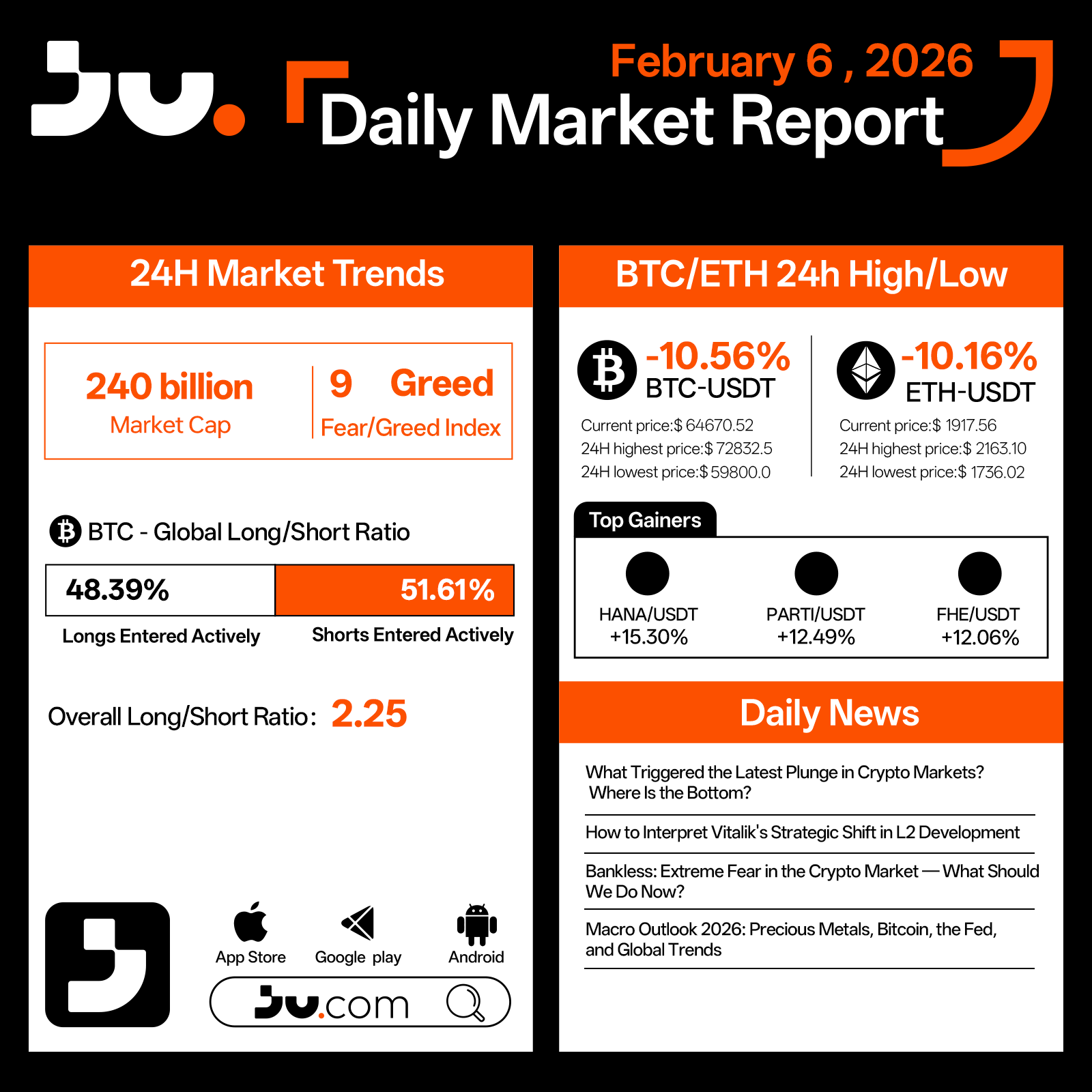
On February 6, the crypto market experienced its sharpest acceleration lower in the current downturn. Total market capitalization fell to $240 billion, while the Fear & Greed Index plunged to 9, firmly entering extreme fear territory. Sentiment and liquidity collapsed simultaneously, pushing the market into a forced, non-linear liquidation phase.
Bitcoin dropped 10.56% to $64,670.52, with an exceptionally wide intraday range from $72,832.50 down to $59,800.00, a clear sign that liquidations and forced selling dominated price action. Ethereum followed closely, falling 10.16% to $1,917.56, after briefly touching $1,736.02. High leverage and Ethereum’s higher beta amplified downside volatility. Positioning remains defensive, with BTC longs at just 48.39% and the aggregate long–short ratio easing to 2.25, suggesting some leverage has been flushed out, though risk aversion persists.
Against this systemic sell-off, a handful of small-cap tokens such as HANA, PARTI, and FHE posted double-digit gains. These moves appeared opportunistic and liquidity-driven, rather than signaling any meaningful recovery in market risk appetite.
Narratively, attention has shifted toward identifying the true trigger of the plunge. While panic selling is the visible catalyst, the underlying drivers remain tightening liquidity, sustained ETF outflows, and mounting macro uncertainty. Discussions around Vitalik’s strategic adjustments to Layer 2 development are increasingly framed as long-term structural shifts, not near-term bullish catalysts.
Notably, voices like Bankless are steering the conversation away from “buying the bottom” toward survival and risk management, emphasizing capital preservation over directional conviction during periods of extreme fear. At the macro level, the ongoing repricing between precious metals, Bitcoin, and Federal Reserve policy expectations continues to pressure risk assets.
In summary, February 6 marks a phase defined by extreme fear and forced deleveraging. Whether the market is approaching a local bottom will depend less on isolated news and more on whether fear is fully exhausted and liquidity conditions stabilize. Until then, violent volatility is likely to remain the market’s dominant feature.
#JU #Jucom #cryptocurrency #blockchain

JU Blog
2026-02-06 09:38
Liquidity Breakdown Amid Extreme Fear - Daily Market Report | February 6, 2026

免责声明:含第三方内容,非财务建议。
详见《条款和条件》
On February 6, the crypto market experienced its sharpest acceleration lower in the current downturn. Total market capitalization fell to $240 billion, while the Fear & Greed Index plunged to 9, firmly entering extreme fear territory. Sentiment and liquidity collapsed simultaneously, pushing the market into a forced, non-linear liquidation phase.
Bitcoin dropped 10.56% to $64,670.52, with an exceptionally wide intraday range from $72,832.50 down to $59,800.00, a clear sign that liquidations and forced selling dominated price action. Ethereum followed closely, falling 10.16% to $1,917.56, after briefly touching $1,736.02. High leverage and Ethereum’s higher beta amplified downside volatility. Positioning remains defensive, with BTC longs at just 48.39% and the aggregate long–short ratio easing to 2.25, suggesting some leverage has been flushed out, though risk aversion persists.
Against this systemic sell-off, a handful of small-cap tokens such as HANA, PARTI, and FHE posted double-digit gains. These moves appeared opportunistic and liquidity-driven, rather than signaling any meaningful recovery in market risk appetite.
Narratively, attention has shifted toward identifying the true trigger of the plunge. While panic selling is the visible catalyst, the underlying drivers remain tightening liquidity, sustained ETF outflows, and mounting macro uncertainty. Discussions around Vitalik’s strategic adjustments to Layer 2 development are increasingly framed as long-term structural shifts, not near-term bullish catalysts.
Notably, voices like Bankless are steering the conversation away from “buying the bottom” toward survival and risk management, emphasizing capital preservation over directional conviction during periods of extreme fear. At the macro level, the ongoing repricing between precious metals, Bitcoin, and Federal Reserve policy expectations continues to pressure risk assets.
In summary, February 6 marks a phase defined by extreme fear and forced deleveraging. Whether the market is approaching a local bottom will depend less on isolated news and more on whether fear is fully exhausted and liquidity conditions stabilize. Until then, violent volatility is likely to remain the market’s dominant feature.
#JU #Jucom #cryptocurrency #blockchain