
ETHGas: The Financialization Revolution of Ethereum Block Space
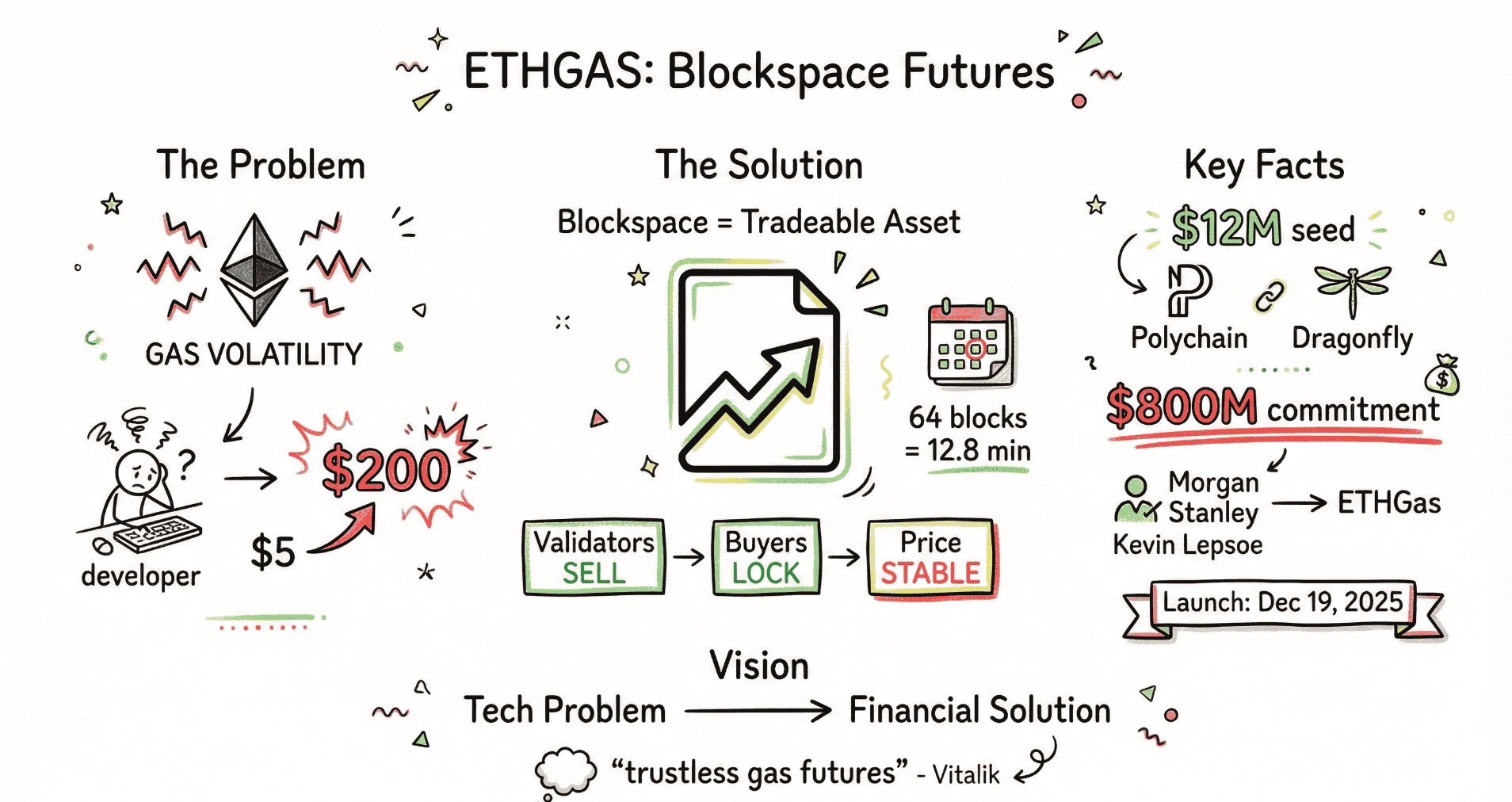
Ethereum generated $2.48 billion in gas fees in 2024, but behind this impressive figure lies a critical problem plaguing the entire ecosystem. Gas costs can fluctuate from $5 to over $200 for a single transaction during network congestion, making it nearly impossible for applications to build sustainable business models. ETHGas officially launched on December 19, 2025, transforming this uncertainty into opportunity by turning block space itself into a tradable financial asset.
💰 Groundbreaking Approach
Founded by Kevin Lepsoe, former Morgan Stanley Executive Director, ETHGas raised $12 million in seed funding led by Polychain Capital and Dragonfly Capital. More significantly, the project secured $800 million in block space liquidity commitments from Ethereum validators and block builders. This massive commitment represents the total amount of future block space that validators are willing to sell on the platform, providing immediate market liquidity that covers roughly 5% to 10% of Ethereum's total annual block space supply.
⚡ Dual Mechanism Innovation
ETHGas operates through two interconnected systems that address both price and time uncertainty. The block space futures mechanism allows validators to sell their next 64 blocks of space in advance, creating a roughly 12.8-minute trading window. Layer 2 sequencers and protocols can now purchase all the block space they need for an entire week upfront, converting unpredictable floating costs into fixed, manageable expenses. This is revolutionary for protocols that currently spend 60% to 80% of their operating budget on gas fees, where a sudden price spike can exhaust an entire monthly budget within hours.
🎯 3-Millisecond Pre-Confirmation
The second mechanism tackles time uncertainty by compressing traditional 12-second confirmation times down to just 3 milliseconds. When users submit transactions, validators in the ETHGas network immediately evaluate and provide cryptographically signed commitments guaranteeing inclusion in the next block. Validators who default on these commitments face economic penalties, ensuring reliability. This creates unprecedented user experiences where decentralized exchanges can offer both instant confirmation and predictable costs simultaneously.
🏆 Strategic Market Position
ETHGas doesn't compete with Layer 2 scaling solutions but complements them perfectly. While Arbitrum and Optimism reduce per-transaction costs by moving computation off-chain, they don't eliminate price volatility. The relationship is analogous to building highways that lower transportation costs versus providing freight insurance that reduces price risk. ETHGas is already in discussions with multiple Layer 2 teams to offer mainnet gas hedging tools, and early data shows that applications integrating pre-confirmation achieve over 30% higher user retention than traditional apps.
💡 Two-Phase Growth Strategy
The project's Open Gas program partners with major protocols like ether.fi, EigenLayer, and Pendle to provide direct gas rebates to users during the initial market education phase. This strategic approach converts market education costs into valuable data assets, as every transaction processed feeds real pricing data into ETHGas' futures algorithms. Once users experience zero-gas convenience, applications will naturally seek sustainable solutions through the futures market in phase two.
🌐 Ecosystem Transformation
Beyond commercial success, ETHGas is building a crucial price discovery mechanism for Ethereum's block space market. The futures curve can signal whether the market expects gas prices to rise or fall, providing valuable insights that could guide investment in scaling solutions. Following mainnet validation, ETHGas plans to expand to major Layer 2 networks, potentially creating a cross-chain block space financial hub that offers unified risk management tools across the entire Ethereum ecosystem.
With Vitalik Buterin repeatedly calling for trustless on-chain gas futures markets, ETHGas is actively turning this vision into reality. The project is now live on mainnet with testing available on the Hoodi testnet. As the blockchain industry matures from focusing purely on technical performance to managing economic risk, ETHGas may establish an entirely new category of infrastructure that proves financial engineering can solve technical problems more efficiently than technical solutions alone.
Read the complete research report with detailed analysis of mechanism design, economic logic, and ecosystem impact: 👇 https://blog.ju.com/ethgas-research-report/?utm_source=blog
#ETHGas #Ethereum #DeFi #Layer2 #Blockchain

JU Blog
2026-01-07 03:13
ETHGas: The Financialization Revolution of Ethereum Block Space
Tuyên bố miễn trừ trách nhiệm:Chứa nội dung của bên thứ ba. Không phải lời khuyên tài chính.
Xem Điều khoản và Điều kiện.
Ethereum generated $2.48 billion in gas fees in 2024, but behind this impressive figure lies a critical problem plaguing the entire ecosystem. Gas costs can fluctuate from $5 to over $200 for a single transaction during network congestion, making it nearly impossible for applications to build sustainable business models. ETHGas officially launched on December 19, 2025, transforming this uncertainty into opportunity by turning block space itself into a tradable financial asset.
💰 Groundbreaking Approach
Founded by Kevin Lepsoe, former Morgan Stanley Executive Director, ETHGas raised $12 million in seed funding led by Polychain Capital and Dragonfly Capital. More significantly, the project secured $800 million in block space liquidity commitments from Ethereum validators and block builders. This massive commitment represents the total amount of future block space that validators are willing to sell on the platform, providing immediate market liquidity that covers roughly 5% to 10% of Ethereum's total annual block space supply.
⚡ Dual Mechanism Innovation
ETHGas operates through two interconnected systems that address both price and time uncertainty. The block space futures mechanism allows validators to sell their next 64 blocks of space in advance, creating a roughly 12.8-minute trading window. Layer 2 sequencers and protocols can now purchase all the block space they need for an entire week upfront, converting unpredictable floating costs into fixed, manageable expenses. This is revolutionary for protocols that currently spend 60% to 80% of their operating budget on gas fees, where a sudden price spike can exhaust an entire monthly budget within hours.
🎯 3-Millisecond Pre-Confirmation
The second mechanism tackles time uncertainty by compressing traditional 12-second confirmation times down to just 3 milliseconds. When users submit transactions, validators in the ETHGas network immediately evaluate and provide cryptographically signed commitments guaranteeing inclusion in the next block. Validators who default on these commitments face economic penalties, ensuring reliability. This creates unprecedented user experiences where decentralized exchanges can offer both instant confirmation and predictable costs simultaneously.
🏆 Strategic Market Position
ETHGas doesn't compete with Layer 2 scaling solutions but complements them perfectly. While Arbitrum and Optimism reduce per-transaction costs by moving computation off-chain, they don't eliminate price volatility. The relationship is analogous to building highways that lower transportation costs versus providing freight insurance that reduces price risk. ETHGas is already in discussions with multiple Layer 2 teams to offer mainnet gas hedging tools, and early data shows that applications integrating pre-confirmation achieve over 30% higher user retention than traditional apps.
💡 Two-Phase Growth Strategy
The project's Open Gas program partners with major protocols like ether.fi, EigenLayer, and Pendle to provide direct gas rebates to users during the initial market education phase. This strategic approach converts market education costs into valuable data assets, as every transaction processed feeds real pricing data into ETHGas' futures algorithms. Once users experience zero-gas convenience, applications will naturally seek sustainable solutions through the futures market in phase two.
🌐 Ecosystem Transformation
Beyond commercial success, ETHGas is building a crucial price discovery mechanism for Ethereum's block space market. The futures curve can signal whether the market expects gas prices to rise or fall, providing valuable insights that could guide investment in scaling solutions. Following mainnet validation, ETHGas plans to expand to major Layer 2 networks, potentially creating a cross-chain block space financial hub that offers unified risk management tools across the entire Ethereum ecosystem.
With Vitalik Buterin repeatedly calling for trustless on-chain gas futures markets, ETHGas is actively turning this vision into reality. The project is now live on mainnet with testing available on the Hoodi testnet. As the blockchain industry matures from focusing purely on technical performance to managing economic risk, ETHGas may establish an entirely new category of infrastructure that proves financial engineering can solve technical problems more efficiently than technical solutions alone.
Read the complete research report with detailed analysis of mechanism design, economic logic, and ecosystem impact: 👇 https://blog.ju.com/ethgas-research-report/?utm_source=blog
#ETHGas #Ethereum #DeFi #Layer2 #Blockchain