
Profil
Zacik
Zacik2025-12-23 09:24
Security and Regulation Are Reshaping Competitive Standards in Crypto

Market scale makes stricter standards inevitable. Frequent security incidents and regulatory actions are not “bad news” for crypto; they are an inevitable response to the industry entering deeper development. As crypto assets become integrated into the broader financial system, security and compliance shift from optional to mandatory. In 2025, total crypto losses from theft reportedly reached $3.4 billion (bankinfosecurity.com), making hacking a non-ignorable systemic risk. This forces exchanges and protocols to invest more in security—upgrading smart contract audits, multisig custody, and risk control systems. Regulators are also moving quickly: Europe’s MiCA framework, Hong Kong’s licensing regime, and U.S. enforcement actions are bringing crypto further into mainstream compliance structures.

Competition is shifting toward stable operations. As security and compliance become hard constraints, competitive evaluation standards change accordingly. Future differentiation will not be about who is more aggressive in bull markets or who pursues higher risk/higher return, but about who can operate long-term under transparent, stable, and compliant frameworks. Projects that ignore security vulnerabilities or remain in regulatory gray zones will struggle to earn trust from mainstream users and capital—and may be forced out. Conversely, companies that protect user assets and embrace compliance will have stronger long-run opportunities. For example, some leading exchanges now proactively publish proof-of-reserves and introduce third-party audits, recognizing that “trustworthiness” has become a new competitive advantage.

A maturity-driven reshuffle. A new industry reshuffle driven by security and regulation is likely to make the crypto sector more mature and resilient. In the short term, stricter standards can create pain for some participants; in the long term, they improve the industry’s credibility. Just as traditional finance earned public trust through strong regulation, crypto must establish similar trust foundations. As bubbles and vulnerabilities are squeezed out, remaining players will be those combining innovation with compliance. After this reshuffle, crypto will enter a healthier and more orderly phase—more capable of integrating with the mainstream financial system.


Post Image
Preview
171
0
Background
Avatar

Zacik

2025-12-24 17:51

Security and Regulation Are Reshaping Competitive Standards in Crypto

[{"type":"paragraph","children":[{"text":"Market scale makes stricter standards inevitable.","bold":true},{"text":" Frequent security incidents and regulatory actions are not “bad news” for crypto; they are an inevitable response to the industry entering deeper development. As crypto assets become integrated into the broader financial system, security and compliance shift from optional to mandatory. In 2025, total crypto losses from theft reportedly reached "},{"text":"$3.4 billion","bold":true},{"text":" (bankinfosecurity.com), making hacking a non-ignorable systemic risk. This forces exchanges and protocols to invest more in security—upgrading smart contract audits, multisig custody, and risk control systems. Regulators are also moving quickly: Europe’s MiCA framework, Hong Kong’s licensing regime, and U.S. enforcement actions are bringing crypto further into mainstream compliance structures."}]},{"type":"paragraph","children":[{"text":""}]},{"type":"paragraph","children":[{"text":"Competition is shifting toward stable operations.","bold":true},{"text":" As security and compliance become hard constraints, competitive evaluation standards change accordingly. Future differentiation will not be about who is more aggressive in bull markets or who pursues higher risk/higher return, but about who can operate long-term under transparent, stable, and compliant frameworks. Projects that ignore security vulnerabilities or remain in regulatory gray zones will struggle to earn trust from mainstream users and capital—and may be forced out. Conversely, companies that protect user assets and embrace compliance will have stronger long-run opportunities. For example, some leading exchanges now proactively publish proof-of-reserves and introduce third-party audits, recognizing that “trustworthiness” has become a new competitive advantage."}]},{"type":"paragraph","children":[{"text":""}]},{"type":"paragraph","children":[{"text":"A maturity-driven reshuffle.","bold":true},{"text":" A new industry reshuffle driven by security and regulation is likely to make the crypto sector more mature and resilient. In the short term, stricter standards can create pain for some participants; in the long term, they improve the industry’s credibility. Just as traditional finance earned public trust through strong regulation, crypto must establish similar trust foundations. As bubbles and vulnerabilities are squeezed out, remaining players will be those combining innovation with compliance. After this reshuffle, crypto will enter a healthier and more orderly phase—more capable of integrating with the mainstream financial system."}]},{"type":"paragraph","children":[{"text":"\n\n\n\n"}]}]
JU Square

Penafian:Berisi konten pihak ketiga. Bukan nasihat keuangan.
Lihat Syarat dan Ketentuan.

Zacik
Zacik2025-12-23 09:23
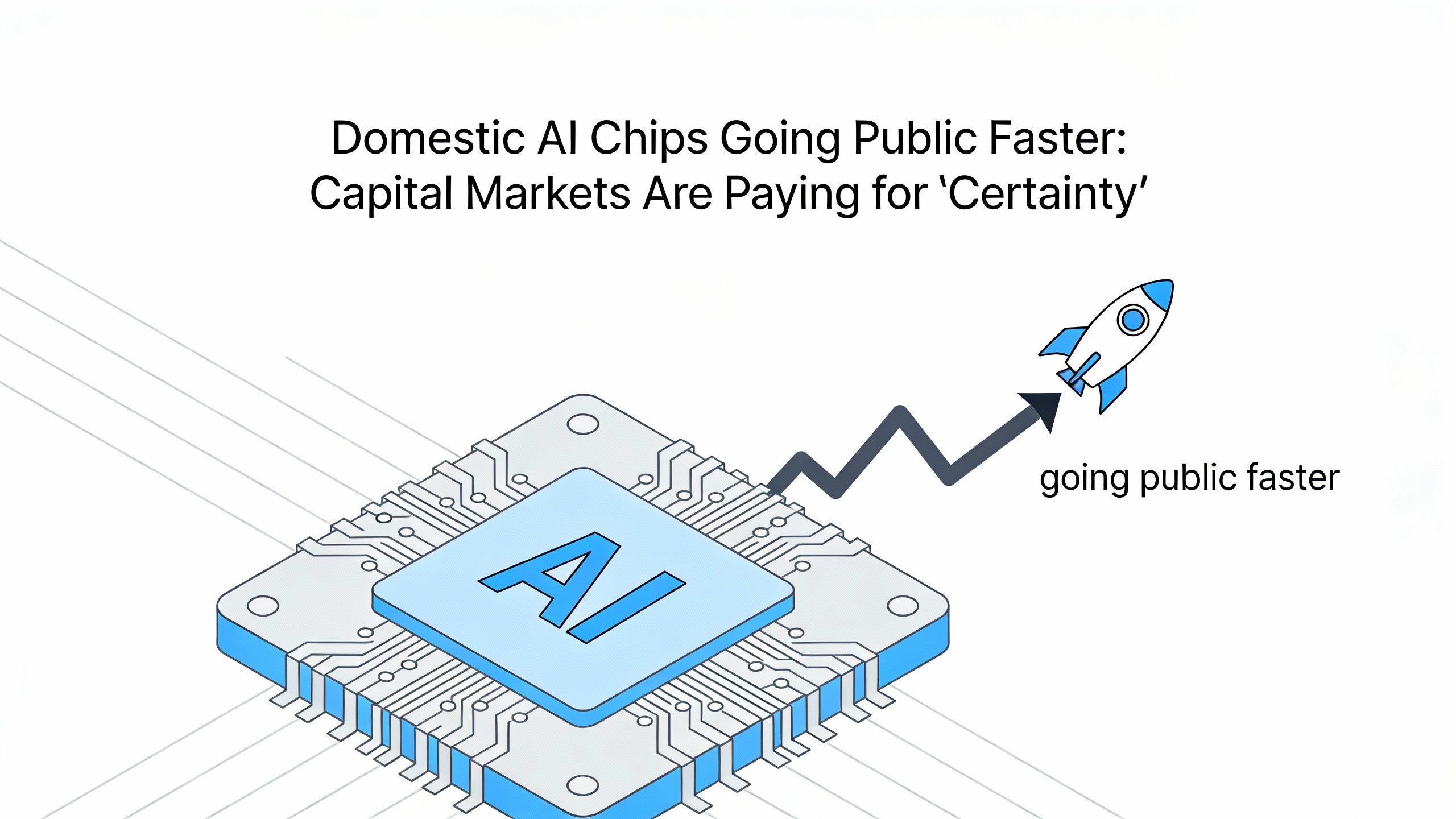
Domestic AI Chips Going Public Faster: Capital Markets Are Paying for “Certainty”

A listing wave among domestic chip companies. Recently, a number of domestic AI chip firms have accelerated capitalization: Moore Threads listed on Shanghai’s STAR Market with a market cap that once exceeded RMB 300 billion (longbridge.com); MetaX followed; Biren Technology launched a Hong Kong IPO plan targeting about $600 million in fundraising (finance.yahoo.com). This wave suggests that in AI chips, “domestic substitution” has become a clear direction strongly favored by capital markets. Even though domestic GPUs still lag global leaders in near-term performance, investors remain willing to support these companies at high valuations.

Certainty carries a premium. Under high geopolitical uncertainty, the certainty of domestic substitution itself commands a premium. Compared with projects that may be technically superior but strategically uncertain, domestic AI chips offer a clearer investment logic: regardless of external conditions, China’s demand for sovereign and controllable compute is structural and increasing. That certainty is why capital pays. In other words, capital does not always chase the theoretical “best” solution; it often favors the most sustainable solution. As domestic substitution becomes a national strategy and a market consensus, companies aligned with that direction are viewed as having long-term value. This explains the strong investor enthusiasm even when short-term profitability remains limited.

A shift in market preferences. The listing boom reflects a shift in how markets evaluate opportunities. In earlier cycles, investors chased high-growth, high-risk concepts; now, amid geopolitical and supply-chain risks, certainty and controllability have become key evaluation criteria. For companies, this implies that aligning with strategic national direction and delivering indispensable value improves the chance of sustained capital support. Domestic AI chip companies are leveraging this tailwind to grow rapidly, strengthening industrial resilience while creating a synergy between industry and capital.
Post Image
Preview
320
3
Background
Avatar

Zacik

2026-01-07 03:17

Domestic AI Chips Going Public Faster: Capital Markets Are Paying for “Certainty”

[{"type":"paragraph","children":[{"text":"A listing wave among domestic chip companies.","bold":true},{"text":" Recently, a number of domestic AI chip firms have accelerated capitalization: Moore Threads listed on Shanghai’s STAR Market with a market cap that once exceeded "},{"text":"RMB 300 billion","bold":true},{"text":" (longbridge.com); MetaX followed; Biren Technology launched a Hong Kong IPO plan targeting about "},{"text":"$600 million","bold":true},{"text":" in fundraising (finance.yahoo.com). This wave suggests that in AI chips, “domestic substitution” has become a clear direction strongly favored by capital markets. Even though domestic GPUs still lag global leaders in near-term performance, investors remain willing to support these companies at high valuations."}]},{"type":"paragraph","children":[{"text":""}]},{"type":"paragraph","children":[{"text":"Certainty carries a premium.","bold":true},{"text":" Under high geopolitical uncertainty, the certainty of domestic substitution itself commands a premium. Compared with projects that may be technically superior but strategically uncertain, domestic AI chips offer a clearer investment logic: regardless of external conditions, China’s demand for sovereign and controllable compute is structural and increasing. That certainty is why capital pays. In other words, capital does not always chase the theoretical “best” solution; it often favors the most sustainable solution. As domestic substitution becomes a national strategy and a market consensus, companies aligned with that direction are viewed as having long-term value. This explains the strong investor enthusiasm even when short-term profitability remains limited."}]},{"type":"paragraph","children":[{"text":""}]},{"type":"paragraph","children":[{"text":"A shift in market preferences.","bold":true},{"text":" The listing boom reflects a shift in how markets evaluate opportunities. In earlier cycles, investors chased high-growth, high-risk concepts; now, amid geopolitical and supply-chain risks, certainty and controllability have become key evaluation criteria. For companies, this implies that aligning with strategic national direction and delivering indispensable value improves the chance of sustained capital support. Domestic AI chip companies are leveraging this tailwind to grow rapidly, strengthening industrial resilience while creating a synergy between industry and capital."}]},{"type":"paragraph","children":[{"text":"\n\n\n\n"}]}]
JU Square

Penafian:Berisi konten pihak ketiga. Bukan nasihat keuangan.
Lihat Syarat dan Ketentuan.

Zacik
Zacik2025-12-23 09:21
The AI Chip “Arms Race”: Compute Is Becoming a New Geoeconomic Resource

Compute is rising to the level of a strategic resource. From tighter U.S. controls on high-end chip exports to China, to Chinese firms seeking GPU capacity through indirect routes, recent developments show that compute has become a key strategic resource in geopolitical competition. It is no longer just a technical metric; it influences national competitiveness, industrial positioning, and capital allocation. The U.S. has repeatedly tightened restrictions, even banning certain modified or down-spec versions of H200 GPUs for China. Meanwhile, Chinese tech companies pursue “workarounds”: accelerating domestic GPU development on one hand, and accessing top-tier chips via overseas cloud services, intermediaries, and other channels on the other. Reports suggest that previously restricted Nvidia H200 and B200 GPUs have quietly appeared domestically.

The compute race is the AI race. In the era of large models, stable access to compute determines how fast a firm can train models, iterate products, and build an AI ecosystem. This elevates AI chips to an economic importance comparable to oil and electricity in earlier eras. Governments and tech giants are investing heavily to secure compute leadership. In capital markets, valuations of compute-related companies have surged, reflecting investors’ view that compute is a new kind of “hard currency.” In essence, AI competition is increasingly a competition in resource allocation capabilities—advanced algorithms still require massive compute. Once compute supply is constrained, AI development can be seriously impaired.

Geoeconomic structures are shifting around compute. The compute arms race is reshaping the global technology landscape and geoeconomic structure. Regions with compute advantages will likely take the lead in the next AI revolution; economies constrained in compute access may fall behind in digital competition. This also explains why countries treat AI chips as strategic assets under strict control. For companies, securing compute supply early and improving compute efficiency will become a core competitive differentiator.
Post Image
Preview
141
0
Background
Avatar

Zacik

2025-12-24 17:51

The AI Chip “Arms Race”: Compute Is Becoming a New Geoeconomic Resource

[{"type":"paragraph","children":[{"text":"Compute is rising to the level of a strategic resource.","bold":true},{"text":" From tighter U.S. controls on high-end chip exports to China, to Chinese firms seeking GPU capacity through indirect routes, recent developments show that compute has become a key strategic resource in geopolitical competition. It is no longer just a technical metric; it influences national competitiveness, industrial positioning, and capital allocation. The U.S. has repeatedly tightened restrictions, even banning certain modified or down-spec versions of H200 GPUs for China. Meanwhile, Chinese tech companies pursue “workarounds”: accelerating domestic GPU development on one hand, and accessing top-tier chips via overseas cloud services, intermediaries, and other channels on the other. Reports suggest that previously restricted Nvidia H200 and B200 GPUs have quietly appeared domestically."}]},{"type":"paragraph","children":[{"text":""}]},{"type":"paragraph","children":[{"text":"The compute race is the AI race.","bold":true},{"text":" In the era of large models, stable access to compute determines how fast a firm can train models, iterate products, and build an AI ecosystem. This elevates AI chips to an economic importance comparable to oil and electricity in earlier eras. Governments and tech giants are investing heavily to secure compute leadership. In capital markets, valuations of compute-related companies have surged, reflecting investors’ view that compute is a new kind of “hard currency.” In essence, AI competition is increasingly a competition in resource allocation capabilities—advanced algorithms still require massive compute. Once compute supply is constrained, AI development can be seriously impaired."}]},{"type":"paragraph","children":[{"text":""}]},{"type":"paragraph","children":[{"text":"Geoeconomic structures are shifting around compute.","bold":true},{"text":" The compute arms race is reshaping the global technology landscape and geoeconomic structure. Regions with compute advantages will likely take the lead in the next AI revolution; economies constrained in compute access may fall behind in digital competition. This also explains why countries treat AI chips as strategic assets under strict control. For companies, securing compute supply early and improving compute efficiency will become a core competitive differentiator."}]},{"type":"paragraph","children":[{"text":"\n\n\n\n"}]}]
JU Square

Penafian:Berisi konten pihak ketiga. Bukan nasihat keuangan.
Lihat Syarat dan Ketentuan.

Zacik
Zacik2025-12-23 09:20
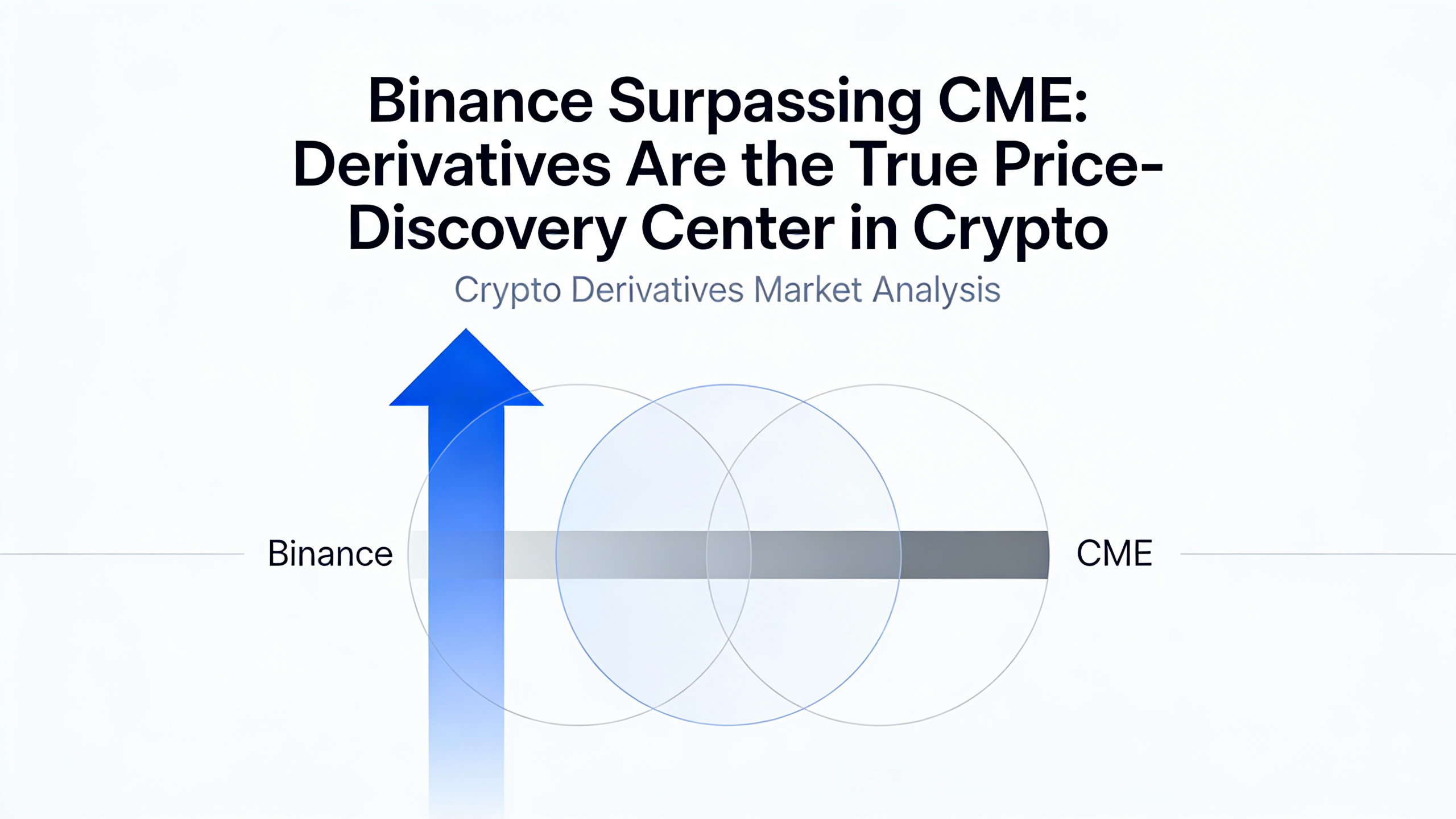
Binance Surpassing CME: Derivatives Are the True Price-Discovery Center in Crypto

Pricing power is shifting from Wall Street to crypto-native platforms. Recently, Binance’s Bitcoin futures open interest surpassed that of CME (the Chicago Mercantile Exchange) (rootdata.com). This symbolic milestone suggests that global crypto pricing power is shifting from traditional financial institutions to crypto-native platforms. In traditional markets, CME has often been treated as an authoritative venue for price discovery; today, crypto platforms that run 24/7—like Binance—offer superior liquidity and depth. Bitcoin’s price behavior is increasingly driven by these high-liquidity, low-friction derivatives markets.

This reflects institutional migration, not a retail victory. Importantly, Binance surpassing CME does not mean retail traders are “beating” Wall Street. If anything, it reflects institutions increasingly using crypto-native platforms to trade more efficiently. Many institutions find they can access higher leverage, richer counterparty networks, and longer trading hours via perpetuals and futures on exchanges like Binance, improving strategy execution. By contrast, regulated venues like CME offer compliance benefits but have limited trading hours and typically lower leverage, which can be less suitable for global high-frequency activity. As a result, more institutional capital flows toward the venues with the best liquidity—making crypto exchanges the functional price anchor.

Derivatives increasingly determine market direction. Looking forward, crypto price discovery will increasingly occur in derivatives rather than spot. As more institutions and professional capital participate—and as retail also engages futures and options—derivatives volumes have remained multiples of spot. Derivatives offer more flexible strategy tools and abundant liquidity, effectively anchoring crypto’s pricing center. For investors, tracking derivatives indicators (open interest, funding rates, basis, options skews) is often more informative than watching spot alone.
Post Image
Preview
129
0
Background
Avatar

Zacik

2025-12-24 17:51

Binance Surpassing CME: Derivatives Are the True Price-Discovery Center in Crypto

[{"type":"paragraph","children":[{"text":"Pricing power is shifting from Wall Street to crypto-native platforms.","bold":true},{"text":" Recently, Binance’s Bitcoin futures open interest surpassed that of CME (the Chicago Mercantile Exchange) (rootdata.com). This symbolic milestone suggests that global crypto pricing power is shifting from traditional financial institutions to crypto-native platforms. In traditional markets, CME has often been treated as an authoritative venue for price discovery; today, crypto platforms that run 24/7—like Binance—offer superior liquidity and depth. Bitcoin’s price behavior is increasingly driven by these high-liquidity, low-friction derivatives markets."}]},{"type":"paragraph","children":[{"text":""}]},{"type":"paragraph","children":[{"text":"This reflects institutional migration, not a retail victory.","bold":true},{"text":" Importantly, Binance surpassing CME does not mean retail traders are “beating” Wall Street. If anything, it reflects institutions increasingly using crypto-native platforms to trade more efficiently. Many institutions find they can access higher leverage, richer counterparty networks, and longer trading hours via perpetuals and futures on exchanges like Binance, improving strategy execution. By contrast, regulated venues like CME offer compliance benefits but have limited trading hours and typically lower leverage, which can be less suitable for global high-frequency activity. As a result, more institutional capital flows toward the venues with the best liquidity—making crypto exchanges the functional price anchor."}]},{"type":"paragraph","children":[{"text":""}]},{"type":"paragraph","children":[{"text":"Derivatives increasingly determine market direction.","bold":true},{"text":" Looking forward, crypto price discovery will increasingly occur in derivatives rather than spot. As more institutions and professional capital participate—and as retail also engages futures and options—derivatives volumes have remained multiples of spot. Derivatives offer more flexible strategy tools and abundant liquidity, effectively anchoring crypto’s pricing center. For investors, tracking derivatives indicators (open interest, funding rates, basis, options skews) is often more informative than watching spot alone."}]},{"type":"paragraph","children":[{"text":"\n\n\n\n"}]}]
JU Square

Penafian:Berisi konten pihak ketiga. Bukan nasihat keuangan.
Lihat Syarat dan Ketentuan.

Zacik
Zacik2025-12-23 09:16
The “De-Mythologizing” of Technology: A Sign of Maturity, Not Decline, in Crypto

From tech worship to rational evaluation. After multiple cycles, the crypto industry is collectively going through a “de-mythologizing” phase. The collapse of Terra and the rise-and-fall trajectories of once-celebrated projects like EOS and Polkadot have taught the market that even the most advanced architectures and dazzling innovations do not automatically translate into durable value (lynalden.com). In the past, investors often held blind faith in novelty; today that mindset is changing. The market is becoming more rational: technical highlights still matter, but without real use cases or a viable economic model, even brilliant technology can be short-lived.

Value judgment is returning to fundamentals. The industry is increasingly focused on whether a project solves real problems and can operate sustainably, rather than chasing technical buzzwords. In summary, the factors that truly determine long-term success include:

Solving real problems: Does the technology address clear needs or pain points in the real world? Otherwise, “innovation” lacks meaning. A sound economic model: Is the token economy or business model sustainable, avoiding a replay of Terra-like collapses driven by high yields without risk control? Withstanding real-world constraints: Can the system run stably under real conditions—security, compliance, and long-term user feedback? If a project cannot stand in a regulatory environment and competitive market, theoretical design will not convert into value.

A necessary step toward mature innovation. De-mythologizing is not a rejection of innovation; it is a sign the industry is becoming more mature in how it evaluates new technologies. Just as emerging markets return to rationality after periods of mania, crypto participants are recognizing: technology is foundational, but not the whole story. Only when innovation connects to real value creation can it endure. After this rational filter, truly resilient projects will stand out, while bubbles built on flashy concepts will be eliminated faster. This is not decline—it is a signal of healthier, more sustainable maturity.
Post Image
Preview
72
0
Background
Avatar

Zacik

2025-12-23 09:17

The “De-Mythologizing” of Technology: A Sign of Maturity, Not Decline, in Crypto

[{"type":"paragraph","children":[{"text":"From tech worship to rational evaluation.","bold":true},{"text":" After multiple cycles, the crypto industry is collectively going through a “de-mythologizing” phase. The collapse of Terra and the rise-and-fall trajectories of once-celebrated projects like EOS and Polkadot have taught the market that even the most advanced architectures and dazzling innovations do not automatically translate into durable value (lynalden.com). In the past, investors often held blind faith in novelty; today that mindset is changing. The market is becoming more rational: technical highlights still matter, but without real use cases or a viable economic model, even brilliant technology can be short-lived."}]},{"type":"paragraph","children":[{"text":"Value judgment is returning to fundamentals.","bold":true},{"text":" The industry is increasingly focused on whether a project solves real problems and can operate sustainably, rather than chasing technical buzzwords. In summary, the factors that truly determine long-term success include:"}]},{"type":"paragraph","children":[{"text":"Solving real problems:","bold":true},{"text":" Does the technology address clear needs or pain points in the real world? Otherwise, “innovation” lacks meaning.\n\n"},{"text":"A sound economic model:","bold":true},{"text":" Is the token economy or business model sustainable, avoiding a replay of Terra-like collapses driven by high yields without risk control?\n\n"},{"text":"Withstanding real-world constraints:","bold":true},{"text":" Can the system run stably under real conditions—security, compliance, and long-term user feedback? If a project cannot stand in a regulatory environment and competitive market, theoretical design will not convert into value.\n"}]},{"type":"paragraph","children":[{"text":"A necessary step toward mature innovation.","bold":true},{"text":" De-mythologizing is not a rejection of innovation; it is a sign the industry is becoming more mature in how it evaluates new technologies. Just as emerging markets return to rationality after periods of mania, crypto participants are recognizing: technology is foundational, but not the whole story. Only when innovation connects to real value creation can it endure. After this rational filter, truly resilient projects will stand out, while bubbles built on flashy concepts will be eliminated faster. This is not decline—it is a signal of healthier, more sustainable maturity."}]},{"type":"paragraph","children":[{"text":"\n\n\n\n\n"}]}]
JU Square

Penafian:Berisi konten pihak ketiga. Bukan nasihat keuangan.
Lihat Syarat dan Ketentuan.

Zacik
Zacik2025-12-23 09:13
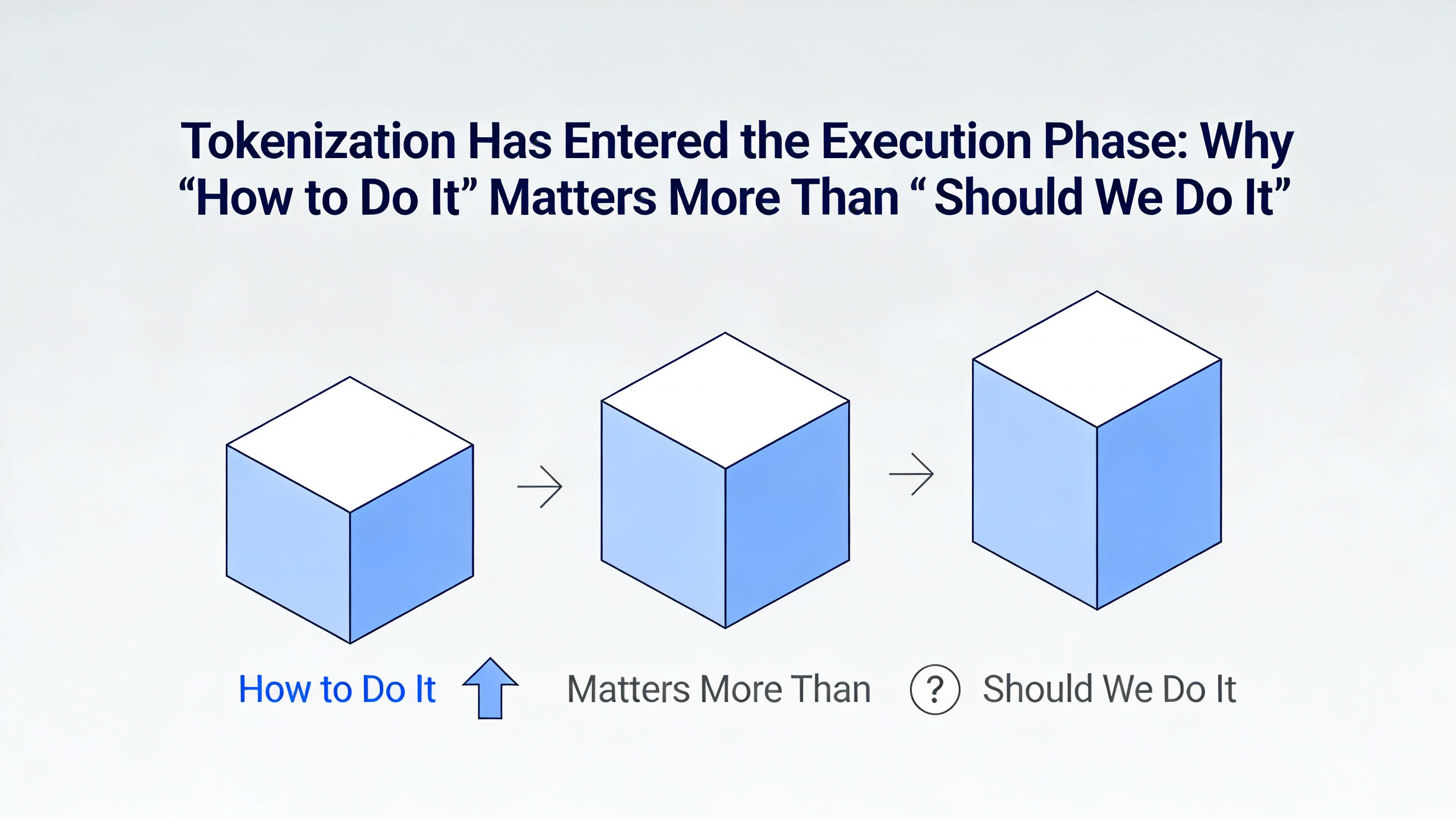
Tokenization Has Entered the Execution Phase: Why “How to Do It” Matters More Than “Should We Do It”

The debate has shifted from principle to implementation. Over the past few years, discussions about bringing real-world assets on-chain (tokenization) repeatedly revolved around “Is it reasonable to tokenize real-world assets?” Today, the answer has effectively become assumed: tokenization is not only reasonable, it is accelerating. The market’s focus has clearly moved to execution. Since 2023, many institutions and projects have entered practical deployment. For example, Centrifuge launched an institutional-oriented tokenization platform to help financial institutions and fintech companies create on-chain financial products (coindesk.com). These developments send a clear signal: tokenization’s challenges no longer sit at the conceptual level, but at the implementation level.

Engineering capability determines success or failure. As doubts about “whether to do it” fade, the industry is asking “how to do it successfully.” Entering the execution phase means attention shifts to operational details and feasibility: How should product design balance on-chain transparency with privacy and compliance? Is the infrastructure secure and efficient enough to support large-scale real-asset transactions? Do issuance and distribution channels actually reach real demand? These pragmatic issues replace earlier grand narratives and become the decisive factors. In other words, storytelling is no longer sufficient; what matters is engineering strength and delivery capacity.

From narrative to value creation. The tokenization wave reflects crypto’s shift from narrative-driven speculation toward real value creation. Projects stuck at the concept stage are fading because they cannot solve implementation problems; meanwhile, teams with both financial and technical competence are emerging, building workable solutions for integrating real assets and blockchains. For example, some traditional financial institutions have successfully issued bonds and fund shares via blockchain, improving efficiency and expanding investor coverage. In this stage, capital markets will likely favor participants with credible, executable solutions—those who can answer “how,” rather than endlessly debating “whether.”
Post Image
Preview
63
0
Background
Avatar

Zacik

2025-12-23 09:16

Tokenization Has Entered the Execution Phase: Why “How to Do It” Matters More Than “Should We Do It”

[{"type":"paragraph","children":[{"text":"The debate has shifted from principle to implementation.","bold":true},{"text":" Over the past few years, discussions about bringing real-world assets on-chain (tokenization) repeatedly revolved around “Is it reasonable to tokenize real-world assets?” Today, the answer has effectively become assumed: tokenization is not only reasonable, it is accelerating. The market’s focus has clearly moved to execution. Since 2023, many institutions and projects have entered practical deployment. For example, Centrifuge launched an institutional-oriented tokenization platform to help financial institutions and fintech companies create on-chain financial products (coindesk.com). These developments send a clear signal: tokenization’s challenges no longer sit at the conceptual level, but at the implementation level."}]},{"type":"paragraph","children":[{"text":""}]},{"type":"paragraph","children":[{"text":"Engineering capability determines success or failure.","bold":true},{"text":" As doubts about “whether to do it” fade, the industry is asking “how to do it successfully.” Entering the execution phase means attention shifts to operational details and feasibility: How should product design balance on-chain transparency with privacy and compliance? Is the infrastructure secure and efficient enough to support large-scale real-asset transactions? Do issuance and distribution channels actually reach real demand? These pragmatic issues replace earlier grand narratives and become the decisive factors. In other words, storytelling is no longer sufficient; what matters is engineering strength and delivery capacity."}]},{"type":"paragraph","children":[{"text":""}]},{"type":"paragraph","children":[{"text":"From narrative to value creation.","bold":true},{"text":" The tokenization wave reflects crypto’s shift from narrative-driven speculation toward real value creation. Projects stuck at the concept stage are fading because they cannot solve implementation problems; meanwhile, teams with both financial and technical competence are emerging, building workable solutions for integrating real assets and blockchains. For example, some traditional financial institutions have successfully issued bonds and fund shares via blockchain, improving efficiency and expanding investor coverage. In this stage, capital markets will likely favor participants with credible, executable solutions—those who can answer “how,” rather than endlessly debating “whether.”"}]},{"type":"paragraph","children":[{"text":"\n\n\n\n"}]}]
JU Square

Penafian:Berisi konten pihak ketiga. Bukan nasihat keuangan.
Lihat Syarat dan Ketentuan.

Zacik
Zacik2025-12-23 09:11
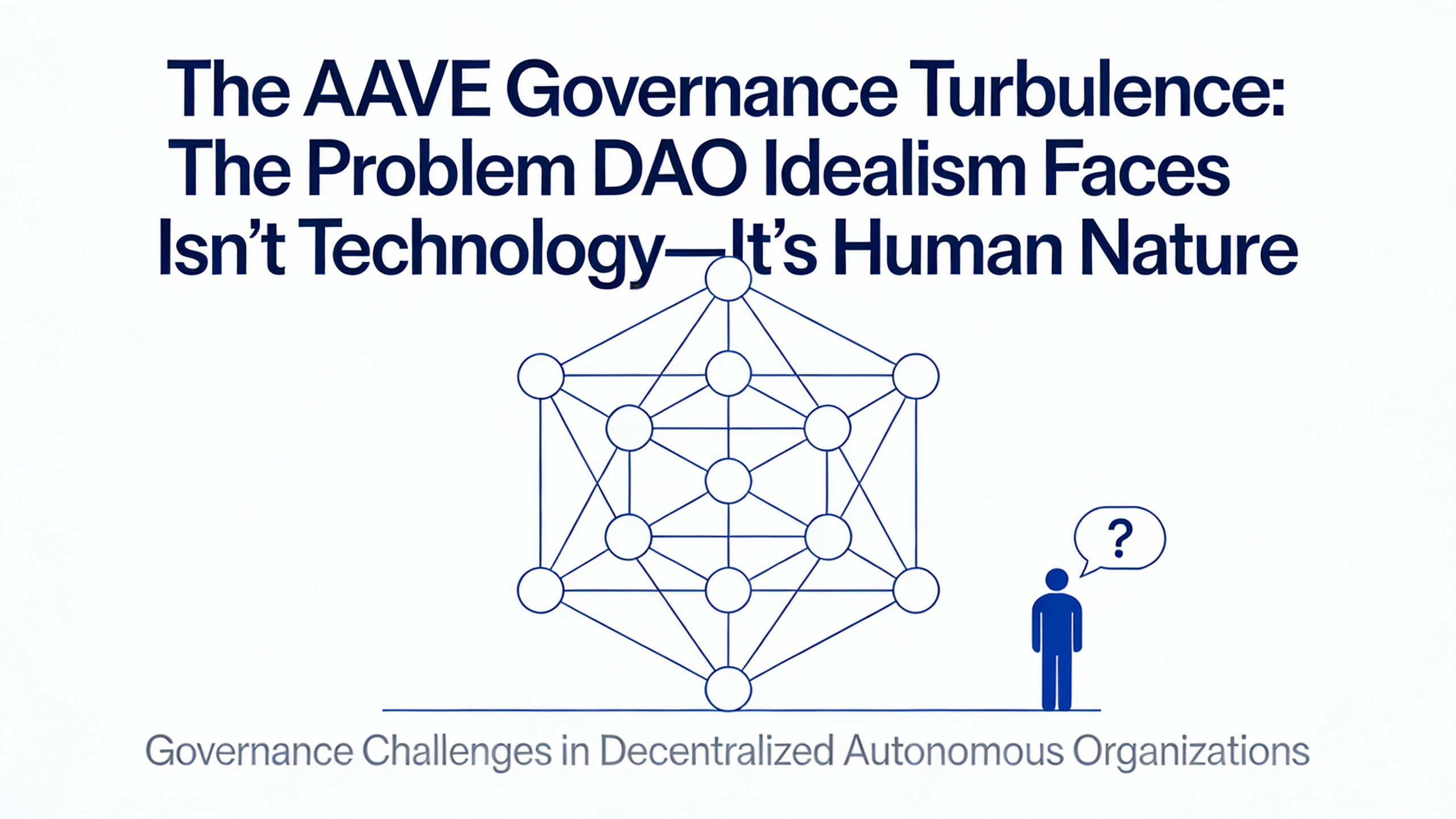
The AAVE Governance Turbulence: The Problem DAO Idealism Faces Isn’t Technology—It’s Human Nature

Misalignment between governance power and execution power. Recent AAVE governance disputes highlight the real-world dilemma faced by DAOs. A proposal that appears technical on the surface can trigger conflict over power ownership: a small group with actual execution capability can act without fully consulting the community, while most token holders can only express dissatisfaction after the fact. For example, without DAO voting approval, the Aave development team reportedly routed fees generated through its CoW Swap integration directly to a team-controlled wallet rather than to the DAO treasury (chaincatcher.com; chaincatcher.com). The community only discovered afterward that millions in revenue had been “bypassed,” exposing the asymmetry between governance processes and execution power.

A structural challenge for distributed governance. This is not unique to AAVE; it is a structural difficulty faced by many distributed governance systems. When core participants control critical permissions without effective checks and balances, even the most advanced voting mechanisms cannot guarantee ideal governance outcomes. Most token holders do not participate in day-to-day operations; they often lack deep understanding of complex proposals and cannot monitor each execution decision in real time. When accountability is hard to trace and power cannot be restrained, incentives for procedural bypass increase. Under these pressures, the decentralization and democracy DAOs pursue can be eroded, and idealism can quickly give way to human incentive realities.

Clear responsibilities matter more than “one token, one vote.” The AAVE incident suggests that the next stage of DAO evolution may not be about more elaborate voting designs, but about clearer allocations of responsibility, authority, and enforcement mechanisms. Future DAOs may need to borrow from traditional governance architecture: maintaining community participation while introducing defined executive teams, audit committees, and oversight mechanisms—ensuring major decisions can be both efficient and accountable. Idealism needs institutional reality. Only then can DAOs balance human nature and efficiency while remaining true to their original intent.
Post Image
Preview
65
0
Background
Avatar

Zacik

2025-12-23 09:11

The AAVE Governance Turbulence: The Problem DAO Idealism Faces Isn’t Technology—It’s Human Nature

[{"type":"paragraph","children":[{"text":"Misalignment between governance power and execution power.","bold":true},{"text":" Recent AAVE governance disputes highlight the real-world dilemma faced by DAOs. A proposal that appears technical on the surface can trigger conflict over power ownership: a small group with actual execution capability can act without fully consulting the community, while most token holders can only express dissatisfaction after the fact. For example, without DAO voting approval, the Aave development team reportedly routed fees generated through its CoW Swap integration directly to a team-controlled wallet rather than to the DAO treasury (chaincatcher.com; chaincatcher.com). The community only discovered afterward that millions in revenue had been “bypassed,” exposing the asymmetry between governance processes and execution power."}]},{"type":"paragraph","children":[{"text":""}]},{"type":"paragraph","children":[{"text":"A structural challenge for distributed governance.","bold":true},{"text":" This is not unique to AAVE; it is a structural difficulty faced by many distributed governance systems. When core participants control critical permissions without effective checks and balances, even the most advanced voting mechanisms cannot guarantee ideal governance outcomes. Most token holders do not participate in day-to-day operations; they often lack deep understanding of complex proposals and cannot monitor each execution decision in real time. When accountability is hard to trace and power cannot be restrained, incentives for procedural bypass increase. Under these pressures, the decentralization and democracy DAOs pursue can be eroded, and idealism can quickly give way to human incentive realities."}]},{"type":"paragraph","children":[{"text":""}]},{"type":"paragraph","children":[{"text":"Clear responsibilities matter more than “one token, one vote.”","bold":true},{"text":" The AAVE incident suggests that the next stage of DAO evolution may not be about more elaborate voting designs, but about clearer allocations of responsibility, authority, and enforcement mechanisms. Future DAOs may need to borrow from traditional governance architecture: maintaining community participation while introducing defined executive teams, audit committees, and oversight mechanisms—ensuring major decisions can be both efficient and accountable. Idealism needs institutional reality. Only then can DAOs balance human nature and efficiency while remaining true to their original intent."}]},{"type":"paragraph","children":[{"text":"\n\n\n\n"}]}]
JU Square

Penafian:Berisi konten pihak ketiga. Bukan nasihat keuangan.
Lihat Syarat dan Ketentuan.

Zacik
Zacik2025-12-23 09:03
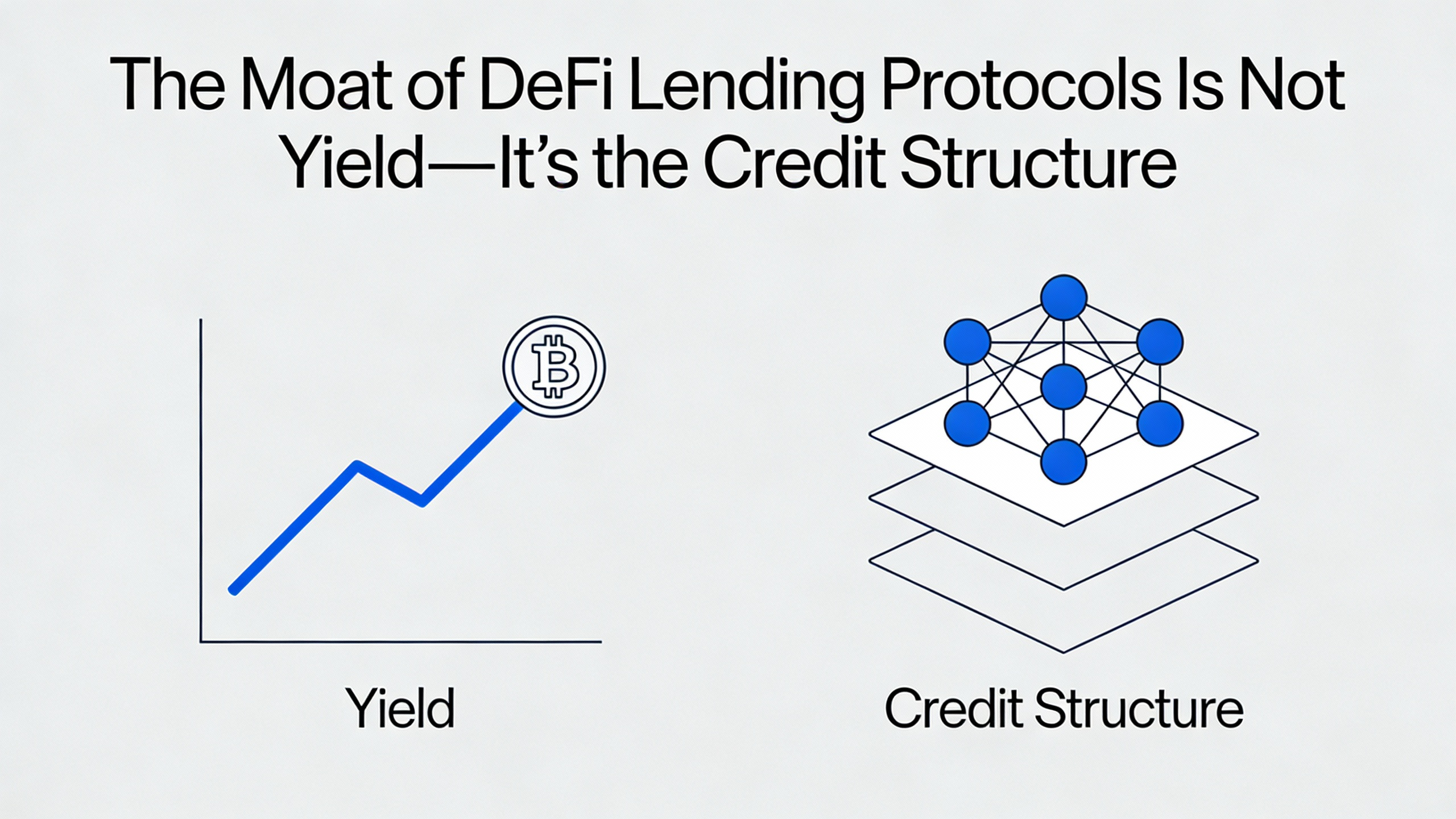
The Moat of DeFi Lending Protocols Is Not Yield—It’s the Credit Structure

The yield illusion and the real moat. For a long time, discussion around DeFi lending has been dominated by APY (annualized yield), with many users treating high yield as the key measure of protocol competitiveness. However, a more essential competitive point is who controls the allocation of on-chain credit—the moat of lending protocols lies in the underlying mechanisms of credit creation and risk management, not in superficial interest rates.

Lending protocols are the on-chain credit hub. The reason leading lending protocols (such as Aave and Compound) are hard to replace is not because they offer the highest rates, but because they sit at the core of the DeFi credit value chain: interest rate formation, liquidation mechanisms, and collateral structure are all built around them. Traditional banks, leveraging low-cost deposits and unsecured high-risk lending, enjoy spreads far beyond the overcollateralized on-chain model (btcc.com). By contrast, DeFi protocols have structurally limited profit space because they lack the ability to expand credit through unsecured lending (btcc.com). In this sense, lending protocols function as the central hub of the on-chain credit market, providing foundational credit supply and risk-bearing capacity for crypto finance.

Structural competition beats yield competition. Yield aggregators and “curators” can optimize user experience and pool capital to raise headline yields, but they still rely on base protocols for interest rate sources and cannot replace the core role of credit creation and risk control. Just as in traditional finance, asset managers can be flexible, but the banking system remains the credit core. Similarly, DeFi is shifting from “competing on rates” to “competing on structure.” Going forward, the players that build more stable and efficient on-chain credit systems (for example, incorporating on-chain credit scoring or supporting real-world asset collateral) and meet real-economy financing needs will gain the upper hand. Control over credit allocation is the true moat.
Post Image
Preview
189
0
Background
Avatar

Zacik

2025-12-24 17:51

The Moat of DeFi Lending Protocols Is Not Yield—It’s the Credit Structure

[{"type":"paragraph","children":[{"text":"The yield illusion and the real moat.","bold":true},{"text":" For a long time, discussion around DeFi lending has been dominated by APY (annualized yield), with many users treating high yield as the key measure of protocol competitiveness. However, a more essential competitive point is "},{"text":"who controls the allocation of on-chain credit","bold":true},{"text":"—the moat of lending protocols lies in the underlying mechanisms of credit creation and risk management, not in superficial interest rates."}]},{"type":"paragraph","children":[{"text":""}]},{"type":"paragraph","children":[{"text":"Lending protocols are the on-chain credit hub.","bold":true},{"text":" The reason leading lending protocols (such as Aave and Compound) are hard to replace is not because they offer the highest rates, but because they sit at the core of the DeFi credit value chain: interest rate formation, liquidation mechanisms, and collateral structure are all built around them. Traditional banks, leveraging low-cost deposits and unsecured high-risk lending, enjoy spreads far beyond the overcollateralized on-chain model (btcc.com). By contrast, DeFi protocols have structurally limited profit space because they lack the ability to expand credit through unsecured lending (btcc.com). In this sense, lending protocols function as the central hub of the on-chain credit market, providing foundational credit supply and risk-bearing capacity for crypto finance."}]},{"type":"paragraph","children":[{"text":""}]},{"type":"paragraph","children":[{"text":"Structural competition beats yield competition.","bold":true},{"text":" Yield aggregators and “curators” can optimize user experience and pool capital to raise headline yields, but they still rely on base protocols for interest rate sources and cannot replace the core role of credit creation and risk control. Just as in traditional finance, asset managers can be flexible, but the banking system remains the credit core. Similarly, DeFi is shifting from “competing on rates” to “competing on structure.” Going forward, the players that build more stable and efficient on-chain credit systems (for example, incorporating on-chain credit scoring or supporting real-world asset collateral) and meet real-economy financing needs will gain the upper hand. Control over credit allocation is the true moat."}]},{"type":"paragraph","children":[{"text":"\n\n\n\n"}]}]
JU Square

Penafian:Berisi konten pihak ketiga. Bukan nasihat keuangan.
Lihat Syarat dan Ketentuan.

Zacik
Zacik2025-12-23 09:02
AI Agent Commercialization Year One: Why “Replacing Labor” Is the Wrong Frame

A fundamental shift in corporate cost structure. Looking ahead to 2026, the industry’s focus is no longer whether AI will replace human labor, but how AI adoption is reshaping corporate cost structures in a profound way (ithome.com.tw). When enterprise spending on AI Agents exceeds labor costs for the first time, it signals a qualitative change in how productivity scales: instead of expanding output linearly by “more people × more hours,” companies scale by reusing systematized intelligence. This is not simply about reducing headcount; it is about assigning AI systems to handle large volumes of repetitive, cross-system, and cross-workflow decision and execution tasks—work that previously required multiple layers of coordination—so that processes become modular, automated, and continuously optimized through machine learning.

AI becomes part of the organization. This shift marks AI’s evolution from a simple “tool” to a “digital employee” or a functional component of the organization. Companies are increasingly embedding AI Agents into core business workflows rather than keeping them at the level of experimentation or auxiliary support. Some analyses argue that 2026 will be a key inflection point for large-scale deployment of AI Agents (ithome.com.tw). More and more companies are using AI Agents for end-to-end workflow automation—“virtual colleagues” operating around the clock—improving efficiency and consistency. More than half of enterprises plan to increase AI investment in 2026, aiming to reduce environmental uncertainty and improve operational visibility through intelligent technologies (ithome.com.tw).

Scaling benefits matter more than labor substitution. The value of AI Agents is not primarily measured by how much payroll they eliminate, but by the scaling benefits they enable. Once AI systems are deployed, the marginal cost of expanding additional capacity is far lower than hiring additional labor. For example, an MIT study suggests that current AI tools can already perform about 11.7% of tasks in the labor market (fastcompany.com). But this does not necessarily lead to mass layoffs; instead, firms redeploy human labor toward higher-value innovation and management work, while assigning repetitive and operational tasks to AI. In short, in AI’s commercialization year one, winners will be those that treat AI as a core productivity module—building human–AI collaboration rather than framing adoption as simple replacement.

Post Image
Preview
69
0
Background
Avatar

Zacik

2025-12-23 09:03

AI Agent Commercialization Year One: Why “Replacing Labor” Is the Wrong Frame

[{"type":"paragraph","children":[{"text":"A fundamental shift in corporate cost structure.","bold":true},{"text":" Looking ahead to 2026, the industry’s focus is no longer whether AI will replace human labor, but how AI adoption is reshaping corporate cost structures in a profound way (ithome.com.tw). When enterprise spending on AI Agents exceeds labor costs for the first time, it signals a qualitative change in how productivity scales: instead of expanding output linearly by “more people × more hours,” companies scale by "},{"text":"reusing systematized intelligence","bold":true},{"text":". This is not simply about reducing headcount; it is about assigning AI systems to handle large volumes of repetitive, cross-system, and cross-workflow decision and execution tasks—work that previously required multiple layers of coordination—so that processes become modular, automated, and continuously optimized through machine learning."}]},{"type":"paragraph","children":[{"text":"AI becomes part of the organization.","bold":true},{"text":" This shift marks AI’s evolution from a simple “tool” to a “digital employee” or a functional component of the organization. Companies are increasingly embedding AI Agents into core business workflows rather than keeping them at the level of experimentation or auxiliary support. Some analyses argue that 2026 will be a key inflection point for large-scale deployment of AI Agents (ithome.com.tw). More and more companies are using AI Agents for end-to-end workflow automation—“virtual colleagues” operating around the clock—improving efficiency and consistency. More than half of enterprises plan to increase AI investment in 2026, aiming to reduce environmental uncertainty and improve operational visibility through intelligent technologies (ithome.com.tw)."}]},{"type":"paragraph","children":[{"text":"Scaling benefits matter more than labor substitution.","bold":true},{"text":" The value of AI Agents is not primarily measured by how much payroll they eliminate, but by the scaling benefits they enable. Once AI systems are deployed, the marginal cost of expanding additional capacity is far lower than hiring additional labor. For example, an MIT study suggests that current AI tools can already perform about "},{"text":"11.7%","bold":true},{"text":" of tasks in the labor market (fastcompany.com). But this does not necessarily lead to mass layoffs; instead, firms redeploy human labor toward higher-value innovation and management work, while assigning repetitive and operational tasks to AI. In short, in AI’s commercialization year one, winners will be those that treat AI as a core productivity module—building human–AI collaboration rather than framing adoption as simple replacement."}]},{"type":"paragraph","children":[{"text":"\n\n\n\n"}]}]
JU Square

Penafian:Berisi konten pihak ketiga. Bukan nasihat keuangan.
Lihat Syarat dan Ketentuan.

Zacik
Zacik2025-12-22 10:30
Japan Is Being Reinterpreted — Not Just as an Arbitrage Market

Following the Bank of Japan’s rate hike, overseas capital did not withdraw. Instead, net inflows have continued, a phenomenon that warrants closer examination.

This indicates that the market is beginning to view Japan as a market gradually restoring normal financial functionality, rather than merely a source of low-interest-rate arbitrage.

As interest rate conditions change, corporate profitability, governance structures, and capital efficiency are becoming increasingly important.

Such changes tend to be gradual, but once consensus forms, the pricing logic can undergo a fundamental shift.

79
0
Background
Avatar

Zacik

2025-12-22 10:30

Japan Is Being Reinterpreted — Not Just as an Arbitrage Market

[{"type":"paragraph","children":[{"text":"Following the Bank of Japan’s rate hike, overseas capital did not withdraw. Instead, net inflows have continued, a phenomenon that warrants closer examination."}]},{"type":"paragraph","children":[{"text":"This indicates that the market is beginning to view Japan as a market gradually restoring normal financial functionality, rather than merely a source of low-interest-rate arbitrage."}]},{"type":"paragraph","children":[{"text":"As interest rate conditions change, corporate profitability, governance structures, and capital efficiency are becoming increasingly important."}]},{"type":"paragraph","children":[{"text":"Such changes tend to be gradual, but once consensus forms, "},{"text":"the pricing logic can undergo a fundamental shift","bold":true},{"text":"."}]},{"type":"paragraph","children":[{"text":"\n\n\n\n\n"}]}]
JU Square

Penafian:Berisi konten pihak ketiga. Bukan nasihat keuangan.
Lihat Syarat dan Ketentuan.

Zacik
Zacik2025-12-22 10:29
Optimism in U.S. Equities Coexists With Global Monetary Policy Divergence

U.S. equity markets are currently trading expectations of a year-end recovery, but from a global perspective, conditions are far from uniform.

Recent policy adjustments by the Bank of Japan serve as a reminder that global monetary conditions are entering a phase of divergence. Different economies face different inflation dynamics, growth pressures, and policy constraints, and the idea of a unified liquidity narrative is losing validity.

This suggests that in the period ahead, asset prices are more likely to be influenced by regional differences and structural factors, rather than a single macro variable.

80
0
Background
Avatar

Zacik

2025-12-22 10:29

Optimism in U.S. Equities Coexists With Global Monetary Policy Divergence

[{"type":"paragraph","children":[{"text":"U.S. equity markets are currently trading expectations of a year-end recovery, but from a global perspective, conditions are far from uniform."}]},{"type":"paragraph","children":[{"text":"Recent policy adjustments by the Bank of Japan serve as a reminder that global monetary conditions are entering a phase of divergence. Different economies face different inflation dynamics, growth pressures, and policy constraints, and the idea of a unified liquidity narrative is losing validity."}]},{"type":"paragraph","children":[{"text":"This suggests that in the period ahead, asset prices are more likely to be influenced by "},{"text":"regional differences and structural factors","bold":true},{"text":", rather than a single macro variable."}]},{"type":"paragraph","children":[{"text":"\n\n\n\n\n"}]}]
JU Square

Penafian:Berisi konten pihak ketiga. Bukan nasihat keuangan.
Lihat Syarat dan Ketentuan.

Zacik
Zacik2025-12-22 10:29
The Strength of the Hainan Sector Is Essentially an Early Pricing of Institutional Dividends

The concentrated rise in Hainan-related stocks may appear theme-driven, but what truly deserves attention is the structure of capital flows.

When long-term capital such as social security funds positions early, it indicates that the market is not focused on short-term fluctuations, but on the sustained dividends that institutional arrangements may release over the coming years.

The core value of the Hainan Free Trade Port does not lie in individual preferential policies, but in its role as an institutional testing ground. For long-term capital, such regions offer clear timelines and relatively high policy predictability.

In periods of rising uncertainty, institutional certainty itself becomes a scarce asset.

68
0
Background
Avatar

Zacik

2025-12-22 10:29

The Strength of the Hainan Sector Is Essentially an Early Pricing of Institutional Dividends

[{"type":"paragraph","children":[{"text":"The concentrated rise in Hainan-related stocks may appear theme-driven, but what truly deserves attention is the structure of capital flows."}]},{"type":"paragraph","children":[{"text":"When long-term capital such as social security funds positions early, it indicates that the market is not focused on short-term fluctuations, but on the sustained dividends that institutional arrangements may release over the coming years."}]},{"type":"paragraph","children":[{"text":"The core value of the Hainan Free Trade Port does not lie in individual preferential policies, but in its role as an institutional testing ground.\n\nFor long-term capital, such regions offer clear timelines and relatively high policy predictability."}]},{"type":"paragraph","children":[{"text":"In periods of rising uncertainty, "},{"text":"institutional certainty itself becomes a scarce asset","bold":true},{"text":"."}]},{"type":"paragraph","children":[{"text":"\n\n\n\n\n"}]}]
JU Square

Penafian:Berisi konten pihak ketiga. Bukan nasihat keuangan.
Lihat Syarat dan Ketentuan.

Zacik
Zacik2025-12-22 10:25
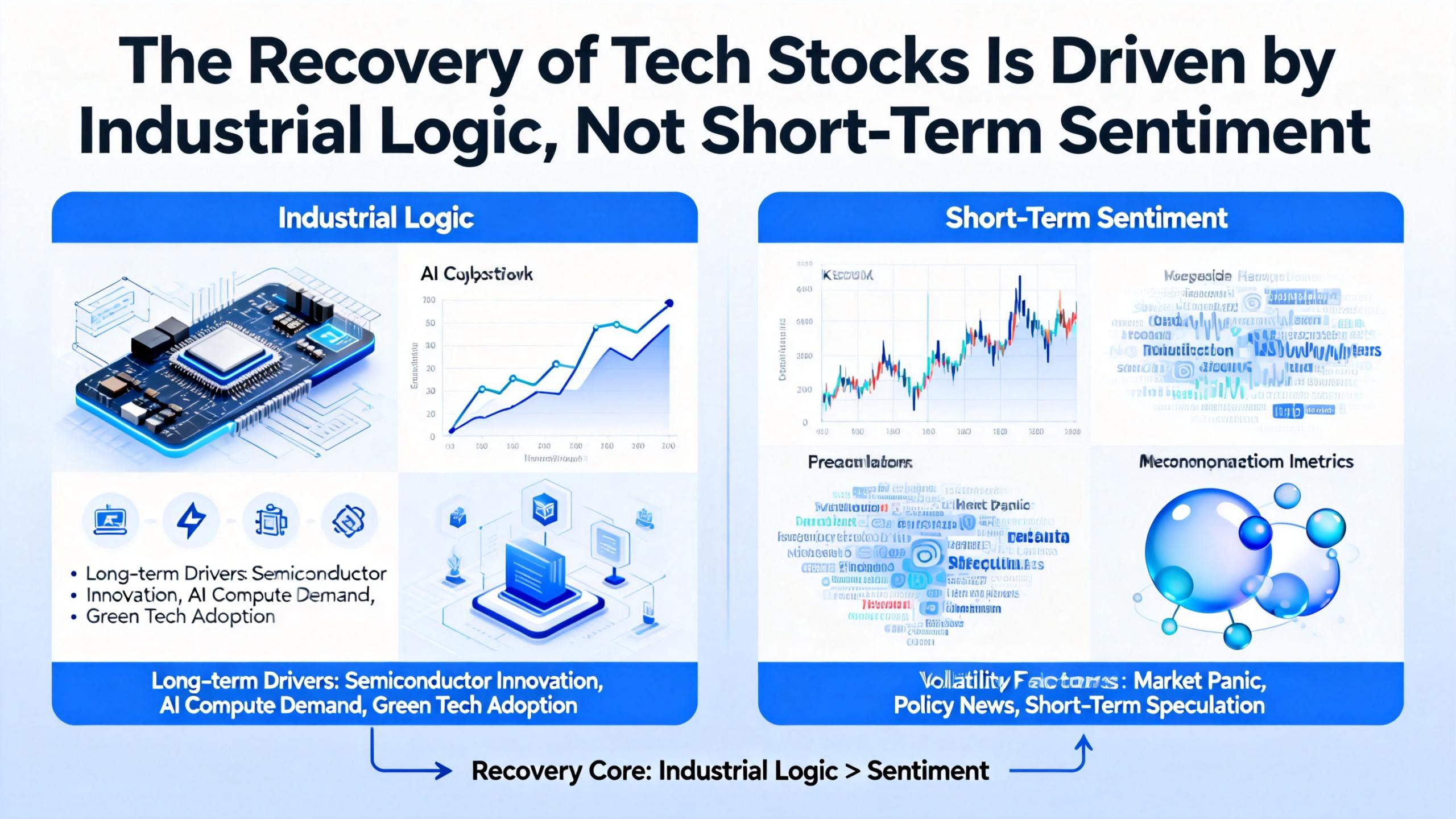
The Recovery of Tech Stocks Is Driven by Industrial Logic, Not Short-Term Sentiment

The recent rebound in technology stocks should not be mistaken for a simple sentiment-driven bounce.

Instead, it reflects multiple industrial dynamics shifting simultaneously. On the policy side, government support around software, computing power, and artificial intelligence continues to gain clarity, with many initiatives moving from planning into execution. On the technology side, progress in computing architecture, optical communication, and AI applications is transitioning from experimental stages into engineering and commercialization.

From a market perspective, this marks a critical shift: the conversation is moving from “Is the technology feasible?” to “Is the business model sustainable?”

Historically, this transition often serves as the starting point for long-term re-pricing.
Post Image
Preview
84
0
Background
Avatar

Zacik

2025-12-22 10:28

The Recovery of Tech Stocks Is Driven by Industrial Logic, Not Short-Term Sentiment

[{"type":"paragraph","children":[{"text":"The recent rebound in technology stocks should not be mistaken for a simple sentiment-driven bounce."}]},{"type":"paragraph","children":[{"text":"Instead, it reflects multiple industrial dynamics shifting simultaneously. On the policy side, government support around software, computing power, and artificial intelligence continues to gain clarity, with many initiatives moving from planning into execution. On the technology side, progress in computing architecture, optical communication, and AI applications is transitioning from experimental stages into engineering and commercialization."}]},{"type":"paragraph","children":[{"text":"From a market perspective, this marks a critical shift:\n\nthe conversation is moving from "},{"text":"“Is the technology feasible?”","bold":true},{"text":" to "},{"text":"“Is the business model sustainable?”","bold":true}]},{"type":"paragraph","children":[{"text":"Historically, this transition often serves as the starting point for long-term re-pricing."}]},{"type":"paragraph","children":[{"text":"\n\n\n\n\n"}]}]
JU Square

Penafian:Berisi konten pihak ketiga. Bukan nasihat keuangan.
Lihat Syarat dan Ketentuan.

Zacik
Zacik2025-12-22 10:24
Structural Momentum Is Returning to China A-Shares

Structural Momentum Is Returning to China A-Shares: Indexes Are Flat, but Directions Are Moving

Over the past 48 hours, the most important signal in China’s A-share market has not come from headline indexes, but from internal structure.

Major indices have remained largely range-bound, yet specific sectors — notably technology-related industries and the Hainan Free Trade Port theme — have shown clear strength. This pattern of “flat index, active structure” typically appears during a transitional phase: the macro environment has not fully turned, but capital has already begun pricing in medium- to long-term certainty.

When overall liquidity is limited, the market tends to concentrate capital into areas with clearer policy guidance and verifiable industrial logic, rather than taking broad, indiscriminate risk exposure.

This suggests that in the coming period, selecting the right direction may matter more than timing the market.
Post Image
Preview
69
0
Background
Avatar

Zacik

2025-12-22 10:25

Structural Momentum Is Returning to China A-Shares

[{"type":"paragraph","children":[{"text":"Structural Momentum Is Returning to China A-Shares: "},{"text":"Indexes Are Flat, but Directions Are Moving","bold":true}]},{"type":"paragraph","children":[{"text":"Over the past 48 hours, the most important signal in China’s A-share market has not come from headline indexes, but from internal structure."}]},{"type":"paragraph","children":[{"text":"Major indices have remained largely range-bound, yet specific sectors — notably technology-related industries and the Hainan Free Trade Port theme — have shown clear strength. This pattern of “flat index, active structure” typically appears during a transitional phase: the macro environment has not fully turned, but capital has already begun pricing in medium- to long-term certainty."}]},{"type":"paragraph","children":[{"text":"When overall liquidity is limited, the market tends to concentrate capital into areas with clearer policy guidance and verifiable industrial logic, rather than taking broad, indiscriminate risk exposure."}]},{"type":"paragraph","children":[{"text":"This suggests that in the coming period, "},{"text":"selecting the right direction may matter more than timing the market","bold":true},{"text":"."}]},{"type":"paragraph","children":[{"text":"\n\n\n\n\n\n\n"}]}]
JU Square

Penafian:Berisi konten pihak ketiga. Bukan nasihat keuangan.
Lihat Syarat dan Ketentuan.

Zacik
Zacik2025-12-19 04:17
AI Talent Flows to Edison: From "Consumer Internet" to "Hardcore Science"

The flocking of top software engineers to biotech companies like Edison AI marks a generational shift in Silicon Valley’s talent flow logic. In the mobile internet era, the smartest brains were dedicated to optimizing ad algorithms and addictive designs, operating in a phase of "exploiting human weakness."

This talent migration indicates that the technical elite are beginning to pursue solutions to fundamental survival problems, shifting their stance from "Traffic Monetization" to "Civilization Upgrade." This change in status means Deep Tech will enjoy an engineer dividend, reducing the risk of scientific breakthroughs failing to land due to a lack of engineering capability.

This is not just job-hopping, but a return to value creation:

  • The Rise of the Meaning Economy: The sense of mission in solving ultimate problems like cancer has become a talent magnet more attractive than stock options.

  • Cross-Disciplinary Fusion: The deep integration of computer science and biology is creating a brand-new class of "Digital Biology" engineers.

Post Image
Preview
73
0
Background
Avatar

Zacik

2025-12-19 04:18

AI Talent Flows to Edison: From "Consumer Internet" to "Hardcore Science"

[{"type":"paragraph","children":[{"text":"The flocking of top software engineers to biotech companies like Edison AI marks a generational shift in Silicon Valley’s talent flow logic. In the mobile internet era, the smartest brains were dedicated to optimizing ad algorithms and addictive designs, operating in a phase of \"exploiting human weakness.\""}]},{"type":"paragraph","children":[{"text":"This talent migration indicates that the technical elite are beginning to pursue solutions to fundamental survival problems, shifting their stance from \"Traffic Monetization\" to \"Civilization Upgrade.\" This change in status means Deep Tech will enjoy an engineer dividend, reducing the risk of scientific breakthroughs failing to land due to a lack of engineering capability."}]},{"type":"paragraph","children":[{"text":"This is not just job-hopping, but a return to value creation:"}]},{"type":"bulleted-list","children":[{"type":"list-item","children":[{"type":"paragraph","children":[{"text":"The Rise of the Meaning Economy: The sense of mission in solving ultimate problems like cancer has become a talent magnet more attractive than stock options."}]}]},{"type":"list-item","children":[{"type":"paragraph","children":[{"text":"Cross-Disciplinary Fusion: The deep integration of computer science and biology is creating a brand-new class of \"Digital Biology\" engineers."}]}]}]},{"type":"paragraph","children":[{"text":"\n\n"}]}]
JU Square

Penafian:Berisi konten pihak ketiga. Bukan nasihat keuangan.
Lihat Syarat dan Ketentuan.

Zacik
Zacik2025-12-19 04:17
Solana Community Resilience: From "Marketing Metrics" to "Cultural Moat"

The community frenzy sparked by Solana’s official tweet marks a deep shift in public chain valuation logic. In the past, public chains primarily engaged in "arms races" via technical metrics like TPS (Transactions Per Second), placing the industry in a "Technology Only" phase.

The Solana case indicates that the market is beginning to recognize "Community Culture" as a core asset value, shifting its stance from "Finding Faster Chains" to "Finding Stickier Tribes." This change in status means future public chain competition will be religious-style cultural wars, reducing the risk of being easily replaced by new chains due to mere technical iteration.

This is not just a Meme carnival, but the socialization of consensus mechanisms:

  • "Culture" on the Balance Sheet: Community loyalty and activity have become assets harder to fork than code.

  • Financialization of Attention: Strong community consensus can rapidly convert attention into market cap, forming a positive feedback loop.

Post Image
Preview
66
0
Background
Avatar

Zacik

2025-12-19 04:17

Solana Community Resilience: From "Marketing Metrics" to "Cultural Moat"

[{"type":"paragraph","children":[{"text":"The community frenzy sparked by Solana’s official tweet marks a deep shift in public chain valuation logic. In the past, public chains primarily engaged in \"arms races\" via technical metrics like TPS (Transactions Per Second), placing the industry in a \"Technology Only\" phase."}]},{"type":"paragraph","children":[{"text":"The Solana case indicates that the market is beginning to recognize \"Community Culture\" as a core asset value, shifting its stance from \"Finding Faster Chains\" to \"Finding Stickier Tribes.\" This change in status means future public chain competition will be religious-style cultural wars, reducing the risk of being easily replaced by new chains due to mere technical iteration."}]},{"type":"paragraph","children":[{"text":"This is not just a Meme carnival, but the socialization of consensus mechanisms:"}]},{"type":"bulleted-list","children":[{"type":"list-item","children":[{"type":"paragraph","children":[{"text":"\"Culture\" on the Balance Sheet: Community loyalty and activity have become assets harder to fork than code."}]}]},{"type":"list-item","children":[{"type":"paragraph","children":[{"text":"Financialization of Attention: Strong community consensus can rapidly convert attention into market cap, forming a positive feedback loop."}]}]}]},{"type":"paragraph","children":[{"text":"\n\n"}]}]
JU Square

Penafian:Berisi konten pihak ketiga. Bukan nasihat keuangan.
Lihat Syarat dan Ketentuan.

Zacik
Zacik2025-12-19 04:12
Google Prompt Engineering Whitepaper: From "Esoteric Tricks" to "Standardized Infrastructure"

Google’s release of the 69-page Prompt Engineering Master Class whitepaper marks the standardization of human-machine interaction logic. Previously, interaction with AI was viewed as "metaphysics" or "art" full of randomness, relying on individual intuition and luck.

The release of this official guide indicates that industry leaders are committing to eliminating interaction uncertainty, shifting their stance from "Exploring a Black Box" to "Defining a Protocol." This change in status means "the ability to ask" will become a replicable, assessable engineering skill, reducing the "hallucination risk" caused by unstable input quality when enterprises adopt AI.

This is not just an educational document, but the establishment of "New Syntax" for the AI era:

  • Delivery of Capabilities: Software services no longer just deliver functions, but deliver the capability standard of "how to harness intelligence."

  • Cognitive Democratization: Standardized tutorials break the technical elite's monopoly on AI interaction skills, driving AI adoption among the general population.

Post Image
Preview
70
0
Background
Avatar

Zacik

2025-12-19 04:14

Google Prompt Engineering Whitepaper: From "Esoteric Tricks" to "Standardized Infrastructure"

[{"type":"paragraph","children":[{"text":"Google’s release of the 69-page "},{"text":"Prompt Engineering Master Class","italic":true},{"text":" whitepaper marks the standardization of human-machine interaction logic. Previously, interaction with AI was viewed as \"metaphysics\" or \"art\" full of randomness, relying on individual intuition and luck."}]},{"type":"paragraph","children":[{"text":"The release of this official guide indicates that industry leaders are committing to eliminating interaction uncertainty, shifting their stance from \"Exploring a Black Box\" to \"Defining a Protocol.\" This change in status means \"the ability to ask\" will become a replicable, assessable engineering skill, reducing the \"hallucination risk\" caused by unstable input quality when enterprises adopt AI."}]},{"type":"paragraph","children":[{"text":"This is not just an educational document, but the establishment of \"New Syntax\" for the AI era:"}]},{"type":"bulleted-list","children":[{"type":"list-item","children":[{"type":"paragraph","children":[{"text":"Delivery of Capabilities: Software services no longer just deliver functions, but deliver the capability standard of \"how to harness intelligence.\""}]}]},{"type":"list-item","children":[{"type":"paragraph","children":[{"text":"Cognitive Democratization: Standardized tutorials break the technical elite's monopoly on AI interaction skills, driving AI adoption among the general population."}]}]}]},{"type":"paragraph","children":[{"text":"\n\n"}]}]
JU Square

Penafian:Berisi konten pihak ketiga. Bukan nasihat keuangan.
Lihat Syarat dan Ketentuan.

Zacik
Zacik2025-12-19 04:09
PayPal Penetrates YouTube: From "Payment Channel" to "Monetary Issuance Right"

PayPal’s stablecoin PYUSD being integrated by YouTube for creator payments marks a historical leap in the business logic of fintech giants. In the past, payment companies acted merely as "channels" for fiat circulation, earning meager transaction fees.

This integration indicates that giants are beginning to realize the strategic value of holding "Seigniorage Rights," shifting their stance from "Money Movers" to "Digital Central Banks." This change in status means they are no longer passive service providers but active liquidity creators, reshaping profit models by capturing yields from underlying assets (like US Treasuries).

This is not just an addition of payment methods, but a process of currency privatization:

  • Monetization of Closed Loops: Giants are beginning to issue currency within their own ecosystem loops, reducing reliance on and costs of traditional banking systems.

  • The Trojan Horse of Web3: Leveraging Web2’s massive user base to achieve mass adoption of Web3 wallets without user friction.

Post Image
Preview
81
0
Background
Avatar

Zacik

2025-12-19 04:12

PayPal Penetrates YouTube: From "Payment Channel" to "Monetary Issuance Right"

[{"type":"paragraph","children":[{"text":"PayPal’s stablecoin PYUSD being integrated by YouTube for creator payments marks a historical leap in the business logic of fintech giants. In the past, payment companies acted merely as \"channels\" for fiat circulation, earning meager transaction fees."}]},{"type":"paragraph","children":[{"text":"This integration indicates that giants are beginning to realize the strategic value of holding \"Seigniorage Rights,\" shifting their stance from \"Money Movers\" to \"Digital Central Banks.\" This change in status means they are no longer passive service providers but active liquidity creators, reshaping profit models by capturing yields from underlying assets (like US Treasuries)."}]},{"type":"paragraph","children":[{"text":"This is not just an addition of payment methods, but a process of currency privatization:"}]},{"type":"bulleted-list","children":[{"type":"list-item","children":[{"type":"paragraph","children":[{"text":"Monetization of Closed Loops: Giants are beginning to issue currency within their own ecosystem loops, reducing reliance on and costs of traditional banking systems."}]}]},{"type":"list-item","children":[{"type":"paragraph","children":[{"text":"The Trojan Horse of Web3: Leveraging Web2’s massive user base to achieve mass adoption of Web3 wallets without user friction."}]}]}]},{"type":"paragraph","children":[{"text":"\n\n"}]}]
JU Square

Penafian:Berisi konten pihak ketiga. Bukan nasihat keuangan.
Lihat Syarat dan Ketentuan.

Zacik
Zacik2025-12-19 04:04
ChainOpera Responds to Doubts: From "Narrative-Driven" to "Code Verification"

The crypto community’s rapid falsification of ChainOpera AI’s alleged testnet via technical means marks the maturation of due diligence logic in the crypto market. In the previous bull cycle, projects often exploited information asymmetry, adopting a stance of "Innovation via Powerpoint" to harvest blindly trusting investors.

This incident indicates that investors are beginning to possess the capability to penetrate technical details, shifting their stance from "Buying Dreams" to "Auditing Reality." This change in status means future projects will face a higher "Proof of Work" barrier to entry, reducing the risk of capital being siphoned off by "vaporware" disguised as innovation.

This is not just a PR crisis, but a purification of the valuation mechanism:

  • The End of "Trust Me, Bro": The era where founders could hide behind technical jargon to harvest capital is ending; open-source culture is evolving into a distributed audit mechanism.

  • Reputation as Collateral: In an environment where code can be easily copied, reputation and transparency have become the only scarce assets that cannot be forked.

Post Image
Preview
70
0
Background
Avatar

Zacik

2025-12-19 04:07

ChainOpera Responds to Doubts: From "Narrative-Driven" to "Code Verification"

[{"type":"paragraph","children":[{"text":"The crypto community’s rapid falsification of ChainOpera AI’s alleged testnet via technical means marks the maturation of due diligence logic in the crypto market. In the previous bull cycle, projects often exploited information asymmetry, adopting a stance of \"Innovation via Powerpoint\" to harvest blindly trusting investors."}]},{"type":"paragraph","children":[{"text":"This incident indicates that investors are beginning to possess the capability to penetrate technical details, shifting their stance from \"Buying Dreams\" to \"Auditing Reality.\" This change in status means future projects will face a higher \"Proof of Work\" barrier to entry, reducing the risk of capital being siphoned off by \"vaporware\" disguised as innovation."}]},{"type":"paragraph","children":[{"text":"This is not just a PR crisis, but a purification of the valuation mechanism:"}]},{"type":"bulleted-list","children":[{"type":"list-item","children":[{"type":"paragraph","children":[{"text":"The End of \"Trust Me, Bro\": The era where founders could hide behind technical jargon to harvest capital is ending; open-source culture is evolving into a distributed audit mechanism."}]}]},{"type":"list-item","children":[{"type":"paragraph","children":[{"text":"Reputation as Collateral: In an environment where code can be easily copied, reputation and transparency have become the only scarce assets that cannot be forked."}]}]}]},{"type":"paragraph","children":[{"text":"\n\n"}]}]
JU Square

Penafian:Berisi konten pihak ketiga. Bukan nasihat keuangan.
Lihat Syarat dan Ketentuan.

Zacik
Zacik2025-12-19 03:59
Circle Global Expansion: From "Crypto Trading Tool" to "Capillary Financial Infrastructure"

Circle’s announcement that its Alliance Program now covers over 1,100 members in 70+ countries marks a structural shift in the utility logic of stablecoins. For years, the market viewed stablecoins primarily through the lens of "liquidity for crypto trading," treating them as accessories to exchanges.

These moves to penetrate African remittances and Latin American commerce indicate that the market is beginning to value the physical utility of "programmable money," shifting its stance from "Serving Speculation" to "Serving the Real Economy." This change in status means stablecoins are becoming the invisible "TCP/IP Protocol" of the financial system—boring, ubiquitous, and essential—thereby eliminating friction costs in cross-border fiat payments.

This is not just business growth, but the "Silent Dollarization" of the Global South:

  • The Shadow SWIFT Network: By bypassing legacy banking rails for B2B payments, Circle is effectively building a parallel, more efficient, 24/7 global settlement layer.

  • Economic Osmosis: Even if crypto asset prices crash, payment infrastructure deeply embedded in 20+ industries possesses extreme stickiness, locking in a valuation floor for the industry.

Post Image
Preview
72
0
Background
Avatar

Zacik

2025-12-19 04:04

Circle Global Expansion: From "Crypto Trading Tool" to "Capillary Financial Infrastructure"

[{"type":"paragraph","children":[{"text":"Circle’s announcement that its Alliance Program now covers over 1,100 members in 70+ countries marks a structural shift in the utility logic of stablecoins. For years, the market viewed stablecoins primarily through the lens of \"liquidity for crypto trading,\" treating them as accessories to exchanges."}]},{"type":"paragraph","children":[{"text":"These moves to penetrate African remittances and Latin American commerce indicate that the market is beginning to value the physical utility of \"programmable money,\" shifting its stance from \"Serving Speculation\" to \"Serving the Real Economy.\" This change in status means stablecoins are becoming the invisible \"TCP/IP Protocol\" of the financial system—boring, ubiquitous, and essential—thereby eliminating friction costs in cross-border fiat payments."}]},{"type":"paragraph","children":[{"text":"This is not just business growth, but the \"Silent Dollarization\" of the Global South:"}]},{"type":"bulleted-list","children":[{"type":"list-item","children":[{"type":"paragraph","children":[{"text":"The Shadow SWIFT Network: By bypassing legacy banking rails for B2B payments, Circle is effectively building a parallel, more efficient, 24/7 global settlement layer."}]}]},{"type":"list-item","children":[{"type":"paragraph","children":[{"text":"Economic Osmosis: Even if crypto asset prices crash, payment infrastructure deeply embedded in 20+ industries possesses extreme stickiness, locking in a valuation floor for the industry."}]}]}]},{"type":"paragraph","children":[{"text":"\n\n"}]}]
JU Square

Penafian:Berisi konten pihak ketiga. Bukan nasihat keuangan.
Lihat Syarat dan Ketentuan.

Gulir ke bawah untuk memuat lebih banyak