
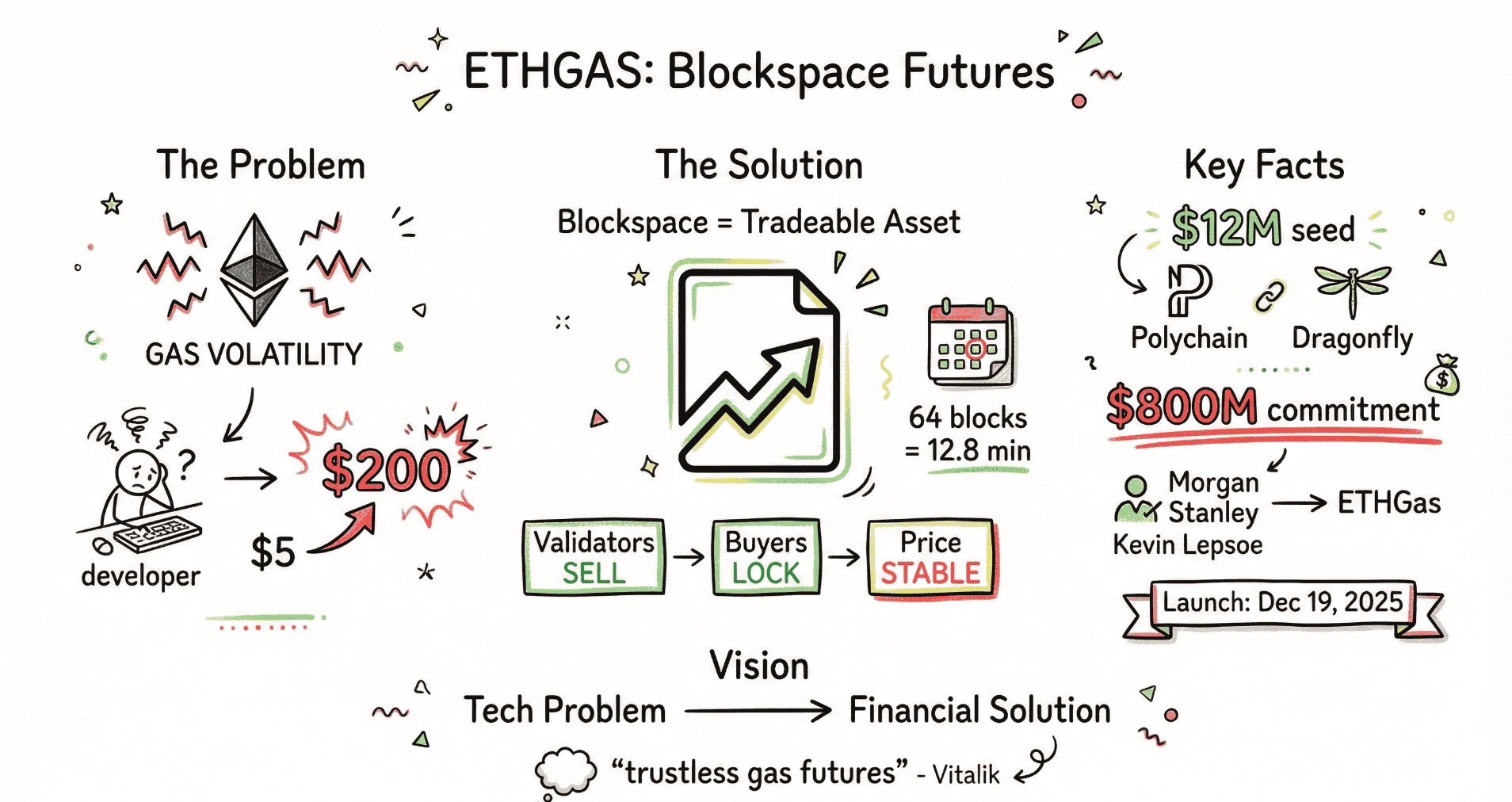
Ethereum generated $2.48 billion in gas fees in 2024, but behind this impressive figure lies a critical problem plaguing the entire ecosystem. Gas costs can fluctuate from $5 to over $200 for a single transaction during network congestion, making it nearly impossible for applications to build sustainable business models. ETHGas officially launched on December 19, 2025, transforming this uncertainty into opportunity by turning block space itself into a tradable financial asset.
💰 Groundbreaking Approach
Founded by Kevin Lepsoe, former Morgan Stanley Executive Director, ETHGas raised $12 million in seed funding led by Polychain Capital and Dragonfly Capital. More significantly, the project secured $800 million in block space liquidity commitments from Ethereum validators and block builders. This massive commitment represents the total amount of future block space that validators are willing to sell on the platform, providing immediate market liquidity that covers roughly 5% to 10% of Ethereum's total annual block space supply.
⚡ Dual Mechanism Innovation
ETHGas operates through two interconnected systems that address both price and time uncertainty. The block space futures mechanism allows validators to sell their next 64 blocks of space in advance, creating a roughly 12.8-minute trading window. Layer 2 sequencers and protocols can now purchase all the block space they need for an entire week upfront, converting unpredictable floating costs into fixed, manageable expenses. This is revolutionary for protocols that currently spend 60% to 80% of their operating budget on gas fees, where a sudden price spike can exhaust an entire monthly budget within hours.
🎯 3-Millisecond Pre-Confirmation
The second mechanism tackles time uncertainty by compressing traditional 12-second confirmation times down to just 3 milliseconds. When users submit transactions, validators in the ETHGas network immediately evaluate and provide cryptographically signed commitments guaranteeing inclusion in the next block. Validators who default on these commitments face economic penalties, ensuring reliability. This creates unprecedented user experiences where decentralized exchanges can offer both instant confirmation and predictable costs simultaneously.
🏆 Strategic Market Position
ETHGas doesn't compete with Layer 2 scaling solutions but complements them perfectly. While Arbitrum and Optimism reduce per-transaction costs by moving computation off-chain, they don't eliminate price volatility. The relationship is analogous to building highways that lower transportation costs versus providing freight insurance that reduces price risk. ETHGas is already in discussions with multiple Layer 2 teams to offer mainnet gas hedging tools, and early data shows that applications integrating pre-confirmation achieve over 30% higher user retention than traditional apps.
💡 Two-Phase Growth Strategy
The project's Open Gas program partners with major protocols like ether.fi, EigenLayer, and Pendle to provide direct gas rebates to users during the initial market education phase. This strategic approach converts market education costs into valuable data assets, as every transaction processed feeds real pricing data into ETHGas' futures algorithms. Once users experience zero-gas convenience, applications will naturally seek sustainable solutions through the futures market in phase two.
🌐 Ecosystem Transformation
Beyond commercial success, ETHGas is building a crucial price discovery mechanism for Ethereum's block space market. The futures curve can signal whether the market expects gas prices to rise or fall, providing valuable insights that could guide investment in scaling solutions. Following mainnet validation, ETHGas plans to expand to major Layer 2 networks, potentially creating a cross-chain block space financial hub that offers unified risk management tools across the entire Ethereum ecosystem.
With Vitalik Buterin repeatedly calling for trustless on-chain gas futures markets, ETHGas is actively turning this vision into reality. The project is now live on mainnet with testing available on the Hoodi testnet. As the blockchain industry matures from focusing purely on technical performance to managing economic risk, ETHGas may establish an entirely new category of infrastructure that proves financial engineering can solve technical problems more efficiently than technical solutions alone.
Read the complete research report with detailed analysis of mechanism design, economic logic, and ecosystem impact: 👇 https://blog.ju.com/ethgas-research-report/?utm_source=blog
#ETHGas #Ethereum #DeFi #Layer2 #Blockchain

JU Blog
2026-01-07 03:13
ETHGas: The Financialization Revolution of Ethereum Block Space
Descargo de responsabilidad:Contiene contenido de terceros. No es asesoramiento financiero.
Consulte los Términos y Condiciones.
🚀 MegaETH: The Real-Time Blockchain Innovation Arena
MegaETH is a breakthrough Ethereum Layer 2 project delivering sub-millisecond latency and 100,000+ TPS through its "node specialization" architecture, pushing on-chain application performance to Web2 levels. Backed by Dragonfly and angel investors including Vitalik Buterin and Joseph Lubin.
💰 Financing Highlights:
- Total raised: $107M (Seed $20M + Community rounds $77M)
- Valuation surge: $100M → $999M FDV (10× growth in 10 months)
- Community heat: Sonar public sale 27.8× oversubscribed
- Investors: 16,000+ participants; Hyperliquid perps implied $5B+ FDV at peak
🔧 Core Technical Innovations:
- Single active sequencer: Eliminates consensus overhead for extreme low latency
- Node specialization architecture: Separates sequencer, prover, and full-node roles
- In-memory execution engine: Optimized for parallel transaction processing
- EigenDA data layer: Provides up to 15 Mb/s bandwidth support
- Full EVM compatibility: Seamless Solidity contract migration
🎯 MegaMafia Accelerator (Core Ecosystem Strategy):
MegaMafia is not a traditional incubator—it's a deep experimental arena around real-time blockchain performance, focusing on "zero-to-one" native innovation:
Phase 1 Results:
- 15 projects raised $40M+ collectively
- Backed by Paradigm, Wintermute, Robot Ventures, Kraken Ventures, Franklin Templeton
- Notable raises: CAP Labs ($1.9M), Valhalla ($1.5M), GTE ($25M+)
Phase 2 Expansion:
- 11 new projects, 25+ total ecosystem projects
- Pivoting to consumer innovation, attracting non-crypto-native users
🌟 Ecosystem Star Projects:
【DeFi - Real-Time Finance】
• Valhalla: DEX aggregator focused on MEV protection
• Cap Money: Third-category stablecoin capturing exogenous yield via MEV and RWA
• Teko Finance: Cross-chain lending protocol
• Benchmark: On-chain fixed-income platform
【Gaming - Web2-Grade Experience】
• Showdown: Real-time TCG with high-frequency interactions
• Stomp: Competitive on-chain gaming
• Legend.Trade: On-chain sports trading platform
【Consumer Apps - On-Chain Culture】
• Euphoria: Real-time options trading with "tap-to-trade" UX (impossible on traditional L2s)
• Noise: Assetizing attention - trade "narrative heat" instead of token prices
• Nectar AI: AI-driven social recommendation system
• Pump Party: Meme token social platform
• Blitzo: Payment-as-entertainment platform
【Infrastructure & Frontier】
• Funes World: "GitHub of the physical world" - 1,000+ building 3D models (4,000-year span), backed by Dragonfly and HashKey
• Cilium: On-chain identity protocol
• Ubitel: Communication infrastructure
• Dorado: Gamified on-chain entertainment platform
💡 Ecosystem Insights:
MegaETH differentiates itself not through "porting" Ethereum apps, but via:
1️⃣ Product Paradigm Reconstruction: Developers ask "What new scenarios can real-time performance enable?" instead of "How do I migrate existing apps?"
2️⃣ Extreme Scenario Nativity: Many projects simply cannot run on traditional chains (e.g., Euphoria's millisecond-level options trading, Noise's real-time heat capture)
3️⃣ Web2-Grade UX: Eliminates "confirmation anxiety," making on-chain interactions as smooth as Web2 apps
4️⃣ Humanistic Value: Funes World uses blockchain to permanently preserve human civilization's memory, transcending financial speculation
🗓️ Key Milestones:
- June 2024: Seed round $20M (valuation $100M)
- Dec 2024: Echo community round $10M (valuation $200M)
- March 2025: Testnet launch with breakthrough performance metrics
- June 2025: Fluffle NFT round $27M (valuation $540M)
- Oct 2025: Sonar public sale $50M (valuation $999M)
- Nov 2025: Pre-deposit Bridge launch (1,000M deposit cap)
- Q4 2025: Mainnet closed beta
- Jan 2026: TGE token distribution
- Mid 2026: PoS staking implementation
⚖️ Technical Trade-offs:
Strengths: Sub-millisecond latency, 100k+ TPS, EVM compatible
Risks: Centralized sequencer dependency, single-point-of-failure risk (team plans mitigation via sequencer rotation and fraud proofs)
👥 Team Background:
- Lei Yang (CTO): MIT PhD, distributed systems expert
- Yilong Li (CEO): Stanford PhD, blockchain security engineer
- Shuyao Kong (CBO): "Bing-xiong," ConsenSys background, strong industry resources
- Team traits: Top academic credentials + rich blockchain experience + rigorous technical research
🎖️ Investment Value Summary:
MegaETH represents a significant exploration of blockchain performance limits. Unlike traditional L2s' "wheel-reinventing" homogeneity, it builds genuine moats through "real-time app incubation + high-performance EVM chain."
Core Highlights:
✓ Compelling technical narrative: Real-time blockchain pioneer
✓ Strong ecosystem differentiation: 25+ native innovation projects, not simple forks
✓ Top-tier capital backing: Vitalik, Paradigm, Dragonfly, etc.
✓ High market recognition: 10× valuation growth in 10 months, 27.8× oversubscription
✓ Ecosystem flourishing pre-mainnet: Unprecedented phenomenon
Risk Warnings:
⚠ Centralized sequencer issue requires ongoing attention to decentralization roadmap
⚠ Mainnet performance versus promised metrics remains to be verified
⚠ High-performance environment requires developers to relearn product design logic
This is an innovative ecosystem worth long-term attention and research. Investors should view it as a venture bet on next-generation on-chain application infrastructure, closely monitoring mainnet performance, ecosystem development, and technical roadmap execution.
Read the complete in-depth research report for technical architecture details, team interviews, project analysis, and investment strategies: 👇
https://blog.ju.com/megaeth-ecosystem-report/?utm_source=blog
JU Blog
2025-11-28 13:55
MegaETH Ecosystem In-Depth Research Report
Descargo de responsabilidad:Contiene contenido de terceros. No es asesoramiento financiero.
Consulte los Términos y Condiciones.

The Ethereum co-founder has repeatedly spoken this year about treating privacy as a basic necessity for digital systems.
- Following a recent data breach involving major US banks, where client information from institutions including JPMorgan, Citi, and Morgan Stanley may have been exposed after a cyberattack on mortgage technology vendor SitusAMC, Buterin responded by describing privacy as a form of “hygiene.”
- Ethereum co-founder Vitalik Buterin said end-to-end encrypted messaging is essential for protecting digital privacy, identifying permissionless account creation and metadata privacy as the next major priorities for the sector.
He pointed to Session and SimpleX as two projects working on these areas and disclosed that he has donated 128 ETH to each of them.
Major ETH Donations
- In a post on X this week, Buterin said both applications are attempting to strengthen decentralization and enhance user protections without relying on phone numbers, while also addressing challenges such as multi-device support and resistance to Sybil or denial-of-service attacks.
- Buterin said the donation addresses are publicly available on the projects’ websites and added that, although the platforms are not yet perfect, they represent active efforts to advance privacy-preserving communication.
- He also called for more developers to help tackle the technical problems that still remain, and added that these issues “need more eyes on them.”
- It is important to note that while Signal has emerged as a widely used encrypted messaging app, it faced renewed scrutiny following a March incident in which senior US national security officials accidentally included a reporter in a Signal group discussing strikes on Houthi targets in Yemen.
- Days later, a Pentagon-wide advisory warned against using the app for any non-public information, citing a vulnerability tied to its linked-devices feature.
- The memo said Russian hacking groups were targeting the users of the app through phishing tactics. Signal later attributed the issue to user-targeted attacks rather than problems with its encryption, and that the company had already implemented safeguards and warnings.
Buterin’s Privacy Push
- In an essay published in April, he argued that “privacy is an important guarantor of decentralization” and outlined a path for Ethereum to support stealth addresses, selective disclosure, and application-level zero-knowledge tools to help reduce unnecessary data exposure.
- More recently, he warned that X’s new geo-inference system, which assigns country labels to user accounts, poses privacy risks.
He said such systems can still reveal sensitive location information and may endanger vulnerable users, even when only broad regions are disclosed.
#Ethereum #VitalikButerin #Jucom #cryptocurrency #EncryptedMessages $ETH/USDT $JU/USDT $BTC/USDT
Lee | Ju.Com
2025-11-28 05:01
🔥Ethereum Co-Founder Vitalik Buterin Launches 256 ETH to Boost Next-Generation Encrypted Messaging!
Descargo de responsabilidad:Contiene contenido de terceros. No es asesoramiento financiero.
Consulte los Términos y Condiciones.

What Is Ethereum’s Role in Smart Contracts?
Ethereum has become a cornerstone of blockchain technology, especially when it comes to enabling smart contracts. These self-executing agreements are transforming how transactions and digital interactions occur across various industries. Understanding Ethereum’s role in this ecosystem is essential for anyone interested in blockchain innovation, decentralized applications (dApps), or the future of digital finance.
How Ethereum Supports Smart Contracts
At its core, Ethereum provides a decentralized platform that allows developers to create and deploy smart contracts without relying on centralized authorities. Unlike traditional contracts that require intermediaries like lawyers or banks, smart contracts on Ethereum automatically execute predefined rules once certain conditions are met. This automation reduces costs, increases transparency, and minimizes the risk of manipulation.
Ethereum's blockchain acts as an immutable ledger where these contracts are stored and executed. Once deployed, they run exactly as programmed—no third-party intervention needed—ensuring trustless interactions between parties. This feature makes Ethereum particularly appealing for applications requiring high security and transparency.
Programming Languages Powering Smart Contracts
One of the key strengths of Ethereum is its support for specialized programming languages designed explicitly for writing smart contracts. Solidity is by far the most popular language used within the ecosystem; it resembles JavaScript in syntax but offers features tailored to blockchain development.
Developers can craft complex logic within their smart contracts using Solidity, enabling functionalities such as token creation (ERC-20 tokens), voting mechanisms, financial derivatives, or even gaming logic. The flexibility provided by these languages allows for innovative use cases across sectors like finance (DeFi), gaming (NFTs), supply chain management, and more.
Gas Fees: The Cost of Running Smart Contracts
Executing smart contracts on Ethereum isn’t free; it involves paying gas fees measured in Ether (ETH). Gas represents computational effort required to process transactions or contract executions on the network. When users initiate a transaction involving a smart contract—say transferring tokens or executing a DeFi trade—they must pay an amount proportional to the complexity involved.
This fee mechanism helps prevent spam attacks but also introduces considerations around cost efficiency during periods of high network congestion. Recent upgrades aim to optimize gas consumption while maintaining security standards—a critical factor influencing user adoption and developer activity.
Smart Contracts’ Role in Decentralized Applications
Smart contracts form the backbone of decentralized applications (dApps). These apps operate without central servers; instead, they rely entirely on code running securely on blockchains like Ethereum. From simple token swaps via platforms like Uniswap to complex lending protocols such as Aave or Compound—these dApps leverage smart contract logic extensively.
The ability to automate processes ensures that dApps can offer services with increased transparency and reduced reliance on intermediaries—a significant advantage over traditional centralized systems. As a result, industries ranging from finance to entertainment have embraced this technology for creating innovative solutions that prioritize user control over assets and data.
Security Challenges Associated With Smart Contracts
While offering numerous benefits—including automation and decentralization—smart contracts also pose security risks if not properly coded or audited. Bugs within contract code can lead to vulnerabilities exploitable by hackers; notable incidents include The DAO hack in 2016 which resulted in millions lost due to flawed code execution.
To mitigate these risks:
- Developers conduct thorough audits before deployment.
- Specialized firms provide security assessments.
- Formal verification methods are increasingly adopted.
Despite advancements in security practices, vulnerabilities remain possible due to human error or unforeseen edge cases within complex logic structures.
Scalability Issues And Upgrades Like Ethereum 2.0
As demand grows for dApps built atop Ethereum’s platform—including DeFi projects and NFTs—the network faces scalability challenges limiting transaction throughput and increasing fees during peak times. To address this:
- Ethereum 2.x aims at transitioning from proof-of-work (PoW) consensus mechanisms toward proof-of-stake (PoS).
- It introduces sharding techniques allowing parallel processing across multiple chains.
These upgrades promise faster transaction speeds with lower costs while enhancing overall network security—a crucial step toward mainstream adoption of blockchain-based solutions involving smart contracts.
Layer 2 Solutions Enhancing Performance
In addition to core upgrades:
- Layer 2 solutions such as Polygon (formerly Matic), Optimism, Arbitrum facilitate off-chain processing.
- They enable faster transactions at reduced costs by batching operations before settling them back onto mainnet.
These innovations help bridge current performance gaps until full-scale upgrades mature.
Regulatory Environment And Its Impact On Smart Contract Adoption
Legal frameworks surrounding blockchain technology continue evolving worldwide—and their influence directly affects how businesses develop with smart contracts on platforms like Ethereum:
- Governments seek clarity around issues such as securities classification for tokens created via smart contract protocols.
- Regulatory uncertainty may hinder innovation if overly restrictive policies emerge.
Conversely:
- Clear guidelines foster trust among users,
- Encourage institutional participation,
- Promote responsible development practices aligned with legal standards.
Importance Of Compliance And Auditing
Given potential legal implications:
- Regular audits ensure compliance with applicable regulations,
- Transparent documentation builds user confidence,3.. Collaboration between developers & regulators promotes sustainable growth.
Future Outlook: Risks And Opportunities
Despite impressive progress made through recent updates like ETH 2.x enhancements:
Risks remain, including:
- Security vulnerabilities leading potentially catastrophic losses,
- Regulatory uncertainties stalling broader adoption,
- Environmental concerns related mainly to energy-intensive proof-of-work models,
Opportunities abound through ongoing innovations:
1.. Continued scalability improvements will make dApps more accessible globally,2.. Growing sectors such as DeFi & NFTs expand use cases leveraging robust smart contract capabilities,3.. Increasing regulatory clarity could accelerate institutional involvement,
By balancing technological advancements with rigorous security measures—and aligning developments with evolving legal landscapes—Ethereum continues shaping its pivotal role at the heart of modern decentralized ecosystems.
Understanding how Ethereum supports intelligent automation through secure & scalable infrastructure reveals why it's considered foundational within blockchain technology today—and why ongoing developments will determine its future trajectory amidst emerging challenges & opportunities alike
JCUSER-IC8sJL1q
2025-05-09 12:40
What is Ethereum’s role in smart contracts?
What Is Ethereum’s Role in Smart Contracts?
Ethereum has become a cornerstone of blockchain technology, especially when it comes to enabling smart contracts. These self-executing agreements are transforming how transactions and digital interactions occur across various industries. Understanding Ethereum’s role in this ecosystem is essential for anyone interested in blockchain innovation, decentralized applications (dApps), or the future of digital finance.
How Ethereum Supports Smart Contracts
At its core, Ethereum provides a decentralized platform that allows developers to create and deploy smart contracts without relying on centralized authorities. Unlike traditional contracts that require intermediaries like lawyers or banks, smart contracts on Ethereum automatically execute predefined rules once certain conditions are met. This automation reduces costs, increases transparency, and minimizes the risk of manipulation.
Ethereum's blockchain acts as an immutable ledger where these contracts are stored and executed. Once deployed, they run exactly as programmed—no third-party intervention needed—ensuring trustless interactions between parties. This feature makes Ethereum particularly appealing for applications requiring high security and transparency.
Programming Languages Powering Smart Contracts
One of the key strengths of Ethereum is its support for specialized programming languages designed explicitly for writing smart contracts. Solidity is by far the most popular language used within the ecosystem; it resembles JavaScript in syntax but offers features tailored to blockchain development.
Developers can craft complex logic within their smart contracts using Solidity, enabling functionalities such as token creation (ERC-20 tokens), voting mechanisms, financial derivatives, or even gaming logic. The flexibility provided by these languages allows for innovative use cases across sectors like finance (DeFi), gaming (NFTs), supply chain management, and more.
Gas Fees: The Cost of Running Smart Contracts
Executing smart contracts on Ethereum isn’t free; it involves paying gas fees measured in Ether (ETH). Gas represents computational effort required to process transactions or contract executions on the network. When users initiate a transaction involving a smart contract—say transferring tokens or executing a DeFi trade—they must pay an amount proportional to the complexity involved.
This fee mechanism helps prevent spam attacks but also introduces considerations around cost efficiency during periods of high network congestion. Recent upgrades aim to optimize gas consumption while maintaining security standards—a critical factor influencing user adoption and developer activity.
Smart Contracts’ Role in Decentralized Applications
Smart contracts form the backbone of decentralized applications (dApps). These apps operate without central servers; instead, they rely entirely on code running securely on blockchains like Ethereum. From simple token swaps via platforms like Uniswap to complex lending protocols such as Aave or Compound—these dApps leverage smart contract logic extensively.
The ability to automate processes ensures that dApps can offer services with increased transparency and reduced reliance on intermediaries—a significant advantage over traditional centralized systems. As a result, industries ranging from finance to entertainment have embraced this technology for creating innovative solutions that prioritize user control over assets and data.
Security Challenges Associated With Smart Contracts
While offering numerous benefits—including automation and decentralization—smart contracts also pose security risks if not properly coded or audited. Bugs within contract code can lead to vulnerabilities exploitable by hackers; notable incidents include The DAO hack in 2016 which resulted in millions lost due to flawed code execution.
To mitigate these risks:
- Developers conduct thorough audits before deployment.
- Specialized firms provide security assessments.
- Formal verification methods are increasingly adopted.
Despite advancements in security practices, vulnerabilities remain possible due to human error or unforeseen edge cases within complex logic structures.
Scalability Issues And Upgrades Like Ethereum 2.0
As demand grows for dApps built atop Ethereum’s platform—including DeFi projects and NFTs—the network faces scalability challenges limiting transaction throughput and increasing fees during peak times. To address this:
- Ethereum 2.x aims at transitioning from proof-of-work (PoW) consensus mechanisms toward proof-of-stake (PoS).
- It introduces sharding techniques allowing parallel processing across multiple chains.
These upgrades promise faster transaction speeds with lower costs while enhancing overall network security—a crucial step toward mainstream adoption of blockchain-based solutions involving smart contracts.
Layer 2 Solutions Enhancing Performance
In addition to core upgrades:
- Layer 2 solutions such as Polygon (formerly Matic), Optimism, Arbitrum facilitate off-chain processing.
- They enable faster transactions at reduced costs by batching operations before settling them back onto mainnet.
These innovations help bridge current performance gaps until full-scale upgrades mature.
Regulatory Environment And Its Impact On Smart Contract Adoption
Legal frameworks surrounding blockchain technology continue evolving worldwide—and their influence directly affects how businesses develop with smart contracts on platforms like Ethereum:
- Governments seek clarity around issues such as securities classification for tokens created via smart contract protocols.
- Regulatory uncertainty may hinder innovation if overly restrictive policies emerge.
Conversely:
- Clear guidelines foster trust among users,
- Encourage institutional participation,
- Promote responsible development practices aligned with legal standards.
Importance Of Compliance And Auditing
Given potential legal implications:
- Regular audits ensure compliance with applicable regulations,
- Transparent documentation builds user confidence,3.. Collaboration between developers & regulators promotes sustainable growth.
Future Outlook: Risks And Opportunities
Despite impressive progress made through recent updates like ETH 2.x enhancements:
Risks remain, including:
- Security vulnerabilities leading potentially catastrophic losses,
- Regulatory uncertainties stalling broader adoption,
- Environmental concerns related mainly to energy-intensive proof-of-work models,
Opportunities abound through ongoing innovations:
1.. Continued scalability improvements will make dApps more accessible globally,2.. Growing sectors such as DeFi & NFTs expand use cases leveraging robust smart contract capabilities,3.. Increasing regulatory clarity could accelerate institutional involvement,
By balancing technological advancements with rigorous security measures—and aligning developments with evolving legal landscapes—Ethereum continues shaping its pivotal role at the heart of modern decentralized ecosystems.
Understanding how Ethereum supports intelligent automation through secure & scalable infrastructure reveals why it's considered foundational within blockchain technology today—and why ongoing developments will determine its future trajectory amidst emerging challenges & opportunities alike
Descargo de responsabilidad:Contiene contenido de terceros. No es asesoramiento financiero.
Consulte los Términos y Condiciones.
📰 Điều gì đang thúc đẩy đà tăng của Ethereum — Và liệu nó có thể kéo dài? 🚀
Xem chia sẻ của Jucoin CEO Sammi Li về chủ đề này trên DecryptMedia 👇🏻
🔗 https://decrypt.co/335292/whats-driving-ethereums-surge-and-can-it-last
#JuCoin #JucoinVietnam #Ethereum #ETH #Blockchain
Lee | Ju.Com
2025-08-15 06:24
📰 Điều gì đang thúc đẩy đà tăng của Ethereum — Và liệu nó có thể kéo dài? 🚀
Descargo de responsabilidad:Contiene contenido de terceros. No es asesoramiento financiero.
Consulte los Términos y Condiciones.
Two leading Federal Reserve chair candidates are advocating aggressive rate cuts despite inflation concerns, potentially creating powerful tailwinds for cryptocurrency markets. With Trump considering 11 candidates to replace Jerome Powell in May 2026, dovish monetary policy could drive substantial crypto gains.
🏛️ Leading Dovish Candidates:
-
Marc Sumerlin: Former Bush admin economist advocating 50+ basis point cuts
David Zervos: Jefferies Chief Market Strategist supporting 200+ basis point total reduction
Key Position: Both believe current monetary policy is "offensively tight" despite PPI data
Trump Alignment: Both support lower borrowing costs and economic stimulus
📈 How Rate Cuts Boost Crypto:
-
Lower Opportunity Costs: Reduced bond/savings yields push investors toward crypto
Increased Liquidity: More money flowing into alternative investments
Dollar Weakness: Makes Bitcoin more attractive as store of value
Risk Appetite: Cheaper borrowing costs encourage higher-yield asset allocation
Historical Precedent: 2020-2021 crypto rally coincided with Fed accommodation
💎 Crypto Market Benefits:
-
Bitcoin: Enhanced digital store of value appeal during dollar weakness
Ethereum: Increased DeFi activity from improved liquidity conditions
Layer-1 Protocols: More developer activity and ecosystem growth
Infrastructure: Crypto companies access cheaper capital for expansion
Stablecoins: Expanded usage in lower-rate environments
🔍 Selection Process Impact:
-
11 Candidates: Diverse backgrounds from Fed officials to market strategists
Timeline: Prolonged uncertainty could create short-term volatility
Market Experience: Candidates like Zervos bring crypto-aware perspectives
Policy Clarity: Dovish positioning provides directional support regardless of final pick
📊 Historical Correlation:
-
2022 Struggle: Crypto fell as rates rose aggressively
2023-2024 Recovery: Crypto rallied as rate hikes peaked and cuts expected
Transmission Speed: Crypto markets react immediately to Fed policy changes
Sustained Impact: Rate cut campaigns provide ongoing support over months
⚠️ Key Considerations:
-
Regulatory uncertainty remains despite monetary tailwinds
Timing matters - gradual vs aggressive cuts create different market dynamics
Fed chair's approach to financial stability could impact crypto oversight
Monetary policy alone cannot drive sustained crypto adoption
🎯 Investment Implications: The combination of dovish Fed leadership and Trump's pro-crypto stance creates potentially explosive conditions for digital assets. Lower rates reduce competition from traditional investments while institutional appetite for alternatives increases dramatically.
Bottom Line: Fed chair candidates advocating aggressive rate cuts could unleash massive liquidity into crypto markets. Historical data shows strong correlations between accommodative monetary policy and crypto rallies. The May 2026 appointment could mark a pivotal moment for digital asset adoption.
Read the complete analysis on Fed chair candidates and crypto market implications: 👇 https://blog.jucoin.com/fed-chair-rate-cuts-crypto/?utm_source=blog
#FedChair #RateCuts #Crypto #Bitcoin #Ethereum
JU Blog
2025-08-16 08:50
💰 Fed Chair Rate Cuts Could Spark Massive Crypto Rally
Descargo de responsabilidad:Contiene contenido de terceros. No es asesoramiento financiero.
Consulte los Términos y Condiciones.
📰 Tom Lee đặt mục tiêu #Ethereum đạt 15,000 USD vào năm 2025, nhờ vào kho $ETH kỷ lục 5 tỷ USD của #BitMine. Chiến lược này tận dụng tăng trưởng #Stablecoin từ 250 tỷ USD lên 2 nghìn tỷ USD và 60% thị phần của #Ethereum trong mảng token hóa tài sản thực.
🔎 Đọc thêm: https://blog.jucoin.com/tom-lee-ethereum-prediction/
#JuCoin #JucoinVietnam #JucoinInsight #Ethereum #ETH #Crypto #Blockchain #CryptoNews #PricePrediction #Tokenization #Stablecoin
Lee | Ju.Com
2025-08-15 06:25
🌟Jucoin Insight | Dự đoán giá #Ethereum của Tom Lee: Mục tiêu 15,000 USD vào 2025! 🚀
Descargo de responsabilidad:Contiene contenido de terceros. No es asesoramiento financiero.
Consulte los Términos y Condiciones.
What is Account Abstraction (EIP-4337)?
Understanding Ethereum Accounts and Their Limitations
Ethereum, the leading blockchain platform for decentralized applications, has traditionally relied on two main types of accounts: externally owned accounts (EOAs) and contract accounts. EOAs are controlled by private keys and are used by users to send transactions, while contract accounts are governed by smart contracts that execute code autonomously. However, this binary structure presents certain limitations in terms of flexibility, security, and user experience.
For example, EOAs require users to manage private keys securely—an often complex task that can lead to loss of funds if mishandled. Contract accounts lack the ability to perform certain operations without external triggers or specific transaction structures. As Ethereum's ecosystem expands into areas like DeFi (Decentralized Finance), NFTs (Non-Fungible Tokens), and enterprise solutions, these constraints hinder seamless user interactions and advanced functionalities.
This context has driven the development of Account Abstraction, a concept aimed at redefining how Ethereum accounts function—making them more versatile and adaptable to modern needs.
What Is Account Abstraction?
Account abstraction refers to a paradigm shift in Ethereum's account model that allows for more flexible account behaviors beyond simple storage of Ether or tokens. Instead of being limited to basic transaction validation via private keys, abstracted accounts can incorporate custom logic for authorization, multi-signature schemes, social recovery mechanisms, or even biometric authentication.
Specifically related to EIP-4337—a prominent proposal within this space—it introduces a new layer where user operations are processed differently from traditional transactions. This enables users to execute complex actions without relying solely on externally owned wallets or traditional smart contracts as intermediaries.
In essence, account abstraction aims to make blockchain interactions more intuitive while enhancing security features such as multi-factor authentication or time-locks directly integrated into account logic.
The Context Behind EIP-4337 Development
The push towards account abstraction stems from several challenges faced by the Ethereum community:
User Experience: Managing private keys is cumbersome for many users; losing access means losing funds.
Security Risks: Private key management exposes vulnerabilities; compromised keys lead directly to asset theft.
Smart Contract Limitations: Existing models do not support advanced features like social recovery or flexible authorization schemes natively.
Scalability & Usability Needs: As DeFi grows exponentially with millions engaging in financial activities on-chain — there’s a pressing need for smarter account management systems that can handle complex workflows efficiently.
In response these issues have prompted proposals like EIP-4337 which aim at creating an improved framework where user operations can be processed more flexibly while maintaining compatibility with existing infrastructure.
Key Features of EIP-4337
Introduced in 2021 by members of the Ethereum community through extensive discussions and development efforts, EIP-4337 proposes several core innovations:
Abstract Accounts & Signers
The proposal introduces two primary components:
- Abstract Accounts: These are enhanced wallet-like entities capable of executing arbitrary transactions based on custom logic embedded within them.
- Abstract Signers: They facilitate signing transactions without exposing sensitive details—enabling features like multi-signature requirements seamlessly integrated into the account itself rather than relying solely on external wallets.
Improved Security Mechanisms
EIP-4337 emphasizes security enhancements such as:
- Multi-signature requirements ensuring multiple approvals before executing critical actions.
- Time-locks preventing immediate transfers—adding layers against unauthorized access.
- Social recovery options allowing trusted contacts or mechanisms restoring access if private keys are lost.
Compatibility & Transition
A significant aspect is backward compatibility with existing Ethereum infrastructure—meaning developers can adopt new features gradually without disrupting current applications or wallets during transition phases.
Recent Progress and Community Engagement
Since its proposal in 2021:
- The idea has gained substantial support among developers aiming at making blockchain interactions safer and easier.
- Multiple projects have begun testing implementations within testnets; some wallets now experiment with integrating abstracted account capabilities.
- Discussions continue around scalability concerns; critics worry about increased complexity potentially impacting network performance if not carefully managed.
Despite ongoing debates about potential scalability bottlenecks—which could arise from added computational overhead—the consensus remains optimistic about its long-term benefits when properly implemented.
Challenges Facing Implementation
While promising, adopting EIP-4337 involves navigating several hurdles:
Scalability Concerns
Adding sophisticated logic directly into accounts might increase transaction processing times or block sizes unless optimized effectively—a crucial consideration given Ethereum’s current throughput limits.
Regulatory Implications
Enhanced security features such as social recovery could raise questions around compliance with legal standards related to identity verification and anti-money laundering regulations across jurisdictions worldwide.
Adoption Timeline
Although initial testing phases began around 2022–2023—with some projects already integrating elements—the full rollout depends heavily on network upgrades (like Shanghai/Capella upgrades) scheduled over upcoming ETH network hard forks.
How Account Abstraction Shapes Future Blockchain Use Cases
If successfully implemented at scale:
- Users will enjoy simplified onboarding processes—no longer needing complex seed phrases managed manually.
- Developers will gain tools for building smarter dApps capable of handling multi-layered permissions natively within user accounts themselves.
- Security protocols will become more robust through customizable safeguards embedded directly into wallet logic rather than relying solely on external hardware solutions.
This evolution aligns well with broader trends toward decentralization combined with enhanced usability—a key factor driving mainstream adoption beyond crypto enthusiasts toward everyday consumers.
By reimagining how identities interact within blockchain ecosystems through proposals like EIP-4337—and addressing longstanding usability issues—it paves the way toward a future where decentralized finance becomes accessible yet secure enough for mass adoption. As ongoing developments unfold over 2024+, observing how communities adapt these innovations will be crucial in understanding their impact across various sectors—from finance institutions adopting blockchain-based identity solutions to individual users seeking safer ways to manage digital assets efficiently.
JCUSER-WVMdslBw
2025-05-14 12:53
What is account abstraction (EIP-4337)?
What is Account Abstraction (EIP-4337)?
Understanding Ethereum Accounts and Their Limitations
Ethereum, the leading blockchain platform for decentralized applications, has traditionally relied on two main types of accounts: externally owned accounts (EOAs) and contract accounts. EOAs are controlled by private keys and are used by users to send transactions, while contract accounts are governed by smart contracts that execute code autonomously. However, this binary structure presents certain limitations in terms of flexibility, security, and user experience.
For example, EOAs require users to manage private keys securely—an often complex task that can lead to loss of funds if mishandled. Contract accounts lack the ability to perform certain operations without external triggers or specific transaction structures. As Ethereum's ecosystem expands into areas like DeFi (Decentralized Finance), NFTs (Non-Fungible Tokens), and enterprise solutions, these constraints hinder seamless user interactions and advanced functionalities.
This context has driven the development of Account Abstraction, a concept aimed at redefining how Ethereum accounts function—making them more versatile and adaptable to modern needs.
What Is Account Abstraction?
Account abstraction refers to a paradigm shift in Ethereum's account model that allows for more flexible account behaviors beyond simple storage of Ether or tokens. Instead of being limited to basic transaction validation via private keys, abstracted accounts can incorporate custom logic for authorization, multi-signature schemes, social recovery mechanisms, or even biometric authentication.
Specifically related to EIP-4337—a prominent proposal within this space—it introduces a new layer where user operations are processed differently from traditional transactions. This enables users to execute complex actions without relying solely on externally owned wallets or traditional smart contracts as intermediaries.
In essence, account abstraction aims to make blockchain interactions more intuitive while enhancing security features such as multi-factor authentication or time-locks directly integrated into account logic.
The Context Behind EIP-4337 Development
The push towards account abstraction stems from several challenges faced by the Ethereum community:
User Experience: Managing private keys is cumbersome for many users; losing access means losing funds.
Security Risks: Private key management exposes vulnerabilities; compromised keys lead directly to asset theft.
Smart Contract Limitations: Existing models do not support advanced features like social recovery or flexible authorization schemes natively.
Scalability & Usability Needs: As DeFi grows exponentially with millions engaging in financial activities on-chain — there’s a pressing need for smarter account management systems that can handle complex workflows efficiently.
In response these issues have prompted proposals like EIP-4337 which aim at creating an improved framework where user operations can be processed more flexibly while maintaining compatibility with existing infrastructure.
Key Features of EIP-4337
Introduced in 2021 by members of the Ethereum community through extensive discussions and development efforts, EIP-4337 proposes several core innovations:
Abstract Accounts & Signers
The proposal introduces two primary components:
- Abstract Accounts: These are enhanced wallet-like entities capable of executing arbitrary transactions based on custom logic embedded within them.
- Abstract Signers: They facilitate signing transactions without exposing sensitive details—enabling features like multi-signature requirements seamlessly integrated into the account itself rather than relying solely on external wallets.
Improved Security Mechanisms
EIP-4337 emphasizes security enhancements such as:
- Multi-signature requirements ensuring multiple approvals before executing critical actions.
- Time-locks preventing immediate transfers—adding layers against unauthorized access.
- Social recovery options allowing trusted contacts or mechanisms restoring access if private keys are lost.
Compatibility & Transition
A significant aspect is backward compatibility with existing Ethereum infrastructure—meaning developers can adopt new features gradually without disrupting current applications or wallets during transition phases.
Recent Progress and Community Engagement
Since its proposal in 2021:
- The idea has gained substantial support among developers aiming at making blockchain interactions safer and easier.
- Multiple projects have begun testing implementations within testnets; some wallets now experiment with integrating abstracted account capabilities.
- Discussions continue around scalability concerns; critics worry about increased complexity potentially impacting network performance if not carefully managed.
Despite ongoing debates about potential scalability bottlenecks—which could arise from added computational overhead—the consensus remains optimistic about its long-term benefits when properly implemented.
Challenges Facing Implementation
While promising, adopting EIP-4337 involves navigating several hurdles:
Scalability Concerns
Adding sophisticated logic directly into accounts might increase transaction processing times or block sizes unless optimized effectively—a crucial consideration given Ethereum’s current throughput limits.
Regulatory Implications
Enhanced security features such as social recovery could raise questions around compliance with legal standards related to identity verification and anti-money laundering regulations across jurisdictions worldwide.
Adoption Timeline
Although initial testing phases began around 2022–2023—with some projects already integrating elements—the full rollout depends heavily on network upgrades (like Shanghai/Capella upgrades) scheduled over upcoming ETH network hard forks.
How Account Abstraction Shapes Future Blockchain Use Cases
If successfully implemented at scale:
- Users will enjoy simplified onboarding processes—no longer needing complex seed phrases managed manually.
- Developers will gain tools for building smarter dApps capable of handling multi-layered permissions natively within user accounts themselves.
- Security protocols will become more robust through customizable safeguards embedded directly into wallet logic rather than relying solely on external hardware solutions.
This evolution aligns well with broader trends toward decentralization combined with enhanced usability—a key factor driving mainstream adoption beyond crypto enthusiasts toward everyday consumers.
By reimagining how identities interact within blockchain ecosystems through proposals like EIP-4337—and addressing longstanding usability issues—it paves the way toward a future where decentralized finance becomes accessible yet secure enough for mass adoption. As ongoing developments unfold over 2024+, observing how communities adapt these innovations will be crucial in understanding their impact across various sectors—from finance institutions adopting blockchain-based identity solutions to individual users seeking safer ways to manage digital assets efficiently.
Descargo de responsabilidad:Contiene contenido de terceros. No es asesoramiento financiero.
Consulte los Términos y Condiciones.
The crypto market experienced significant losses in August 2025, with most major tokens posting notable declines. Here's what's driving the downturn and what investors need to know:
💰 Major Losses Overview:
-
Bitcoin (BTC): -8% to $113,562
Ethereum (ETH): -5.2% to $4,166
Cardano (ADA): -6.3% to $0.8526
XRP: -3.77% to $2.89
Dogecoin (DOGE): -2.21% to $0.2127
🎯 Key Market Drivers:
1️⃣ Jackson Hole Uncertainty: Fed rate cut expectations dropped from 98% to 15%, dampening institutional risk appetite
2️⃣ ETF Volatility: Ethereum ETFs saw $196.6 million outflows after a record $2.8 billion inflow the previous week
3️⃣ Regulatory Delays: Stalled altcoin ETF approvals and unclear stablecoin legislation adding market anxiety
4️⃣ Technical Liquidations: Over $1.2 billion in long positions liquidated as Bitcoin hit resistance at $124,000
🚨 Security Concerns:
-
AI-powered wallet drainers targeting developers
$2.17 billion in crypto hacks recorded in 2025
GreedyBear exploit affecting 150+ fake browser extensions
🏆 Biggest Altcoin Losers (24h):
-
Gari Network (GARI): -23.15%
Useless Coin (USELESS): -17.98%
League of Kingdoms Arena (LOKA): -10.03%
Livepeer (LPT): -9.90%
💡 What's Next:
-
All eyes on Powell's Jackson Hole speech for Fed policy signals
ETF flows remain key indicator for short-term price action
Most analysts view this as temporary correction, not trend reversal
Long-term fundamentals remain intact despite current volatility
The market correction appears driven by macro uncertainty rather than fundamental crypto weaknesses. Investors are consolidating positions ahead of key policy announcements.
Read the complete market analysis with detailed charts and expert insights: 👇 https://blog.jucoin.com/crypto-losses-recent-key-market-declines-explained/
#CryptoLosses #Bitcoin #Ethereum
JU Blog
2025-08-20 10:37
📉 Crypto Market Takes Sharp Hit: Major Tokens Down 3-8% This Week
Descargo de responsabilidad:Contiene contenido de terceros. No es asesoramiento financiero.
Consulte los Términos y Condiciones.
n a landmark Bankless interview marking Ethereum's 10th anniversary, co-founder Vitalik Buterin unveiled his comprehensive roadmap transforming Ethereum from "world computer" to "world ledger" - the platform that stores civilization's assets and records.
💰 Key Vision Highlights:
-
Identity Evolution: Clear pivot to "world ledger" positioning for institutional adoption
Privacy Revolution: ZK-powered privacy becomes DEFAULT, not optional
Massive Scaling: 10,000 TPS on Layer 1 through ZK-proof verification
Treasury Strategy: Cautious support for ETH treasury companies worth $12B
🎯 Technical Roadmap:
1️⃣ ZK-EVM Integration: Complete within one year for simplified verification 2️⃣ Privacy-by-Default: Direct wallet integration eliminating specialized privacy apps 3️⃣ Protocol Simplification: Reduced complexity while preserving programmability 4️⃣ Gas Limit Scaling: Progressive increases toward 10,000 TPS capacity
🏆 Revolutionary Features Coming:
-
Privacy Wallets: Seamless public/private balance management in MetaMask
Scalable Privacy Pools: Exclude bad actors while protecting legitimate users
Cross-L2 Interoperability: Minutes instead of hours for withdrawals
Hardware Accessibility: Even "$7 Raspberry Pi" can validate ZK-proofs
💡 Strategic Insights:
-
Barbell Strategy: L1 optimized for security, L2 for performance and UX
Quantum Resistance: Post-quantum cryptography implementation planned
Cypherpunk Renaissance: Return to original privacy-focused values
Conservative Leverage: Warning against overleveraged ETH treasury risks
🔥 Market Implications:
With BlackRock endorsing Ethereum as the "master ledger for the world" and 3.04 million ETH ($12B) held by treasury companies, Buterin's vision positions Ethereum as foundational global infrastructure while maintaining decentralized ethos.
The transition from experimental platform to civilization-scale registry represents the next phase of blockchain adoption - moving beyond speculation toward real economic utility.
Read the complete technical analysis and implementation timeline: 👇 https://blog.jucoin.com/vitalik-buterin-ethereum-world-ledger-vision/
#Ethereum #VitalikButerin #ETH
JU Blog
2025-08-13 07:46
🚀 Vitalik Buterin Reveals Ethereum's "World Ledger" Vision for the Next Decade!
Descargo de responsabilidad:Contiene contenido de terceros. No es asesoramiento financiero.
Consulte los Términos y Condiciones.

Everyone's asking when will ETH go up? 📊 Here's our Ethereum Price Prediction for 2025. Not financial advice. DYOR. 🧠 This video is for entertainment purposes only.
Ju.com Media
2025-08-04 08:44
Ethereum Price Prediction for 2025 📈
Descargo de responsabilidad:Contiene contenido de terceros. No es asesoramiento financiero.
Consulte los Términos y Condiciones.
How Has the Net Staking Participation Rate Evolved on Ethereum Since the Merge?
Understanding Ethereum’s Transition to Proof of Stake
Ethereum's transition from proof-of-work (PoW) to proof-of-stake (PoS), known as "The Merge," took place on September 15, 2022. This significant upgrade aimed to enhance the network’s scalability, security, and energy efficiency. Unlike PoW, which relies on miners solving complex puzzles to validate transactions, PoS depends on validators who stake their ETH tokens to participate in consensus. This shift was driven by a desire to reduce energy consumption and improve network sustainability while maintaining decentralization.
Initial Impact of The Merge on Validator Participation
Immediately following The Merge, there was a notable surge in validator activity. Many users and institutions saw staking as an attractive opportunity due to the potential for earning rewards through newly minted ETH. This initial enthusiasm led to a rapid increase in active validators—participants actively involved in validating transactions and securing the network.
This spike reflected both market optimism and confidence in Ethereum’s new consensus mechanism. Validators were incentivized not only by staking rewards but also by supporting a more sustainable blockchain infrastructure. During this period, participation rates reached high levels compared with pre-Merge figures.
Trends in Validator Growth Post-Merge
Since that initial surge, data indicates that while validator participation has stabilized somewhat, there has been consistent growth in total validator numbers over time. The number of active validators tends to fluctuate based on market conditions but generally shows an upward trend.
This steady increase suggests ongoing interest from individual investors and institutional players alike who recognize staking as a long-term opportunity within Ethereum's ecosystem. As more ETH is staked—either directly or via third-party services—the overall security of the network continues improving due to increased decentralization efforts.
Factors Influencing Staking Participation Rates
Several key factors influence how many validators participate actively:
Market Volatility: Cryptocurrency markets are inherently volatile; during downturns or periods of high fluctuation, some validators may choose temporarily or permanently exit their positions either for risk mitigation or profit-taking.
Staking Rewards: The attractiveness of staking rewards plays a crucial role; higher yields tend to encourage more participation while reductions can lead some participants to withdraw.
Regulatory Environment: Legal clarity around crypto assets impacts validator engagement significantly. Favorable regulations can boost confidence among participants; uncertainty may cause hesitation or withdrawal.
Network Security Measures: Protocol upgrades like Casper FFG aim at preventing centralization risks by incentivizing diverse validator participation across different entities.
Challenges: Centralization Risks & Economic Incentives
While increased validator numbers are positive for decentralization and security, there's always concern about centralization—where control over large portions of staked ETH could threaten network integrity. If too few entities hold significant stakes (a phenomenon called "rich-get-richer"), it could undermine Ethereum's decentralized ethos despite technical safeguards like Casper FFG designed for fairness.
Economic incentives remain vital: if staking rewards diminish due to protocol changes or market conditions such as declining ETH prices relative to fiat currencies, fewer users might find validation profitable enough—potentially reducing overall participation rates over time.
Market Volatility’s Effect on Validator Engagement
The cryptocurrency landscape is highly sensitive; sharp price swings often impact user behavior regarding staking activities:
- During bullish phases with rising ETH prices and strong market sentiment, more users are motivated by potential gains.
- Conversely, during bearish trends or high volatility episodes—such as sudden dips—they might withdraw their stakes temporarily or entirely exit until conditions stabilize.
Such fluctuations can cause short-term dips but typically do not significantly alter long-term growth trends if underlying fundamentals remain strong.
Regulatory Developments Shaping Future Participation
Regulatory clarity remains one of the most influential external factors affecting net staking rates post-Merge:
- Countries like the United States have begun clarifying rules around crypto assets which tend toward encouraging institutional involvement.
- Conversely, regulatory crackdowns or ambiguous policies could deter smaller investors from participating further into staking activities due to compliance concerns or legal uncertainties.
As governments worldwide refine their stance towards cryptocurrencies—including proposals related specifically to securities classification—the future landscape for Ethereum validators will be shaped accordingly.
Maintaining Decentralization & Economic Incentives for Sustained Growth
Ensuring that validation remains decentralized requires continuous efforts beyond just increasing numbers:
- Protocol updates should promote fair distribution among diverse participants.
- Reward structures must balance profitability with inclusivity so smaller holders can participate without disproportionate influence.
- Education campaigns can help new users understand benefits and risks associated with staking under evolving regulatory environments.
Tracking Long-Term Trends: Is Validator Participation Sustainable?
Overall data suggests that since The Merge,
- Validator counts have grown steadily,
- Initial enthusiasm has transitioned into sustained interest,
- Fluctuations driven by market dynamics are normal but do not threaten overall upward momentum,
indicating robust confidence within parts of the community about Ethereum’s future prospects under PoS governance.
Final Thoughts: What Does It Mean for Users & Investors?
For existing stakeholders considering whether they should stake their ETH—or newcomers evaluating entry points—the evolving net participation rate offers valuable insights into network health:
- A high level indicates strong community engagement,
- Growing validator numbers suggest increasing trust,
- Stability amidst volatility reflects resilience,
making it clear that despite challenges posed by external factors like regulation and market swings—all signs point toward continued maturation of Ethereum's proof-of-stake ecosystem.
References
Lo
2025-05-11 06:24
How has the net staking participation rate evolved on Ethereum (ETH) since the Merge?
How Has the Net Staking Participation Rate Evolved on Ethereum Since the Merge?
Understanding Ethereum’s Transition to Proof of Stake
Ethereum's transition from proof-of-work (PoW) to proof-of-stake (PoS), known as "The Merge," took place on September 15, 2022. This significant upgrade aimed to enhance the network’s scalability, security, and energy efficiency. Unlike PoW, which relies on miners solving complex puzzles to validate transactions, PoS depends on validators who stake their ETH tokens to participate in consensus. This shift was driven by a desire to reduce energy consumption and improve network sustainability while maintaining decentralization.
Initial Impact of The Merge on Validator Participation
Immediately following The Merge, there was a notable surge in validator activity. Many users and institutions saw staking as an attractive opportunity due to the potential for earning rewards through newly minted ETH. This initial enthusiasm led to a rapid increase in active validators—participants actively involved in validating transactions and securing the network.
This spike reflected both market optimism and confidence in Ethereum’s new consensus mechanism. Validators were incentivized not only by staking rewards but also by supporting a more sustainable blockchain infrastructure. During this period, participation rates reached high levels compared with pre-Merge figures.
Trends in Validator Growth Post-Merge
Since that initial surge, data indicates that while validator participation has stabilized somewhat, there has been consistent growth in total validator numbers over time. The number of active validators tends to fluctuate based on market conditions but generally shows an upward trend.
This steady increase suggests ongoing interest from individual investors and institutional players alike who recognize staking as a long-term opportunity within Ethereum's ecosystem. As more ETH is staked—either directly or via third-party services—the overall security of the network continues improving due to increased decentralization efforts.
Factors Influencing Staking Participation Rates
Several key factors influence how many validators participate actively:
Market Volatility: Cryptocurrency markets are inherently volatile; during downturns or periods of high fluctuation, some validators may choose temporarily or permanently exit their positions either for risk mitigation or profit-taking.
Staking Rewards: The attractiveness of staking rewards plays a crucial role; higher yields tend to encourage more participation while reductions can lead some participants to withdraw.
Regulatory Environment: Legal clarity around crypto assets impacts validator engagement significantly. Favorable regulations can boost confidence among participants; uncertainty may cause hesitation or withdrawal.
Network Security Measures: Protocol upgrades like Casper FFG aim at preventing centralization risks by incentivizing diverse validator participation across different entities.
Challenges: Centralization Risks & Economic Incentives
While increased validator numbers are positive for decentralization and security, there's always concern about centralization—where control over large portions of staked ETH could threaten network integrity. If too few entities hold significant stakes (a phenomenon called "rich-get-richer"), it could undermine Ethereum's decentralized ethos despite technical safeguards like Casper FFG designed for fairness.
Economic incentives remain vital: if staking rewards diminish due to protocol changes or market conditions such as declining ETH prices relative to fiat currencies, fewer users might find validation profitable enough—potentially reducing overall participation rates over time.
Market Volatility’s Effect on Validator Engagement
The cryptocurrency landscape is highly sensitive; sharp price swings often impact user behavior regarding staking activities:
- During bullish phases with rising ETH prices and strong market sentiment, more users are motivated by potential gains.
- Conversely, during bearish trends or high volatility episodes—such as sudden dips—they might withdraw their stakes temporarily or entirely exit until conditions stabilize.
Such fluctuations can cause short-term dips but typically do not significantly alter long-term growth trends if underlying fundamentals remain strong.
Regulatory Developments Shaping Future Participation
Regulatory clarity remains one of the most influential external factors affecting net staking rates post-Merge:
- Countries like the United States have begun clarifying rules around crypto assets which tend toward encouraging institutional involvement.
- Conversely, regulatory crackdowns or ambiguous policies could deter smaller investors from participating further into staking activities due to compliance concerns or legal uncertainties.
As governments worldwide refine their stance towards cryptocurrencies—including proposals related specifically to securities classification—the future landscape for Ethereum validators will be shaped accordingly.
Maintaining Decentralization & Economic Incentives for Sustained Growth
Ensuring that validation remains decentralized requires continuous efforts beyond just increasing numbers:
- Protocol updates should promote fair distribution among diverse participants.
- Reward structures must balance profitability with inclusivity so smaller holders can participate without disproportionate influence.
- Education campaigns can help new users understand benefits and risks associated with staking under evolving regulatory environments.
Tracking Long-Term Trends: Is Validator Participation Sustainable?
Overall data suggests that since The Merge,
- Validator counts have grown steadily,
- Initial enthusiasm has transitioned into sustained interest,
- Fluctuations driven by market dynamics are normal but do not threaten overall upward momentum,
indicating robust confidence within parts of the community about Ethereum’s future prospects under PoS governance.
Final Thoughts: What Does It Mean for Users & Investors?
For existing stakeholders considering whether they should stake their ETH—or newcomers evaluating entry points—the evolving net participation rate offers valuable insights into network health:
- A high level indicates strong community engagement,
- Growing validator numbers suggest increasing trust,
- Stability amidst volatility reflects resilience,
making it clear that despite challenges posed by external factors like regulation and market swings—all signs point toward continued maturation of Ethereum's proof-of-stake ecosystem.
References
Descargo de responsabilidad:Contiene contenido de terceros. No es asesoramiento financiero.
Consulte los Términos y Condiciones.

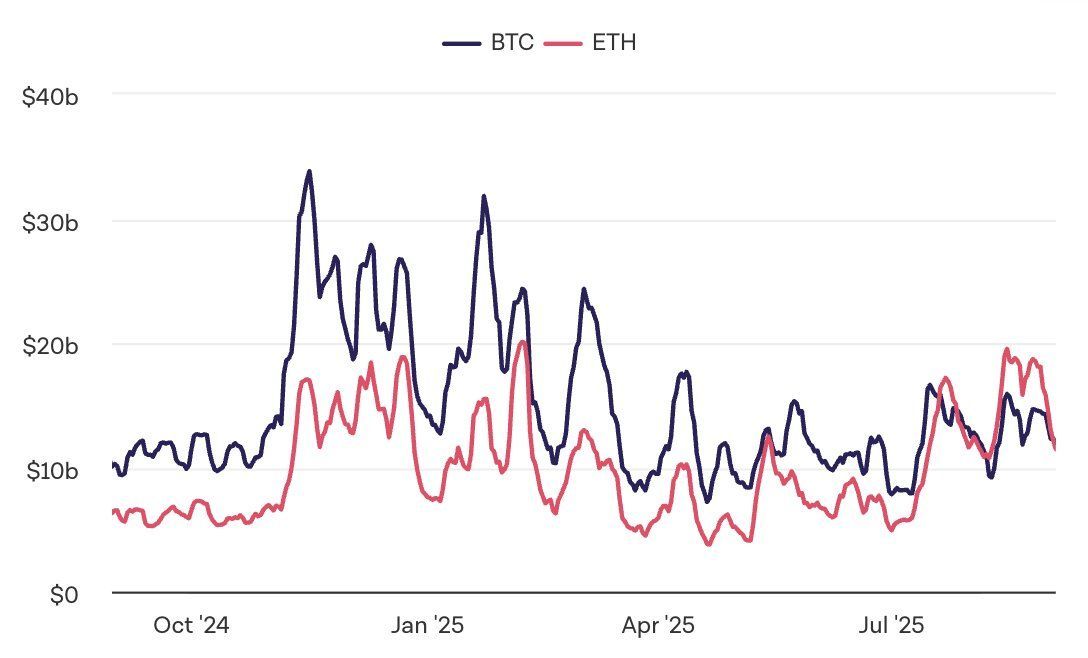
For the first time in 7 years, $ETH > $BTC in 7-day spot volume, per The Block. 🔁 👉 Bitcoin whales are rotating heavily into Ethereum.
With capital reallocating + rate cut anticipation, analysts now eye fresh ATHs in Q4 for majors.
#Ethereum #Bitcoin #cryptocurrency #blockchain
Carmelita
2025-09-04 16:37
🚨 Historic Shift on CEXs
Descargo de responsabilidad:Contiene contenido de terceros. No es asesoramiento financiero.
Consulte los Términos y Condiciones.
Cross-Chain Bridges Connecting Solana (SOL), Ethereum (ETH), and Avalanche (AVAX)
Understanding Cross-Chain Bridges in Blockchain Ecosystems
Cross-chain bridges are essential components of the modern blockchain landscape, enabling interoperability between different networks. They serve as connectors that facilitate the transfer of digital assets, such as tokens and NFTs, across diverse blockchain platforms. This capability is vital for expanding decentralized finance (DeFi) applications, enhancing liquidity, and fostering innovation within the crypto space.
By allowing users to move assets seamlessly from one blockchain to another, cross-chain bridges help overcome limitations inherent in isolated networks. For example, Ethereum’s widespread adoption often leads to congestion and high transaction fees. Bridging assets to faster or more scalable chains like Solana or Avalanche can mitigate these issues while maintaining access to a broad ecosystem of DeFi protocols.
Key Cross-Chain Bridges Supporting Solana and Ethereum
Several prominent protocols enable asset transfers between Solana (SOL) and Ethereum (ETH). These include Connext Network, Multichain, and Celer Network—each offering unique features tailored for security, scalability, and user experience.
Connext Network
Launched in 2020, Connext is a decentralized protocol supporting multiple blockchains including Solana and Ethereum. It facilitates fast asset transfers with low latency by leveraging state channels—a technology that allows transactions off-chain before settling on the main chain. Recently expanded support has increased its utility within DeFi markets by enabling seamless movement of tokens like USDC or wrapped ETH across these networks.
Multichain
Originally launched in 2021 under different branding but now known as Multichain—this protocol supports an extensive range of blockchains beyond just SOL and ETH. Its primary focus is on providing secure cross-chain asset transfers with minimal delays. Recent updates have improved scalability features significantly in 2024; this has attracted more developers seeking reliable infrastructure for multi-network DeFi applications.
Celer Network
Celer Network offers a suite of tools designed for building scalable cross-chain applications since its inception in 2020. It supports both Solana and Ethereum among other chains through its layer-2 scaling solutions called State Channels & Virtual Chains. The platform’s recent emphasis on scalability enhancements has led to increased adoption among DeFi projects aiming for high throughput without compromising security.
Connecting Solana with Avalanche: The Role of Specialized Bridges
While bridging SOL directly with ETH involves well-established protocols like Connext or Multichain, connecting Solana with Avalanche introduces additional options tailored specifically for interoperability between these two high-performance chains.
Avalanche Bridge: Native Solution for Asset Transfers
Launched by the Avalanche team in 2022, the Avalanche Bridge provides native support for transferring assets such as AVAX tokens between Avalanche’s network and other blockchains including Solana. Its design emphasizes security while ensuring quick transaction finality—making it popular among NFT marketplaces and DeFi platforms seeking efficient cross-platform liquidity flows.
Supporting Protocols: Connext & Multichain
Both Connext Network and Multichain extend their support beyond SOL-Ethereum interactions to include SOL-Avalanche transfers as well:
Connext offers decentralized solutions that prioritize security during asset migration.
Multichain ensures robust performance through continuous protocol upgrades aimed at improving scalability when moving assets across these chains.
These integrations allow users to leverage each network's strengths—such as Solana's speed or Avalanche's low fees—in their broader crypto activities.
Implications of Cross-Chain Connectivity
The development of interconnected ecosystems involving Solana, Ethereum, and Avalanche carries significant implications:
Enhanced Interoperability: Users can access diverse dApps spanning multiple networks without needing separate wallets or complex processes.
Increased Scalability: Transferring assets onto faster chains reduces congestion on congested networks like Ethereum during peak periods.
Broader Market Access: Asset mobility enables participation across various NFT marketplaces or DeFi protocols regardless of underlying blockchain constraints.
Security Considerations: While benefits are clear — especially regarding efficiency — risks associated with bridge exploits remain prevalent due to protocol complexity.
Regulatory Challenges: As cross-chain activity grows exponentially; regulators may scrutinize these mechanisms more closely due to potential misuse scenarios such as money laundering or unregulated token swaps.
Timeline Highlights & Recent Developments
Understanding key milestones helps contextualize current capabilities:
Connext was launched in 2020; recent updates have enhanced multi-assets support along with improved security features throughout 2023.
Multichain debuted officially around 2021; its latest upgrade cycle occurred early 2024 focusing heavily on scalability improvements which boosted user confidence.
Celer Network, also starting operations in late 2019/early 2020s’, focused heavily last year on increasing throughput capacity via layer-two scaling techniques.
Avalanche Bridge, introduced mid-last decade but saw significant growth after major updates rolled out into early this year—including expanded supported tokens facilitating broader use cases especially within NFT sectors.
Risks & Future Outlook
Despite promising advancements toward seamless interoperability among major blockchains like SOL/Ethereum/AVAX—the landscape isn’t without challenges:
Security vulnerabilities: Cross-chain bridges are complex systems susceptible to exploits if not properly secured—a concern highlighted by past incidents involving bridge hacks resulting in substantial losses.*
Regulatory environment: As governments worldwide develop frameworks governing digital assets’ transferability across borders—and increasingly scrutinize crypto exchanges—the regulatory landscape could impact how these bridges operate moving forward.*
Looking ahead:
The continued evolution will likely see further integration efforts driven by industry collaborations aiming at reducing risks while expanding functionality—for example through standardized protocols that enhance trustworthiness—and possibly integrating emerging technologies such as zk-rollups or optimistic rollups into bridge architectures.
By understanding how specific cross-chain bridges connect prominent blockchains like Solana (SOL), Ethereum (ETH),and Avalanche (AVAX), stakeholders—from developers to investors—can better navigate this rapidly evolving ecosystem while appreciating both opportunitiesand inherent risks involvedin multi-network operations
kai
2025-05-14 21:31
What cross-chain bridges connect Solana (SOL) with Ethereum (ETH) and Avalanche (AVAX)?
Cross-Chain Bridges Connecting Solana (SOL), Ethereum (ETH), and Avalanche (AVAX)
Understanding Cross-Chain Bridges in Blockchain Ecosystems
Cross-chain bridges are essential components of the modern blockchain landscape, enabling interoperability between different networks. They serve as connectors that facilitate the transfer of digital assets, such as tokens and NFTs, across diverse blockchain platforms. This capability is vital for expanding decentralized finance (DeFi) applications, enhancing liquidity, and fostering innovation within the crypto space.
By allowing users to move assets seamlessly from one blockchain to another, cross-chain bridges help overcome limitations inherent in isolated networks. For example, Ethereum’s widespread adoption often leads to congestion and high transaction fees. Bridging assets to faster or more scalable chains like Solana or Avalanche can mitigate these issues while maintaining access to a broad ecosystem of DeFi protocols.
Key Cross-Chain Bridges Supporting Solana and Ethereum
Several prominent protocols enable asset transfers between Solana (SOL) and Ethereum (ETH). These include Connext Network, Multichain, and Celer Network—each offering unique features tailored for security, scalability, and user experience.
Connext Network
Launched in 2020, Connext is a decentralized protocol supporting multiple blockchains including Solana and Ethereum. It facilitates fast asset transfers with low latency by leveraging state channels—a technology that allows transactions off-chain before settling on the main chain. Recently expanded support has increased its utility within DeFi markets by enabling seamless movement of tokens like USDC or wrapped ETH across these networks.
Multichain
Originally launched in 2021 under different branding but now known as Multichain—this protocol supports an extensive range of blockchains beyond just SOL and ETH. Its primary focus is on providing secure cross-chain asset transfers with minimal delays. Recent updates have improved scalability features significantly in 2024; this has attracted more developers seeking reliable infrastructure for multi-network DeFi applications.
Celer Network
Celer Network offers a suite of tools designed for building scalable cross-chain applications since its inception in 2020. It supports both Solana and Ethereum among other chains through its layer-2 scaling solutions called State Channels & Virtual Chains. The platform’s recent emphasis on scalability enhancements has led to increased adoption among DeFi projects aiming for high throughput without compromising security.
Connecting Solana with Avalanche: The Role of Specialized Bridges
While bridging SOL directly with ETH involves well-established protocols like Connext or Multichain, connecting Solana with Avalanche introduces additional options tailored specifically for interoperability between these two high-performance chains.
Avalanche Bridge: Native Solution for Asset Transfers
Launched by the Avalanche team in 2022, the Avalanche Bridge provides native support for transferring assets such as AVAX tokens between Avalanche’s network and other blockchains including Solana. Its design emphasizes security while ensuring quick transaction finality—making it popular among NFT marketplaces and DeFi platforms seeking efficient cross-platform liquidity flows.
Supporting Protocols: Connext & Multichain
Both Connext Network and Multichain extend their support beyond SOL-Ethereum interactions to include SOL-Avalanche transfers as well:
Connext offers decentralized solutions that prioritize security during asset migration.
Multichain ensures robust performance through continuous protocol upgrades aimed at improving scalability when moving assets across these chains.
These integrations allow users to leverage each network's strengths—such as Solana's speed or Avalanche's low fees—in their broader crypto activities.
Implications of Cross-Chain Connectivity
The development of interconnected ecosystems involving Solana, Ethereum, and Avalanche carries significant implications:
Enhanced Interoperability: Users can access diverse dApps spanning multiple networks without needing separate wallets or complex processes.
Increased Scalability: Transferring assets onto faster chains reduces congestion on congested networks like Ethereum during peak periods.
Broader Market Access: Asset mobility enables participation across various NFT marketplaces or DeFi protocols regardless of underlying blockchain constraints.
Security Considerations: While benefits are clear — especially regarding efficiency — risks associated with bridge exploits remain prevalent due to protocol complexity.
Regulatory Challenges: As cross-chain activity grows exponentially; regulators may scrutinize these mechanisms more closely due to potential misuse scenarios such as money laundering or unregulated token swaps.
Timeline Highlights & Recent Developments
Understanding key milestones helps contextualize current capabilities:
Connext was launched in 2020; recent updates have enhanced multi-assets support along with improved security features throughout 2023.
Multichain debuted officially around 2021; its latest upgrade cycle occurred early 2024 focusing heavily on scalability improvements which boosted user confidence.
Celer Network, also starting operations in late 2019/early 2020s’, focused heavily last year on increasing throughput capacity via layer-two scaling techniques.
Avalanche Bridge, introduced mid-last decade but saw significant growth after major updates rolled out into early this year—including expanded supported tokens facilitating broader use cases especially within NFT sectors.
Risks & Future Outlook
Despite promising advancements toward seamless interoperability among major blockchains like SOL/Ethereum/AVAX—the landscape isn’t without challenges:
Security vulnerabilities: Cross-chain bridges are complex systems susceptible to exploits if not properly secured—a concern highlighted by past incidents involving bridge hacks resulting in substantial losses.*
Regulatory environment: As governments worldwide develop frameworks governing digital assets’ transferability across borders—and increasingly scrutinize crypto exchanges—the regulatory landscape could impact how these bridges operate moving forward.*
Looking ahead:
The continued evolution will likely see further integration efforts driven by industry collaborations aiming at reducing risks while expanding functionality—for example through standardized protocols that enhance trustworthiness—and possibly integrating emerging technologies such as zk-rollups or optimistic rollups into bridge architectures.
By understanding how specific cross-chain bridges connect prominent blockchains like Solana (SOL), Ethereum (ETH),and Avalanche (AVAX), stakeholders—from developers to investors—can better navigate this rapidly evolving ecosystem while appreciating both opportunitiesand inherent risks involvedin multi-network operations
Descargo de responsabilidad:Contiene contenido de terceros. No es asesoramiento financiero.
Consulte los Términos y Condiciones.
Début de mois = possible dip 📉 2ᵉ moitié = éventuelle étincelle si la Fed coupe les taux 🔥
👉 Septembre pourrait être le mois pour se positionner avant le prochain leg haussier. 🚀
#Ethereum #crypto
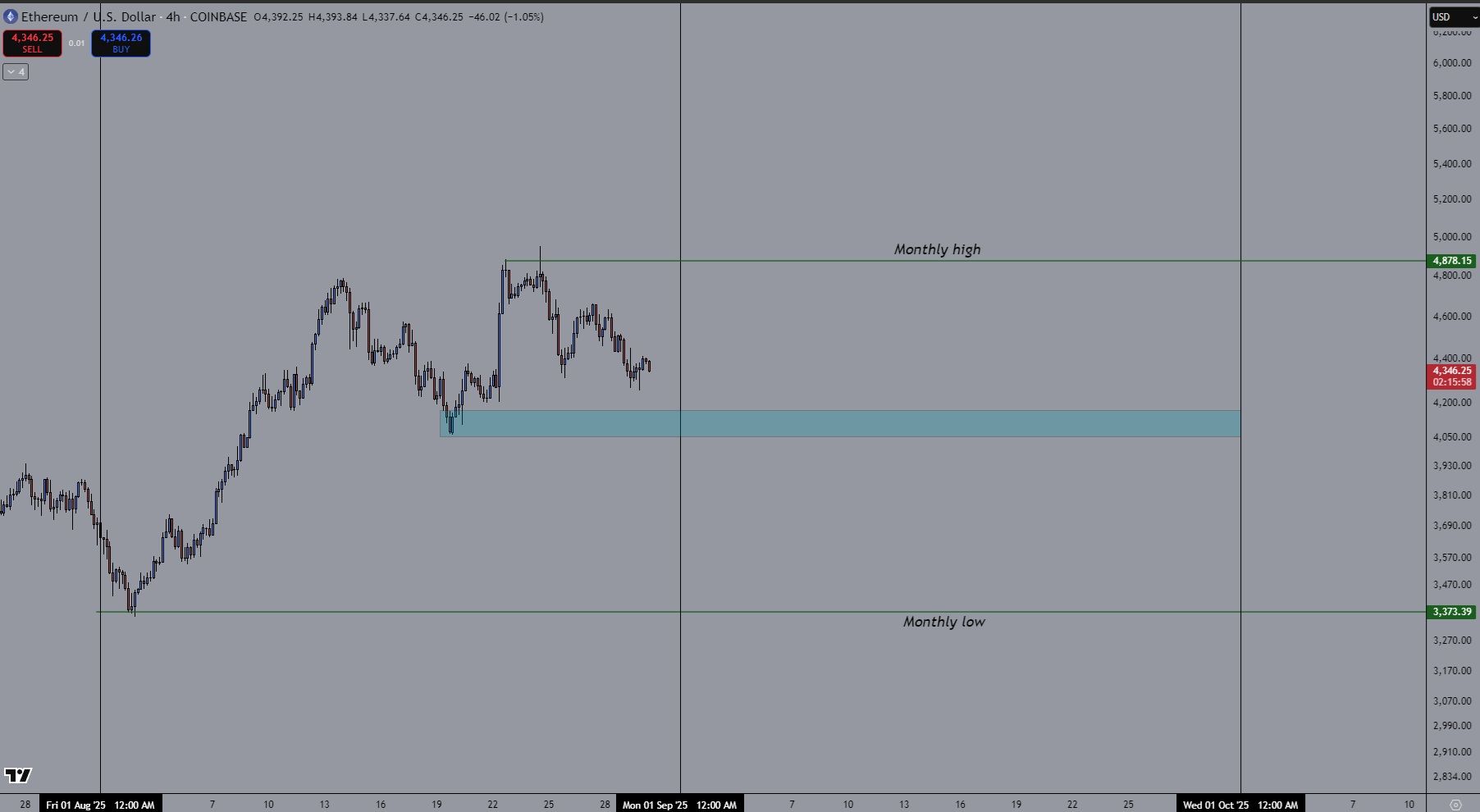
Carmelita
2025-08-30 23:40
$ETH – Septembre en ligne de mire
Descargo de responsabilidad:Contiene contenido de terceros. No es asesoramiento financiero.
Consulte los Términos y Condiciones.
Fundstrat's Tom Lee, the strategist who correctly called Bitcoin's 2017 surge, has made his boldest prediction yet: Ethereum could hit $15,000 by year-end 2025. His conviction is backed by BitMine Immersion Technologies' record-breaking $5 billion ETH treasury accumulation.
💰 The Bold Investment Thesis:
-
Price Target: $4K by July, $10K-$15K by year-end 2025 (400% upside potential)
Corporate Treasury: 1.15 million ETH ($5B) - world's largest corporate Ethereum position
Growth Strategy: Targeting 5% of total ETH supply (~6 million tokens worth $25B+)
Market Driver: Stablecoin explosion from $250B to $2T market cap
🎯 Key Catalysts Driving the Prediction:
1️⃣ Stablecoin Dominance: Ethereum powers 60%+ of all stablecoin transactions - the "ChatGPT moment" for crypto adoption 2️⃣ Wall Street's Choice: Institutions prefer Ethereum for regulatory compliance and established infrastructure 3️⃣ Real-World Assets: 60% market share in asset tokenization as traditional finance goes digital 4️⃣ Treasury Strategy: BitMine accumulating ETH 12x faster than MicroStrategy's Bitcoin pace
🏆 BitMine's Aggressive Accumulation:
-
Holdings: 1.15M ETH worth ~$5B (targeting 5% of total supply)
Stock Performance: BMNR up 634% year-to-date
Trading Volume: $1.6B daily, rivaling major corporations
Expansion: $24.5B equity offering for additional acquisitions
Staking Rewards: Earning ~3% annual yields on ETH holdings
💡 The "Digital Infrastructure" Thesis:
Why ETH > BTC for Institutions:
-
Bitcoin = Digital Gold (store of value)
Ethereum = Financial Infrastructure (powers the digital economy)
Stablecoins creating viral adoption among banks, merchants, consumers
JPMorgan, Visa, Robinhood building on Ethereum infrastructure
🔥 Technical Analysis & Targets:
-
Immediate: $4,000 breakout level (July 2025)
Historical Ratio: ETH/BTC returning to 2017 peak suggests $16,000 potential
Fundamental Value: Circle's 100x EBITDA multiple applied to Ethereum = $10K+ fair value
Network Effects: 10-year operational history without downtime = institutional confidence
📊 Market Transformation Indicators:
-
Stablecoin Growth: 8x expansion potential ($250B → $2T)
Fee Revenue: 10x network fee growth from increased usage
Regulatory Support: GENIUS Act providing legal framework
Corporate Adoption: Treasury strategies becoming mainstream
⚠️ Investment Considerations:
Opportunities:
-
Leveraged exposure through BitMine stock (BMNR)
Direct ETH investment at potentially attractive entry points
1-2% portfolio allocation recommended for conservative investors
Risks:
-
Blockchain competition (Solana, others offering faster/cheaper alternatives)
Regulatory uncertainties around stablecoins
Market volatility (30-50% drawdowns possible)
Layer 2 scaling potentially reducing Layer 1 value capture
💎 Bottom Line:
Tom Lee's $15K Ethereum prediction isn't just price speculation—it's a thesis about Ethereum becoming the backbone of digitized traditional finance. With BitMine's $5B bet and stablecoin adoption accelerating, Ethereum could experience its "Bitcoin 2017 moment" driven by institutional adoption rather than retail speculation.
The strategy mirrors MicroStrategy's Bitcoin approach but focuses on Ethereum's unique utility in powering the next generation of financial infrastructure. Success depends on continued stablecoin growth and real-world asset tokenization dominance.
Read the complete analysis and investment strategy breakdown: 👇 https://blog.jucoin.com/tom-lee-ethereum-prediction/
#Ethereum #TomLee #BitMine
JU Blog
2025-08-13 07:50
🚀 Wall Street Legend Tom Lee Predicts Ethereum $15K by 2025 with $5B Corporate Bet!
Descargo de responsabilidad:Contiene contenido de terceros. No es asesoramiento financiero.
Consulte los Términos y Condiciones.
How the Beacon Chain Coordinates Validator Duties and Shard Transitions in Ethereum
Understanding how Ethereum's Beacon Chain manages validator responsibilities and facilitates shard transitions is essential for grasping the network’s ongoing evolution toward scalability and security. As part of Ethereum 2.0, the Beacon Chain introduces a new proof-of-stake (PoS) consensus mechanism that replaces traditional proof-of-work (PoW). This shift aims to make the network more sustainable, efficient, and capable of handling increased transaction volumes through sharding.
The Role of the Beacon Chain in Validator Coordination
The Beacon Chain acts as the backbone for validator management within Ethereum 2.0. Validators are responsible for proposing new blocks, validating transactions, and maintaining network security. Unlike miners in PoW systems, validators are chosen based on their staked ETH—meaning their financial commitment directly influences their chances of participating in block creation.
Validator selection is governed by a randomized process that ensures fairness while incentivizing honest participation. When selected to propose a block during a specific slot—a fixed time interval—the validator must create or validate transactions within that window. To prevent malicious activities such as double proposals or equivocation, Ethereum employs slashing mechanisms: if validators act dishonestly or fail to perform duties correctly, they risk losing part or all of their staked ETH.
The Beacon Chain organizes these activities into epochs—larger time frames composed of multiple slots (typically 32). Each epoch allows for validator rotations and updates to be processed systematically, ensuring smooth operation across the entire network.
Managing Shard Transitions for Scalability
One of Ethereum 2.0’s primary goals is scalability through sharding—a technique where the blockchain is split into smaller pieces called shards that operate concurrently. Each shard handles its own subset of transactions and smart contracts, significantly increasing overall throughput compared to a single monolithic chain.
Shard transitions involve several key steps:
- Initialization: The Beacon Chain assigns validators to different shards based on current network needs.
- Activation Phases: Shards are gradually activated through phased rollouts—initially testing shard functionality via dedicated testnets like the Shard Canary Network launched in 2023.
- Data Migration: During transition phases, data from existing chains migrates into shards seamlessly without disrupting ongoing operations.
- Cross-Linking Mechanisms: To enable communication between shards—such as transferring assets or verifying cross-shard data—the protocol implements cross-linking structures that connect individual shard chains back to the main chain.
This architecture allows multiple transactions across different shards simultaneously without bottlenecking at one point—a significant improvement over traditional blockchain models prone to congestion during high demand periods.
Recent Developments Supporting Validator Coordination & Sharding
Ethereum's recent advancements underscore its commitment toward achieving full scalability with robust security measures:
Shard Canary Network (SCN): Launched in 2023 as an experimental environment for testing shard functionalities under real-world conditions before deploying on mainnet.
Mainnet Merge: Expected late 2023 or early 2024 marks a pivotal milestone where Ethereum will combine its existing PoW mainnet with the PoS-based Beacon Chain—a process known as "the Merge." This event will fully transition validation duties onto PoS while integrating sharding features progressively afterward.
These developments demonstrate continuous progress towards decentralization and efficiency but also highlight technical challenges such as ensuring secure cross-shard communication and maintaining validator incentives throughout complex upgrades.
Challenges Facing Validator Coordination & Shard Transition
While promising, transitioning from traditional blockchain architectures involves notable hurdles:
Technical Complexity: Implementing seamless communication between numerous shards requires sophisticated protocols; any vulnerabilities could compromise security.
Validator Participation Rates: The success hinges on active validator engagement; low participation could slow down progress or cause instability.
Network Security Risks: As complexity increases with sharding—and especially during transitional phases—the attack surface expands if not properly managed.
Regulatory Uncertainty: Evolving legal frameworks around cryptocurrencies may influence adoption rates among validators and users alike.
Addressing these issues demands rigorous testing—including testnets like SCN—and community support aligned with long-term development goals.
Key Facts About Ethereum’s Transition Timeline
| Event | Date/Expected Timeline | Significance |
|---|---|---|
| Launch of Beacon Chain | December 2020 | Foundation layer supporting staking |
| Launch of Shard Canary Network | 2023 | Testing environment for shard functionality |
| Expected Mainnet Merge | Late 2023 / Early 2024 | Full transition from PoW to PoS |
As these milestones approach, stakeholders closely monitor progress due to their impact on scalability improvements and overall network health.
Monitoring Future Developments in Validator Management & Sharding
Ethereum’s journey towards full-scale adoption relies heavily on effective coordination mechanisms provided by its consensus layer—the Beacon Chain—and successful implementation of sharding technology. Continuous upgrades aim not only at increasing transaction capacity but also at reinforcing decentralization by enabling more participants worldwide to become validators securely.
Staying informed about upcoming updates like protocol upgrades or testnet launches helps users understand how these changes might influence transaction speeds, costs (gas fees), security assurances, and overall user experience within this rapidly evolving ecosystem.
Final Thoughts: Navigating Growth Through Innovation
Ethereum's innovative approach via its beacon chain architecture exemplifies how layered coordination can transform blockchain networks into scalable platforms capable of supporting global applications—from decentralized finance (DeFi) projects to enterprise solutions—all while maintaining high-security standards through proof-of-stake validation processes combined with advanced sharding techniques.
By understanding how validator duties are managed alongside complex shard transitions—and keeping an eye on upcoming milestones—you can better appreciate both current capabilities and future potentialities shaping one of today’s most influential blockchain ecosystems
JCUSER-F1IIaxXA
2025-05-11 06:19
How does the Beacon Chain coordinate validator duties and shard transitions in Ethereum (ETH)?
How the Beacon Chain Coordinates Validator Duties and Shard Transitions in Ethereum
Understanding how Ethereum's Beacon Chain manages validator responsibilities and facilitates shard transitions is essential for grasping the network’s ongoing evolution toward scalability and security. As part of Ethereum 2.0, the Beacon Chain introduces a new proof-of-stake (PoS) consensus mechanism that replaces traditional proof-of-work (PoW). This shift aims to make the network more sustainable, efficient, and capable of handling increased transaction volumes through sharding.
The Role of the Beacon Chain in Validator Coordination
The Beacon Chain acts as the backbone for validator management within Ethereum 2.0. Validators are responsible for proposing new blocks, validating transactions, and maintaining network security. Unlike miners in PoW systems, validators are chosen based on their staked ETH—meaning their financial commitment directly influences their chances of participating in block creation.
Validator selection is governed by a randomized process that ensures fairness while incentivizing honest participation. When selected to propose a block during a specific slot—a fixed time interval—the validator must create or validate transactions within that window. To prevent malicious activities such as double proposals or equivocation, Ethereum employs slashing mechanisms: if validators act dishonestly or fail to perform duties correctly, they risk losing part or all of their staked ETH.
The Beacon Chain organizes these activities into epochs—larger time frames composed of multiple slots (typically 32). Each epoch allows for validator rotations and updates to be processed systematically, ensuring smooth operation across the entire network.
Managing Shard Transitions for Scalability
One of Ethereum 2.0’s primary goals is scalability through sharding—a technique where the blockchain is split into smaller pieces called shards that operate concurrently. Each shard handles its own subset of transactions and smart contracts, significantly increasing overall throughput compared to a single monolithic chain.
Shard transitions involve several key steps:
- Initialization: The Beacon Chain assigns validators to different shards based on current network needs.
- Activation Phases: Shards are gradually activated through phased rollouts—initially testing shard functionality via dedicated testnets like the Shard Canary Network launched in 2023.
- Data Migration: During transition phases, data from existing chains migrates into shards seamlessly without disrupting ongoing operations.
- Cross-Linking Mechanisms: To enable communication between shards—such as transferring assets or verifying cross-shard data—the protocol implements cross-linking structures that connect individual shard chains back to the main chain.
This architecture allows multiple transactions across different shards simultaneously without bottlenecking at one point—a significant improvement over traditional blockchain models prone to congestion during high demand periods.
Recent Developments Supporting Validator Coordination & Sharding
Ethereum's recent advancements underscore its commitment toward achieving full scalability with robust security measures:
Shard Canary Network (SCN): Launched in 2023 as an experimental environment for testing shard functionalities under real-world conditions before deploying on mainnet.
Mainnet Merge: Expected late 2023 or early 2024 marks a pivotal milestone where Ethereum will combine its existing PoW mainnet with the PoS-based Beacon Chain—a process known as "the Merge." This event will fully transition validation duties onto PoS while integrating sharding features progressively afterward.
These developments demonstrate continuous progress towards decentralization and efficiency but also highlight technical challenges such as ensuring secure cross-shard communication and maintaining validator incentives throughout complex upgrades.
Challenges Facing Validator Coordination & Shard Transition
While promising, transitioning from traditional blockchain architectures involves notable hurdles:
Technical Complexity: Implementing seamless communication between numerous shards requires sophisticated protocols; any vulnerabilities could compromise security.
Validator Participation Rates: The success hinges on active validator engagement; low participation could slow down progress or cause instability.
Network Security Risks: As complexity increases with sharding—and especially during transitional phases—the attack surface expands if not properly managed.
Regulatory Uncertainty: Evolving legal frameworks around cryptocurrencies may influence adoption rates among validators and users alike.
Addressing these issues demands rigorous testing—including testnets like SCN—and community support aligned with long-term development goals.
Key Facts About Ethereum’s Transition Timeline
| Event | Date/Expected Timeline | Significance |
|---|---|---|
| Launch of Beacon Chain | December 2020 | Foundation layer supporting staking |
| Launch of Shard Canary Network | 2023 | Testing environment for shard functionality |
| Expected Mainnet Merge | Late 2023 / Early 2024 | Full transition from PoW to PoS |
As these milestones approach, stakeholders closely monitor progress due to their impact on scalability improvements and overall network health.
Monitoring Future Developments in Validator Management & Sharding
Ethereum’s journey towards full-scale adoption relies heavily on effective coordination mechanisms provided by its consensus layer—the Beacon Chain—and successful implementation of sharding technology. Continuous upgrades aim not only at increasing transaction capacity but also at reinforcing decentralization by enabling more participants worldwide to become validators securely.
Staying informed about upcoming updates like protocol upgrades or testnet launches helps users understand how these changes might influence transaction speeds, costs (gas fees), security assurances, and overall user experience within this rapidly evolving ecosystem.
Final Thoughts: Navigating Growth Through Innovation
Ethereum's innovative approach via its beacon chain architecture exemplifies how layered coordination can transform blockchain networks into scalable platforms capable of supporting global applications—from decentralized finance (DeFi) projects to enterprise solutions—all while maintaining high-security standards through proof-of-stake validation processes combined with advanced sharding techniques.
By understanding how validator duties are managed alongside complex shard transitions—and keeping an eye on upcoming milestones—you can better appreciate both current capabilities and future potentialities shaping one of today’s most influential blockchain ecosystems
Descargo de responsabilidad:Contiene contenido de terceros. No es asesoramiento financiero.
Consulte los Términos y Condiciones.
➡️ Achat de 2,588 $BTC/USDT pour 258,8 M$ 🟢 ➡️ Vente de 35,009 $ETH/USDT pour 152,7 M$ 🔴
Un rééquilibrage massif qui en dit long sur leur vision court-terme du marché. 👀
#Bitcoin #Ethereum #cryptocurrency #blockchain

Carmelita
2025-09-04 13:11
🔥 Mouvement stratégique de BlackRock aujourd’hui
Descargo de responsabilidad:Contiene contenido de terceros. No es asesoramiento financiero.
Consulte los Términos y Condiciones.
$TRX/USDT : ~$82B |$SOL/USDT : ~$34B
Le TVL des écosystèmes révèle où le vrai capital circule. Suivez les flux et soyez prêts pour la prochaine opportunité. 👀
#Ethereum #CryptoInsights #cryptocurrency #blockchain
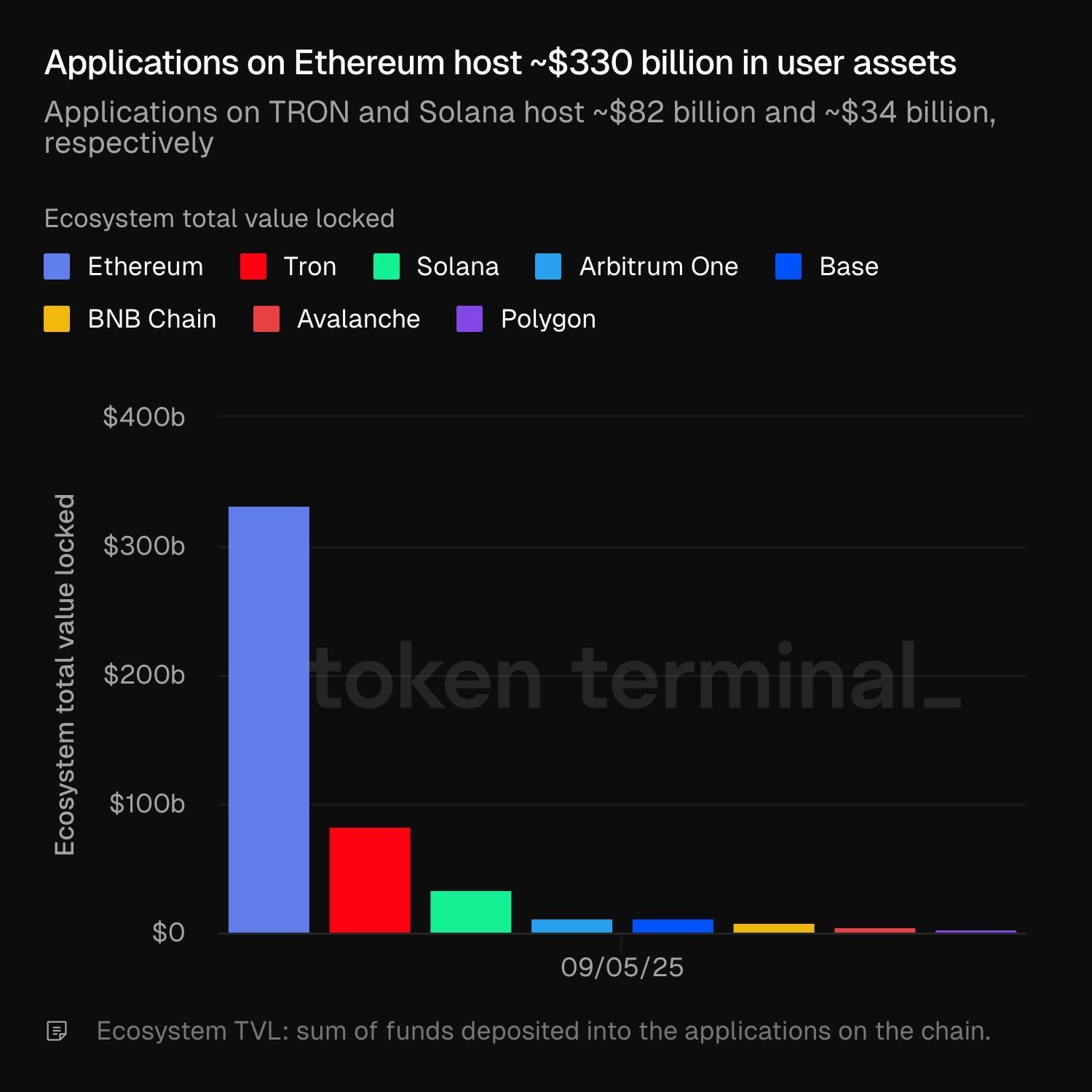
Carmelita
2025-09-06 16:53
🔥 Ethereum domine le game !
Descargo de responsabilidad:Contiene contenido de terceros. No es asesoramiento financiero.
Consulte los Términos y Condiciones.
Platforms Supporting Smart Contracts: A Comprehensive Overview
Smart contracts are transforming the way digital agreements are created, executed, and enforced. These self-executing contracts, embedded with code that automatically enforces terms, rely heavily on blockchain platforms to operate securely and efficiently. Understanding which platforms support smart contracts—and their unique features—is essential for developers, investors, and enthusiasts aiming to navigate the decentralized ecosystem effectively.
What Are Smart Contracts?
Smart contracts are programmable agreements that automatically execute predefined actions once certain conditions are met. Unlike traditional contracts requiring intermediaries such as lawyers or banks for enforcement, smart contracts leverage blockchain technology's transparency and immutability to ensure trustless execution. They can facilitate a wide range of applications—from simple token transfers to complex financial derivatives—making them foundational components of decentralized applications (dApps).
The Role of Blockchain Platforms in Supporting Smart Contracts
Blockchain platforms serve as the infrastructure enabling smart contract deployment and execution. These platforms provide the necessary programming environments, consensus mechanisms, security protocols, and interoperability features crucial for building scalable dApps across various industries like finance (DeFi), gaming, supply chain management, and more.
Different blockchain networks offer varying capabilities regarding smart contract support—some focus on scalability and speed; others emphasize security or interoperability. As a result, selecting an appropriate platform depends on project requirements such as transaction throughput needs or compatibility with existing systems.
Leading Blockchain Platforms Supporting Smart Contracts
Ethereum: The Pioneer in Smart Contract Support
Launched in 2015 by Vitalik Buterin, Ethereum is widely regarded as the first blockchain platform designed explicitly for supporting smart contracts at scale. Its robust ecosystem has fostered countless innovations within DeFi (Decentralized Finance), NFTs (Non-Fungible Tokens), gaming dApps—and continues to be a dominant force despite scalability challenges.
Ethereum’s programming language Solidity allows developers to write complex logic into their smart contracts easily. Its proof-of-work consensus mechanism initially provided security but faced criticism over energy consumption issues—a concern addressed by its ongoing transition toward Ethereum 2.0’s proof-of-stake model aimed at improving scalability while reducing environmental impact.
Binance Smart Chain: Fast & Cost-Effective Alternative
Developed by Binance in 2020 as an alternative to Ethereum’s network congestion issues—such as high gas fees—Binance Smart Chain (BSC) offers faster transaction speeds coupled with lower costs without sacrificing compatibility with existing tools like MetaMask or Remix IDE.
BSC supports Solidity-based smart contracts similar to Ethereum but benefits from a delegated proof-of-stake consensus algorithm that enhances throughput efficiency. This makes BSC particularly attractive for developers seeking rapid deployment cycles or users prioritizing low-cost transactions within DeFi projects or NFT marketplaces.
Polkadot: Enabling Interoperability Between Blockchains
Polkadot introduces a novel approach by facilitating communication between different blockchains through its parachain architecture—a network of parallel chains connected via relay chains ensuring shared security and data transfer capabilities.
Supporting multiple languages—including ink! (Rust-based)—Polkadot enables deploying interoperable smart contracts across diverse ecosystems simultaneously. This cross-chain functionality addresses one of blockchain technology's critical limitations: siloed networks unable to communicate seamlessly—a barrier hindering widespread adoption of decentralized solutions.
Solana: High-Performance Blockchain for Scalability
Designed specifically for high-throughput applications like DeFi protocols or NFT marketplaces requiring rapid transaction processing—Solana employs innovative Proof-of-Stake combined with Proof-of-History mechanisms allowing it to process thousands of transactions per second with minimal latency.
Developers can write Solana programs using Rust or C language frameworks; this flexibility has led many projects seeking scalable solutions away from congested networks like Ethereum towards Solana’s fast environment suitable for real-time applications such as gaming dApps or high-frequency trading platforms.
Cardano: Focused on Security & Scalability
Cardano emphasizes formal verification methods rooted in academic research principles aimed at creating highly secure yet scalable blockchain infrastructure capable of supporting complex decentralized apps over time confidently.Its native scripting language Plutus enables writing secure smart contract logic based on Haskell—a functional programming language known for robustness against bugs.Recent developments include launching sidechains that extend Cardano's capabilities further while maintaining core decentralization principles vital for enterprise-grade deployments across sectors including finance and healthcare sectors needing compliant solutions aligned with regulatory standards globally.
How Do These Platforms Differ?
While all these platforms support deploying self-executing code via their respective ecosystems—their differences lie mainly in:
- Consensus algorithms (Proof-of-Work vs Proof-of-Stake vs Delegated Stake)
- Transaction speeds
- Cost structures
- Interoperability features
- Programming languages supported
For example:Ethereum remains dominant due to its extensive developer community but faces scalability hurdles.Binance Smart Chain offers speed at lower costs but may compromise some decentralization aspects.Polkadot excels at cross-chain communication but is relatively newer.Solana, known for speed; however it faces concerns about network stability during peak loads.Cardano, emphasizing formal verification ensures higher assurance levels suitable especially where compliance matters.
Challenges Facing Platform Adoption
Despite technological advancements supporting smarter contract deployment:
- Security vulnerabilities remain prevalent; poorly written code can lead to exploits causing significant financial losses—as seen in past hacks involving flash loan attacks.
- Scalability constraints continue limiting user experience during peak demand periods leading developers toward layer-two solutions like rollups.
- The evolving regulatory landscape adds uncertainty around compliance requirements affecting how these technologies develop long-term strategies.
- Interoperability remains an ongoing challenge; seamless communication among diverse blockchains is crucial yet still under active development.
Future Outlook & Industry Trends
The future points toward increasingly sophisticated multi-chain ecosystems where interoperability becomes standard rather than exception—with projects like Polkadot leading this charge—and improvements in scalability through Layer 2 solutions integrated into mainnets will likely address current bottlenecks significantly.
Furthermore:
- Transition phases such as Ethereum 2.o's move from PoW/PoS hybrid models will reshape network performance.
- Growing emphasis on security audits will enhance trustworthiness among users engaging with complex dApps
- Regulatory clarity could foster broader institutional adoption beyond crypto-native communities
Key Takeaways
Understanding which blockchain platforms support smart contracts involves evaluating factors such as speed requirements, cost considerations, security needs,and interoperability goals:
- Ethereum remains the most established platform, offering extensive developer resources despite facing scaling challenges;
- Binance Smart Chain provides faster transactions at lower fees, making it popular among DeFi startups;
- Polkadot facilitates cross-chain interactions, opening new opportunities across multiple ecosystems;
- Solana delivers high throughput idealfor real-time apps, though stability concerns persist;
- Cardano emphasizes formal methods ensuring secure deployments, suited especially where compliance matters most.
By aligning project goals with each platform’s strengths—and staying informed about ongoing upgrades—the industry can harness these technologies' full potential while addressing inherent limitations responsibly.
This overview aims not only to inform readers about current options supporting smart contract development but also highlights emerging trends shaping future innovations within this rapidly evolving field — empowering stakeholders across industries committed towards building transparent,decentralized systems grounded firmly in proven technological foundations..
Lo
2025-05-14 05:59
Which platforms support smart contracts?
Platforms Supporting Smart Contracts: A Comprehensive Overview
Smart contracts are transforming the way digital agreements are created, executed, and enforced. These self-executing contracts, embedded with code that automatically enforces terms, rely heavily on blockchain platforms to operate securely and efficiently. Understanding which platforms support smart contracts—and their unique features—is essential for developers, investors, and enthusiasts aiming to navigate the decentralized ecosystem effectively.
What Are Smart Contracts?
Smart contracts are programmable agreements that automatically execute predefined actions once certain conditions are met. Unlike traditional contracts requiring intermediaries such as lawyers or banks for enforcement, smart contracts leverage blockchain technology's transparency and immutability to ensure trustless execution. They can facilitate a wide range of applications—from simple token transfers to complex financial derivatives—making them foundational components of decentralized applications (dApps).
The Role of Blockchain Platforms in Supporting Smart Contracts
Blockchain platforms serve as the infrastructure enabling smart contract deployment and execution. These platforms provide the necessary programming environments, consensus mechanisms, security protocols, and interoperability features crucial for building scalable dApps across various industries like finance (DeFi), gaming, supply chain management, and more.
Different blockchain networks offer varying capabilities regarding smart contract support—some focus on scalability and speed; others emphasize security or interoperability. As a result, selecting an appropriate platform depends on project requirements such as transaction throughput needs or compatibility with existing systems.
Leading Blockchain Platforms Supporting Smart Contracts
Ethereum: The Pioneer in Smart Contract Support
Launched in 2015 by Vitalik Buterin, Ethereum is widely regarded as the first blockchain platform designed explicitly for supporting smart contracts at scale. Its robust ecosystem has fostered countless innovations within DeFi (Decentralized Finance), NFTs (Non-Fungible Tokens), gaming dApps—and continues to be a dominant force despite scalability challenges.
Ethereum’s programming language Solidity allows developers to write complex logic into their smart contracts easily. Its proof-of-work consensus mechanism initially provided security but faced criticism over energy consumption issues—a concern addressed by its ongoing transition toward Ethereum 2.0’s proof-of-stake model aimed at improving scalability while reducing environmental impact.
Binance Smart Chain: Fast & Cost-Effective Alternative
Developed by Binance in 2020 as an alternative to Ethereum’s network congestion issues—such as high gas fees—Binance Smart Chain (BSC) offers faster transaction speeds coupled with lower costs without sacrificing compatibility with existing tools like MetaMask or Remix IDE.
BSC supports Solidity-based smart contracts similar to Ethereum but benefits from a delegated proof-of-stake consensus algorithm that enhances throughput efficiency. This makes BSC particularly attractive for developers seeking rapid deployment cycles or users prioritizing low-cost transactions within DeFi projects or NFT marketplaces.
Polkadot: Enabling Interoperability Between Blockchains
Polkadot introduces a novel approach by facilitating communication between different blockchains through its parachain architecture—a network of parallel chains connected via relay chains ensuring shared security and data transfer capabilities.
Supporting multiple languages—including ink! (Rust-based)—Polkadot enables deploying interoperable smart contracts across diverse ecosystems simultaneously. This cross-chain functionality addresses one of blockchain technology's critical limitations: siloed networks unable to communicate seamlessly—a barrier hindering widespread adoption of decentralized solutions.
Solana: High-Performance Blockchain for Scalability
Designed specifically for high-throughput applications like DeFi protocols or NFT marketplaces requiring rapid transaction processing—Solana employs innovative Proof-of-Stake combined with Proof-of-History mechanisms allowing it to process thousands of transactions per second with minimal latency.
Developers can write Solana programs using Rust or C language frameworks; this flexibility has led many projects seeking scalable solutions away from congested networks like Ethereum towards Solana’s fast environment suitable for real-time applications such as gaming dApps or high-frequency trading platforms.
Cardano: Focused on Security & Scalability
Cardano emphasizes formal verification methods rooted in academic research principles aimed at creating highly secure yet scalable blockchain infrastructure capable of supporting complex decentralized apps over time confidently.Its native scripting language Plutus enables writing secure smart contract logic based on Haskell—a functional programming language known for robustness against bugs.Recent developments include launching sidechains that extend Cardano's capabilities further while maintaining core decentralization principles vital for enterprise-grade deployments across sectors including finance and healthcare sectors needing compliant solutions aligned with regulatory standards globally.
How Do These Platforms Differ?
While all these platforms support deploying self-executing code via their respective ecosystems—their differences lie mainly in:
- Consensus algorithms (Proof-of-Work vs Proof-of-Stake vs Delegated Stake)
- Transaction speeds
- Cost structures
- Interoperability features
- Programming languages supported
For example:Ethereum remains dominant due to its extensive developer community but faces scalability hurdles.Binance Smart Chain offers speed at lower costs but may compromise some decentralization aspects.Polkadot excels at cross-chain communication but is relatively newer.Solana, known for speed; however it faces concerns about network stability during peak loads.Cardano, emphasizing formal verification ensures higher assurance levels suitable especially where compliance matters.
Challenges Facing Platform Adoption
Despite technological advancements supporting smarter contract deployment:
- Security vulnerabilities remain prevalent; poorly written code can lead to exploits causing significant financial losses—as seen in past hacks involving flash loan attacks.
- Scalability constraints continue limiting user experience during peak demand periods leading developers toward layer-two solutions like rollups.
- The evolving regulatory landscape adds uncertainty around compliance requirements affecting how these technologies develop long-term strategies.
- Interoperability remains an ongoing challenge; seamless communication among diverse blockchains is crucial yet still under active development.
Future Outlook & Industry Trends
The future points toward increasingly sophisticated multi-chain ecosystems where interoperability becomes standard rather than exception—with projects like Polkadot leading this charge—and improvements in scalability through Layer 2 solutions integrated into mainnets will likely address current bottlenecks significantly.
Furthermore:
- Transition phases such as Ethereum 2.o's move from PoW/PoS hybrid models will reshape network performance.
- Growing emphasis on security audits will enhance trustworthiness among users engaging with complex dApps
- Regulatory clarity could foster broader institutional adoption beyond crypto-native communities
Key Takeaways
Understanding which blockchain platforms support smart contracts involves evaluating factors such as speed requirements, cost considerations, security needs,and interoperability goals:
- Ethereum remains the most established platform, offering extensive developer resources despite facing scaling challenges;
- Binance Smart Chain provides faster transactions at lower fees, making it popular among DeFi startups;
- Polkadot facilitates cross-chain interactions, opening new opportunities across multiple ecosystems;
- Solana delivers high throughput idealfor real-time apps, though stability concerns persist;
- Cardano emphasizes formal methods ensuring secure deployments, suited especially where compliance matters most.
By aligning project goals with each platform’s strengths—and staying informed about ongoing upgrades—the industry can harness these technologies' full potential while addressing inherent limitations responsibly.
This overview aims not only to inform readers about current options supporting smart contract development but also highlights emerging trends shaping future innovations within this rapidly evolving field — empowering stakeholders across industries committed towards building transparent,decentralized systems grounded firmly in proven technological foundations..
Descargo de responsabilidad:Contiene contenido de terceros. No es asesoramiento financiero.
Consulte los Términos y Condiciones.