
Ju.com: Redefining the Future of Digital Trading
In a crypto world crowded with exchanges and endless promises, Ju.com stands out as a platform that has steadily evolved from its early roots into a full digital asset ecosystem. Once known as JuCoin, the company has reintroduced itself to the world under a new identity — Ju.com — signaling a bold step toward bridging traditional finance and decentralized technology.
From JuCoin to Ju.com
Ju.com began its journey as JuCoin in 2013, making it one of the early players in the global cryptocurrency exchange scene. Over the years, JuCoin gained recognition for offering reliable trading services and access to a wide range of crypto assets. But in 2025, the company decided to go further, rebranding as Ju.com to represent a broader vision that extends beyond trading.
The rebrand was more than a name change. It came with a new philosophy centered on simplicity, accessibility, and innovation. Ju.com’s campaign, themed around transforming “IMPOSSIBLE” into “I’M POSSIBLE,” reflects its mission to make crypto trading easier for everyone. The updated platform is built to give users a seamless experience that combines centralized exchange services with decentralized finance tools.
The Vision Behind Ju.com
Ju.com is built on a simple but powerful idea: that crypto trading should be easy enough for anyone to participate in, without sacrificing performance or security. The company describes its approach with the phrase “Point. Click. Trade.” — a design mindset focused on eliminating unnecessary complexity while preserving advanced trading functionality.
Beyond simplicity, Ju.com aims to bridge the gap between centralized finance (CeFi) and decentralized finance (DeFi). The platform supports traditional trading pairs, futures, and derivatives, while also integrating a Web3 wallet that allows users to interact with decentralized applications and DeFi protocols. This dual structure enables users to move between centralized and decentralized environments without switching platforms.
What Ju.com Offers
Ju.com’s ecosystem covers nearly every aspect of digital asset management. The platform provides spot trading, futures trading, staking, and wallet services. Users can trade more than 200 cryptocurrencies, manage their portfolios, and even access traditional financial assets in the same ecosystem.
The company has also introduced the JuCard, a crypto-backed Visa card that lets users spend their digital assets in real-world transactions. This product represents Ju.com’s effort to connect crypto wealth to everyday life, making digital assets usable beyond the exchange.
In addition, Ju.com runs an affiliate program that rewards users who refer new traders. The platform claims to offer up to 50 percent commission on referrals, one of the highest rates in the industry. Alongside that, Ju.com frequently launches airdrops, community campaigns, and promotions to attract and reward its growing user base.
Global Reach and Growth
According to the company, Ju.com now serves users in more than 35 countries and is rapidly expanding its presence across 100 markets. The exchange reports over 50 million investors and partnerships with more than 300 projects across blockchain, artificial intelligence, and real-world asset sectors.
The platform’s parent company, Exor Digital Holdings Limited, has positioned Ju.com as part of a global push toward inclusive digital finance. With the rebrand, the company seeks to reach new audiences and strengthen its influence in both established and emerging crypto regions.
Strengths and Opportunities
Ju.com’s key strength lies in its longevity and experience. Having operated since 2013, it has witnessed multiple crypto cycles and market shifts, giving it insights into both user behavior and market demands. Its ecosystem model — which combines exchange services, wallets, cards, and Web3 integration — allows it to compete with leading platforms that are expanding beyond trading.
The user-friendly interface also makes it accessible to newcomers, while the advanced features cater to professional traders. Its focus on localized services ensures users from different regions can access the platform in their preferred languages with compatible payment options.
Challenges and Considerations
Despite its progress, Ju.com faces challenges common to most global exchanges. Regulatory uncertainty remains a major issue. Depending on the jurisdiction, some of its features — such as futures or leveraged trading — may be subject to restrictions.
Transparency is another area that users should keep an eye on. While Ju.com claims impressive user and transaction numbers, independent verification of these figures would strengthen its credibility. Like all exchanges, it also faces potential risks from cyberattacks, so users are encouraged to enable two-factor authentication and use secure withdrawal methods.
Another consideration is sustainability. Aggressive promotional campaigns and large referral incentives can help drive user growth, but long-term stability depends on the platform’s ability to maintain liquidity and consistent trading volume.
Ju.com in the African Context
For users in regions such as Nigeria, Ju.com offers an opportunity to access global crypto markets and assets that may not be available on local platforms. The combination of a Web3 wallet and exchange makes it easier to move funds between decentralized protocols and traditional trading environments.
However, it is important for African users to confirm whether Ju.com supports local fiat onramps and withdrawals. Regulatory policies around crypto trading and foreign exchanges vary across countries, so understanding the legal framework before using the platform is crucial.
The Road Ahead
Ju.com’s transformation from JuCoin represents more than just a new name — it marks an attempt to redefine what a modern crypto exchange can be. By merging traditional finance with decentralized systems, it seeks to make crypto accessible to a global audience while maintaining the professionalism and structure of established financial platforms.
The platform’s focus on simplicity, its integrated ecosystem, and its drive to democratize digital asset trading could position it as a major player in the next phase of the crypto industry. Still, as with all exchanges, users should remain cautious, informed, and proactive in securing their funds.
In the end, Ju.com’s story is one of reinvention. From an early crypto exchange in 2013 to a global digital finance platform in 2025, it embodies the spirit of innovation that defines the blockchain industry — a constant evolution toward making the impossible possible.

MEMER
2025-10-18 15:24
Ju.com: Redefining the Future of Digital Trading
免責事項:第三者のコンテンツを含みます。これは財務アドバイスではありません。
詳細は利用規約をご覧ください。

To seize the global opportunities brought about by the rapid development of artificial intelligence (AI) technology and to further promote the deep integration of cutting-edge technology with the real economy and the digital economy, Ju.com officially announces the establishment of a $30 million AI special investment fund.
This fund will systematically invest around core AI technologies and the next generation of intelligent product forms. Key investment areas include, but are not limited to: • AI foundational models and underlying technologies • AI Agent products and solutions, encompassing autonomous decision-making, task execution, and automation scenarios • Intelligent robotics-related products, including software-driven robots, Embodied AI, and human-robot collaboration systems • Convergent applications of AI and Blockchain / Web3, such as smart contract automation, on-chain governance and risk control, and decentralized intelligent execution systems • Commercialization and implementation of AI in fields like fintech, enterprise services, content generation, and data analytics
This special fund will invite several listed companies and industrial capital to co-invest. By leveraging synergies from industrial resources, application scenarios, and financial support, it aims to provide portfolio projects with full-cycle empowerment, from technology validation and commercial implementation to long-term strategic partnerships.
Ju.com has always adhered to a long-term value and technological innovation-oriented approach, continuously building an open, robust, and sustainable technology investment ecosystem. The establishment of this AI special fund represents a crucial strategic move by Ju.com in the context of cutting-edge technology and the intelligent trend, and also reflects our high recognition of the long-term industrial value of AI, AI Agent, and robotics technologies.
In the future, Ju.com will collaborate with outstanding entrepreneurial teams, technical talent, and industrial partners worldwide to jointly promote the large-scale application and industrial upgrading of the next generation of intelligent products.
This is hereby announced.
#AI #Jucom
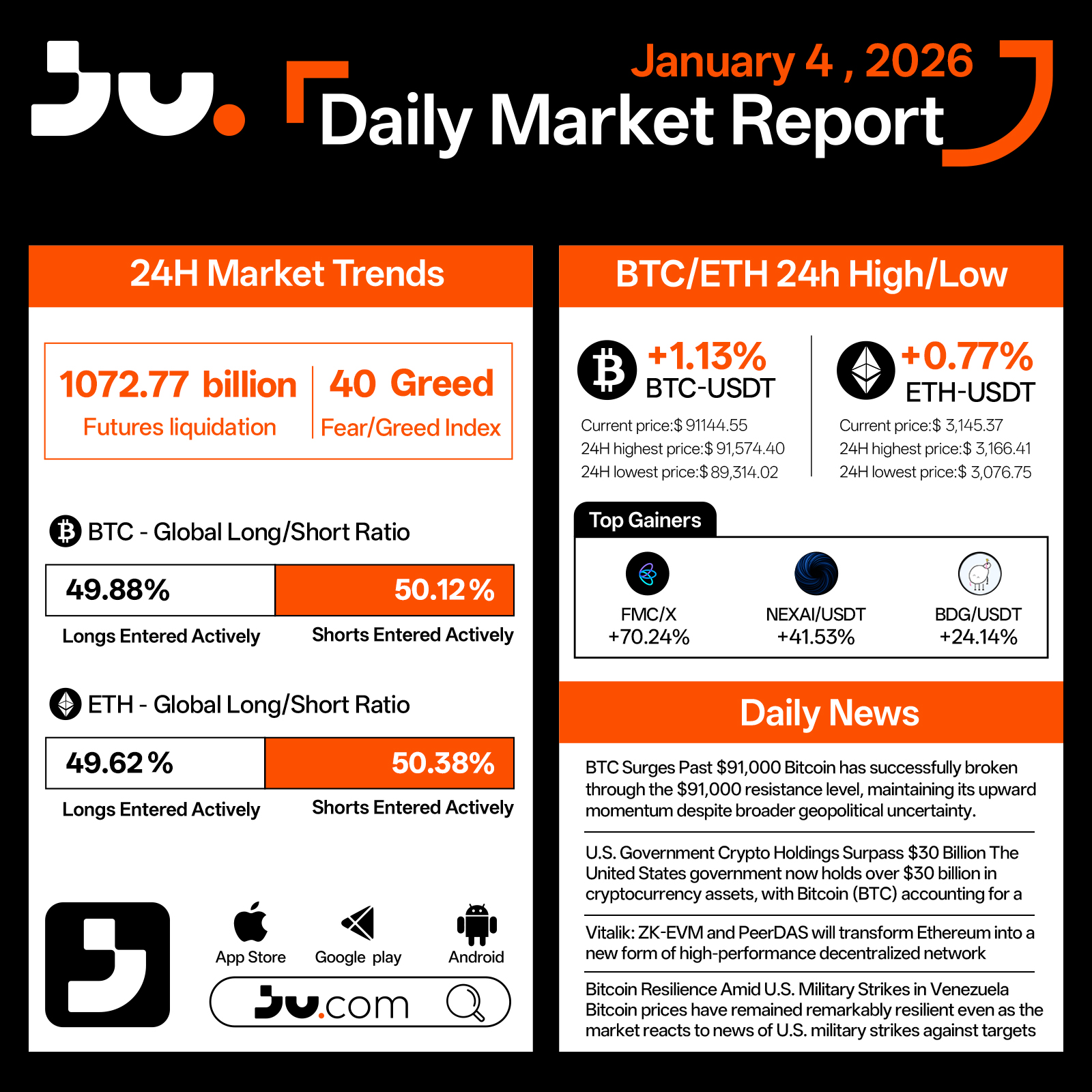
On January 4, the crypto market carried forward its early-year momentum, with Bitcoin decisively breaking through a key resistance level and lifting overall sentiment. Over the past 24 hours, market activity expanded notably, with total turnover and liquidations reaching $107.27 billion, while the Fear & Greed Index climbed to 40, signaling a clear rebound in risk appetite compared with year-end conditions.
Bitcoin rose 1.13% to $91,144.55, posting an intraday high of $91,574.40 and a low of $89,314.02. The successful break above the $91,000 level and subsequent consolidation suggest sustained bullish momentum. Ethereum followed with a 0.77% gain to $3,145.37, trading within a $3,166.41–$3,076.75 range and maintaining a steady correlation with BTC’s upward move. Positioning remained balanced, with BTC longs at 49.88% and ETH longs at 49.62%, indicating that the advance has been driven more by spot demand and trend-following capital than by excessive leverage.
Structural opportunities remained active across smaller-cap assets. FMC/X surged 70.24%, while NEXAI/USDT and PIPPIN/USDT advanced 41.53% and 24.14%, respectively. These moves reflect selective capital rotation as traders respond to Bitcoin’s breakout without broad-based risk expansion.
Macro and fundamental signals added depth to the move. The U.S. government disclosed that its cryptocurrency holdings now exceed $30 billion, with Bitcoin accounting for 97% of the total, reinforcing BTC’s status as the dominant digital reserve asset. On the Ethereum front, Vitalik Buterin stated that ZK-EVM and PeerDAS will transform Ethereum into a new form of high-performance decentralized network, strengthening long-term scalability and data availability narratives. Despite heightened geopolitical headlines, including reports of U.S. military strikes in Venezuela, Bitcoin prices remained resilient, underscoring its growing role as an asset capable of withstanding external shocks.
Overall, the opening days of 2026 show a market regaining directional clarity. Bitcoin’s breakout provides a clear technical anchor, while Ethereum’s roadmap supports medium-term confidence. With liquidity and sentiment improving in tandem, the crypto market appears to be entering the early phase of a new structural advance.
#cryptocurrency #blockchain
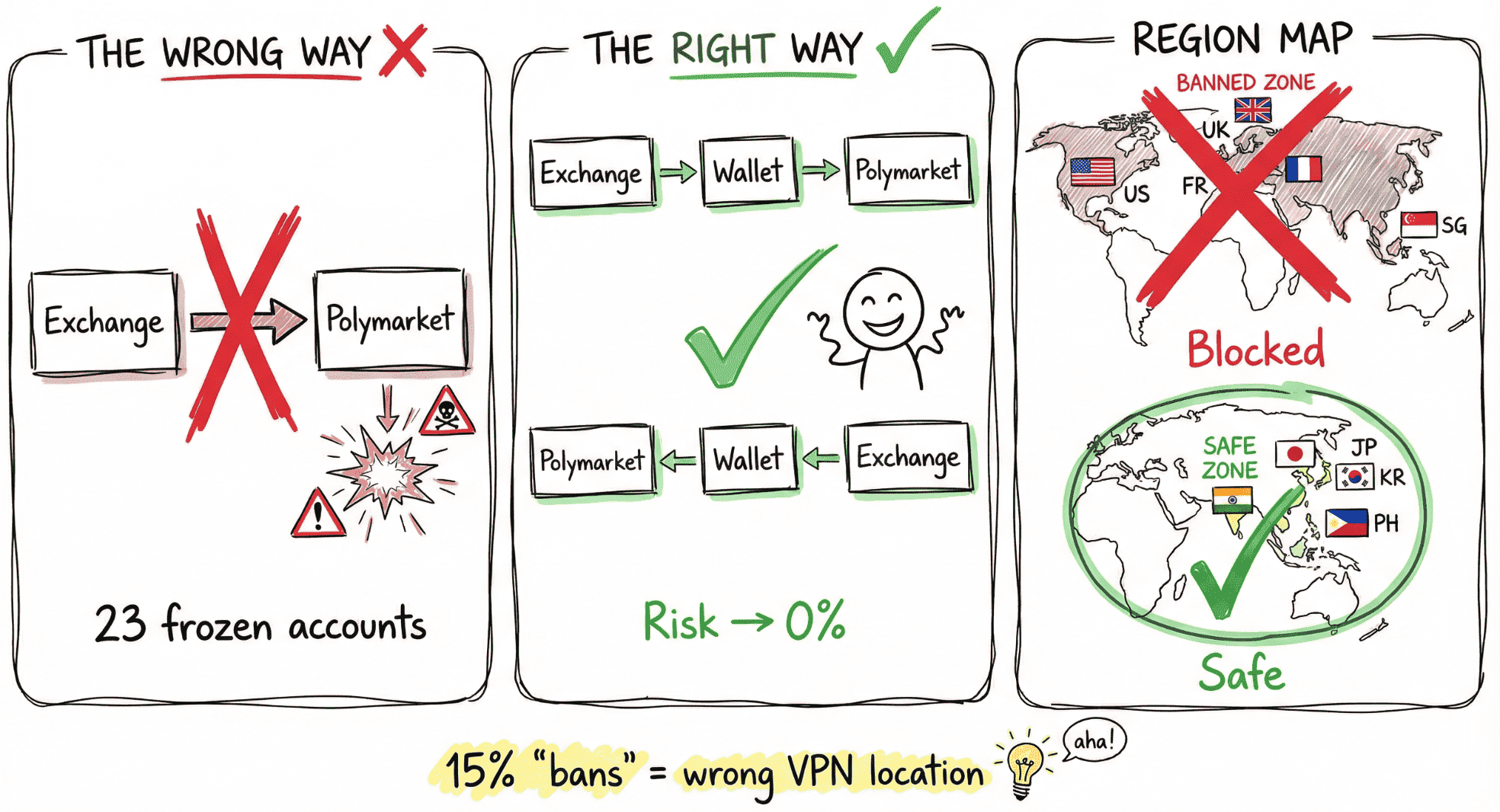
2025 marked prediction markets' breakthrough into mainstream consciousness. Polymarket alone processed over 95 million trades with $21.5 billion in volume, while the entire ecosystem reached $40-44 billion. With 1.77 million total users and monthly actives stabilizing at 400,000-500,000, these numbers dwarf many DeFi protocols.
💰 The Reality Check: Why 95% Lose
Only 5.08% of wallets realized profits over $1,000, with just 30.2% profitable overall. The top 0.04% of addresses captured over 70% of total profits, accumulating $4 billion in realized gains. This zero-sum game demands strategy over speculation.
🔄 The Turning Point: ICE's $2B Investment
In October 2025, the NYSE parent company ICE valued Polymarket at $9 billion with a $2 billion investment. The platform acquired a CFTC-licensed exchange for U.S. market re-entry and announced migration from Polygon to its own Ethereum L2 (POLY). Market expects token generation event after the 2026 World Cup.
🚨 Risk Controls: The Zero Line of Defense
Never withdraw directly from exchanges to Polymarket. The correct flow is Exchange → Wallet → Polymarket for deposits, and reverse for withdrawals. This extra step costs minimal gas but eliminates account freeze risks. Explicitly prohibited regions include USA, UK, France, Ontario, Singapore, Poland, Thailand, and Taiwan. Recommended regions are Japan, Korea, India, Philippines, Spain, Portugal, and Netherlands.
📊 Airdrop Positioning: Become a High-Quality User
The platform values users who keep markets efficient and participate in price discovery. Key weight factors include Maker orders over Taker orders, Split/Merge operations for ~4% annual position rewards, diverse market participation across crypto/politics/sports/culture/economics, multiple time horizons from short-term to long-term markets, and sustained holding periods. The optimal trade size is $50-$500, with behavioral diversity and holding time carrying the highest weights.
🎯 Six Arbitrage Strategies for Profit
Cross-platform arbitrage exploits price differences where YES on Platform A plus NO on Platform B totals under $1. Multi-outcome arbitrage buys all mutually exclusive options when their combined YES prices sum below $1. Cross-event arbitrage identifies semantically identical events priced differently on the same platform. Term structure spread trades mispriced time value, buying longer-dated options while selling shorter ones. Rule-edge trading focuses on settlement criteria rather than headlines, finding value in the fine print. High-probability compounding targets events over 90% probability with under 72 hours to settlement, generating 80-150% annualized returns through disciplined execution.
💡 The Long-Term Builder's Edge
Prediction markets are approaching their "iPhone moment." Technology is ready, early user education is complete, and breakout events are imminent. Success rewards those who build information advantages, understand underlying mechanics, and prepare systematically. Don't chase short-term gains—build repeatable edges through compliant fund flows, line-by-line rule verification, and disciplined execution from low-risk arbitrage to late-stage strategies.
Read the complete survival guide with advanced strategies and risk mitigation: 👇 https://blog.ju.com/polymarket-prediction-markets/?utm_source=blog
#Polymarket #PredictionMarkets #Crypto #DeFi
The consolidation of major crypto assets within key price ranges does not necessarily signal the end of a trend. It more likely reflects a shift in market rhythm following increased institutional participation.
ETF flows have allocation characteristics, and their behavioral patterns differ significantly from retail sentiment. When volatility declines and options markets become more cautious, it often indicates that the market is waiting for new external variables.
In such phases, emotion-driven trading strategies tend to be less effective.

A listing wave among domestic chip companies. Recently, a number of domestic AI chip firms have accelerated capitalization: Moore Threads listed on Shanghai’s STAR Market with a market cap that once exceeded RMB 300 billion (longbridge.com); MetaX followed; Biren Technology launched a Hong Kong IPO plan targeting about $600 million in fundraising (finance.yahoo.com). This wave suggests that in AI chips, “domestic substitution” has become a clear direction strongly favored by capital markets. Even though domestic GPUs still lag global leaders in near-term performance, investors remain willing to support these companies at high valuations.
Certainty carries a premium. Under high geopolitical uncertainty, the certainty of domestic substitution itself commands a premium. Compared with projects that may be technically superior but strategically uncertain, domestic AI chips offer a clearer investment logic: regardless of external conditions, China’s demand for sovereign and controllable compute is structural and increasing. That certainty is why capital pays. In other words, capital does not always chase the theoretical “best” solution; it often favors the most sustainable solution. As domestic substitution becomes a national strategy and a market consensus, companies aligned with that direction are viewed as having long-term value. This explains the strong investor enthusiasm even when short-term profitability remains limited.
A shift in market preferences. The listing boom reflects a shift in how markets evaluate opportunities. In earlier cycles, investors chased high-growth, high-risk concepts; now, amid geopolitical and supply-chain risks, certainty and controllability have become key evaluation criteria. For companies, this implies that aligning with strategic national direction and delivering indispensable value improves the chance of sustained capital support. Domestic AI chip companies are leveraging this tailwind to grow rapidly, strengthening industrial resilience while creating a synergy between industry and capital.
PancakeSwap incubates the prediction market platform Probable, which is far more than just adding a product feature. It also reveals the strategic evolution of top DeFi applications: Expanding from a single "trading venue" to a comprehensive "on-chain casino/casino" ecosystem.
Strategic logic deduction:
1. User retention and value-added: The prediction market has strong entertainment and user stickiness , which can effectively improve user engagement rate and stay time, guide traffic to the PancakeSwap main station and create new sources of income.
2. Ecosystem collaboration: Probable seamlessly integrates PancakeSwap's liquidity and exchange functions to form an experience loop. Its automatic token conversion is the best example.
3. Seize the track: The prediction market is regarded as a key track in 2026 by institutions such as a16z, with huge trading volume (the peak of the sector in 2025 will reach $10 billion per month). PancakeSwap seizes the position in advance through incubation.
Challenge: Faced with the Network Effect and Liquidity Depth of mature platforms such as Polymarket (with monthly trading volume exceeding $2 billion), Probable needs to prove that its "zero commission" strategy is enough to attract users to migrate.
Analysis of ecosystem strategy:https://blog.ju.com/probable-prediction-market-bnb-chain/?utm_source=blog #DeFi #ecosystem #strategy #competition #PancakeSwap