
What is Bitcoin Gold?
What Is Bitcoin Gold?
Bitcoin Gold (BTG) is a cryptocurrency that emerged in 2017 as a fork of the original Bitcoin blockchain. It was developed with the goal of creating a more decentralized and community-driven alternative to Bitcoin, addressing some of the centralization issues that had begun to surface within the Bitcoin ecosystem.
The Origins and Purpose of Bitcoin Gold
Bitcoin Gold was launched on October 25, 2017, by a group of developers who aimed to tackle the increasing centralization in Bitcoin mining. Over time, large-scale mining operations using specialized hardware known as ASICs (Application-Specific Integrated Circuits) came to dominate the network. This trend raised concerns about decentralization because it limited participation primarily to those with access to expensive equipment.
To counter this trend, BTG's creators designed it so that it could be mined using GPUs (Graphics Processing Units). GPUs are more accessible and affordable for individual miners compared to ASICs. By promoting GPU-friendly mining algorithms, Bitcoin Gold sought to democratize access and foster greater decentralization across its network.
Technical Features of Bitcoin Gold
Bitcoin Gold shares many similarities with its predecessor but also incorporates unique features:
- Blockchain Fork: BTG is a direct fork from the original Bitcoin blockchain, meaning it shares history up until its creation.
- Supply Cap: Like Bitcoin, BTG has a maximum supply limit set at 21 million coins.
- Mining Algorithm: It uses Equihash—a memory-hard proof-of-work algorithm designed specifically for GPU mining—making ASIC development less feasible.
- Decentralized Mining: The primary aim is enabling broader participation in mining activities by reducing hardware barriers.
These technical choices reflect an emphasis on maintaining decentralization while leveraging proven blockchain principles like transparency and security.
Market Performance and Price Trends
Since its launch in late 2017, Bitcoin Gold has experienced considerable price volatility. Initially peaking shortly after release during December 2017’s crypto market surge, BTG's value has since declined significantly. Its price movements have been influenced by broader market trends rather than specific developments within BTG itself.
Despite fluctuations in value—often falling well below its initial peak—BTG maintains an active community interested in promoting its use cases and technological principles. However, compared with major cryptocurrencies like Bitcoin or Ethereum, adoption remains relatively limited due to factors such as lower liquidity and less widespread recognition.
Security Challenges Faced by BTC
One notable event impacting BTG was a successful 51% attack carried out in 2020. In such attacks, malicious actors gain majority control over network hashing power allowing them to double-spend coins or manipulate transaction confirmations. This incident exposed vulnerabilities inherent among smaller cryptocurrencies with lower hash rates or less robust security measures.
The attack underscored ongoing challenges faced by smaller projects: balancing decentralization goals against practical security considerations. Following this event, efforts increased toward improving network resilience through better monitoring tools and community vigilance.
Regulatory Environment Impacting BTC
As with most cryptocurrencies operating globally without comprehensive regulation frameworks yet established universally—regulatory bodies are paying closer attention worldwide—the future regulatory landscape remains uncertain for BTG as well.
Potential legal developments could influence aspects such as:
- Exchange listings
- Mining regulations
- Taxation policies
These factors may affect user participation levels or even lead some jurisdictions to impose restrictions on certain crypto activities involving BTG.
Recent Developments & Market Outlook
In recent times, there have been no major announcements specific solely to BTC that significantly alter its trajectory or technological roadmap. The project continues largely based on community support rather than aggressive marketing campaigns or strategic partnerships seen elsewhere in crypto markets.
However,
- Broader trends like decentralized finance (DeFi), non-fungible tokens (NFTs), and increased institutional interest shape overall market dynamics.
- Ongoing debates around scalability solutions continue influencing how projects like BTG evolve their networks.
- The reliance on GPU mining makes future success sensitive not only to technological advancements but also external factors such as GPU availability and pricing fluctuations.
Potential Risks Facing Bitcoin Gold
Investors should consider several risks associated with holding or supporting BTG:
- Security Vulnerabilities: Past attacks highlight ongoing risks; future breaches could undermine trust.
- Market Volatility: Price swings can be severe due to low liquidity compared with mainstream cryptos.
- Regulatory Changes: New laws might restrict usage or trading activities related directly or indirectly affecting BTG.
- Mining Centralization Risks: Despite design intentions for decentralization via GPU compatibility; economic incentives might still favor larger miners over time.
Opportunities for Growth & Community Engagement
While recent activity appears subdued relative to other top-tier cryptos,
- Continued advocacy around decentralizing power structures can attract dedicated users aligned with these values.
- Technological upgrades focusing on scalability improvements may enhance usability.
- Strategic collaborations within niche sectors could expand adoption among enthusiasts prioritizing open-source principles.
Understanding Where Blockchain Projects Like BTC Fit In
Bitcoin Gold exemplifies efforts within cryptocurrency communities aiming for true decentralization—a core principle underpinning blockchain technology’s appeal beyond mere financial speculation:
- Promoting accessible mining options helps distribute control away from centralized entities,
- Transparency ensures trustworthiness,
- Open-source development fosters innovation driven by collective input.
By examining projects like BTC critically—including their successes alongside vulnerabilities—we gain insights into both technical challenges faced across blockchain ecosystems—and opportunities where continued innovation can reinforce foundational ideals.
Final Thoughts on What Makes Bitcoin Gold Unique
Bitcoin Gold stands out primarily because of its focus on democratizing cryptocurrency participation through GPU-based mining alternatives—a response rooted deeply in addressing perceived centralizations within traditional networks like bitcoin itself.. While facing hurdles such as security incidents and fluctuating market interest,
it remains an example of how grassroots initiatives attempt reshaping digital currency landscapes towards greater inclusivity—and ultimately resilience—in an evolving digital economy.
This overview provides clarity about what exactly constitutes Bitcoin Gold’s purpose, features,and current standing within the wider cryptocurrency environment — essential knowledge whether you're considering investment opportunities , researching blockchain innovations ,or simply seeking understanding about alternative cryptocurrencies rooted in core values of decentralization .

JCUSER-IC8sJL1q
2025-06-05 06:54
What is Bitcoin Gold?
What Is Bitcoin Gold?
Bitcoin Gold (BTG) is a cryptocurrency that emerged in 2017 as a fork of the original Bitcoin blockchain. It was developed with the goal of creating a more decentralized and community-driven alternative to Bitcoin, addressing some of the centralization issues that had begun to surface within the Bitcoin ecosystem.
The Origins and Purpose of Bitcoin Gold
Bitcoin Gold was launched on October 25, 2017, by a group of developers who aimed to tackle the increasing centralization in Bitcoin mining. Over time, large-scale mining operations using specialized hardware known as ASICs (Application-Specific Integrated Circuits) came to dominate the network. This trend raised concerns about decentralization because it limited participation primarily to those with access to expensive equipment.
To counter this trend, BTG's creators designed it so that it could be mined using GPUs (Graphics Processing Units). GPUs are more accessible and affordable for individual miners compared to ASICs. By promoting GPU-friendly mining algorithms, Bitcoin Gold sought to democratize access and foster greater decentralization across its network.
Technical Features of Bitcoin Gold
Bitcoin Gold shares many similarities with its predecessor but also incorporates unique features:
- Blockchain Fork: BTG is a direct fork from the original Bitcoin blockchain, meaning it shares history up until its creation.
- Supply Cap: Like Bitcoin, BTG has a maximum supply limit set at 21 million coins.
- Mining Algorithm: It uses Equihash—a memory-hard proof-of-work algorithm designed specifically for GPU mining—making ASIC development less feasible.
- Decentralized Mining: The primary aim is enabling broader participation in mining activities by reducing hardware barriers.
These technical choices reflect an emphasis on maintaining decentralization while leveraging proven blockchain principles like transparency and security.
Market Performance and Price Trends
Since its launch in late 2017, Bitcoin Gold has experienced considerable price volatility. Initially peaking shortly after release during December 2017’s crypto market surge, BTG's value has since declined significantly. Its price movements have been influenced by broader market trends rather than specific developments within BTG itself.
Despite fluctuations in value—often falling well below its initial peak—BTG maintains an active community interested in promoting its use cases and technological principles. However, compared with major cryptocurrencies like Bitcoin or Ethereum, adoption remains relatively limited due to factors such as lower liquidity and less widespread recognition.
Security Challenges Faced by BTC
One notable event impacting BTG was a successful 51% attack carried out in 2020. In such attacks, malicious actors gain majority control over network hashing power allowing them to double-spend coins or manipulate transaction confirmations. This incident exposed vulnerabilities inherent among smaller cryptocurrencies with lower hash rates or less robust security measures.
The attack underscored ongoing challenges faced by smaller projects: balancing decentralization goals against practical security considerations. Following this event, efforts increased toward improving network resilience through better monitoring tools and community vigilance.
Regulatory Environment Impacting BTC
As with most cryptocurrencies operating globally without comprehensive regulation frameworks yet established universally—regulatory bodies are paying closer attention worldwide—the future regulatory landscape remains uncertain for BTG as well.
Potential legal developments could influence aspects such as:
- Exchange listings
- Mining regulations
- Taxation policies
These factors may affect user participation levels or even lead some jurisdictions to impose restrictions on certain crypto activities involving BTG.
Recent Developments & Market Outlook
In recent times, there have been no major announcements specific solely to BTC that significantly alter its trajectory or technological roadmap. The project continues largely based on community support rather than aggressive marketing campaigns or strategic partnerships seen elsewhere in crypto markets.
However,
- Broader trends like decentralized finance (DeFi), non-fungible tokens (NFTs), and increased institutional interest shape overall market dynamics.
- Ongoing debates around scalability solutions continue influencing how projects like BTG evolve their networks.
- The reliance on GPU mining makes future success sensitive not only to technological advancements but also external factors such as GPU availability and pricing fluctuations.
Potential Risks Facing Bitcoin Gold
Investors should consider several risks associated with holding or supporting BTG:
- Security Vulnerabilities: Past attacks highlight ongoing risks; future breaches could undermine trust.
- Market Volatility: Price swings can be severe due to low liquidity compared with mainstream cryptos.
- Regulatory Changes: New laws might restrict usage or trading activities related directly or indirectly affecting BTG.
- Mining Centralization Risks: Despite design intentions for decentralization via GPU compatibility; economic incentives might still favor larger miners over time.
Opportunities for Growth & Community Engagement
While recent activity appears subdued relative to other top-tier cryptos,
- Continued advocacy around decentralizing power structures can attract dedicated users aligned with these values.
- Technological upgrades focusing on scalability improvements may enhance usability.
- Strategic collaborations within niche sectors could expand adoption among enthusiasts prioritizing open-source principles.
Understanding Where Blockchain Projects Like BTC Fit In
Bitcoin Gold exemplifies efforts within cryptocurrency communities aiming for true decentralization—a core principle underpinning blockchain technology’s appeal beyond mere financial speculation:
- Promoting accessible mining options helps distribute control away from centralized entities,
- Transparency ensures trustworthiness,
- Open-source development fosters innovation driven by collective input.
By examining projects like BTC critically—including their successes alongside vulnerabilities—we gain insights into both technical challenges faced across blockchain ecosystems—and opportunities where continued innovation can reinforce foundational ideals.
Final Thoughts on What Makes Bitcoin Gold Unique
Bitcoin Gold stands out primarily because of its focus on democratizing cryptocurrency participation through GPU-based mining alternatives—a response rooted deeply in addressing perceived centralizations within traditional networks like bitcoin itself.. While facing hurdles such as security incidents and fluctuating market interest,
it remains an example of how grassroots initiatives attempt reshaping digital currency landscapes towards greater inclusivity—and ultimately resilience—in an evolving digital economy.
This overview provides clarity about what exactly constitutes Bitcoin Gold’s purpose, features,and current standing within the wider cryptocurrency environment — essential knowledge whether you're considering investment opportunities , researching blockchain innovations ,or simply seeking understanding about alternative cryptocurrencies rooted in core values of decentralization .
免責事項:第三者のコンテンツを含みます。これは財務アドバイスではありません。
詳細は利用規約をご覧ください。
Bitcoin bags are getting blown out today, as the price of BTC falls to nearly $80,000 and marks a new seven-month low.
- The continued downward pressure on its price has pushed Bitcoin into a so-called death cross—when the average price of an asset over the short term falls below the average price over the long term. It’s a technical pattern that typically signals extended bearish momentum. For traders who study charts, it confirms what permabulls don’t want to hear: It’s over—at least for now.
- It’s happening as the crypto market as a whole shrinks to $2.91 trillion, shedding nearly $60 billion in the past 24 hours alone. Almost every single coin in the top 100 by market cap is bleeding red.
- The Fear and Greed Index, which measures market sentiment on a scale from 0 to 100, has cratered to 14 points—just four points above the year's low of 10 back in February. When this index drops below 20, it signals "extreme fear," and right now, traders are absolutely terrified.
- But it's not just crypto drama driving the market selloff. The macro picture is turning nasty. Just weeks ago, markets were pricing in a 97% chance the Federal Reserve would cut interest rates in December. Now? Those odds have collapsed to somewhere between 22% and 43%, depending on which metric you check.
- Fed officials are openly divided, with many signaling they'd prefer to keep rates unchanged through year-end. For risk assets like crypto that thrive on easy money, this is poison.
- On Myriad, a prediction market developed by Decrypt’s parent company Dastan, traders are now overwhelmingly convinced that Bitcoin will not mark a new all-time high this year, placing odds at almost 90% that BTC will not top the $126K mark that it hit on October 6.
- The bearish vibes are so strong, Myriad traders also currently place 40% odds that Bitcoin falls as low as $69K. So how low will it go? Here’s what the charts say.
- Bitcoin opened today at $86,691 and immediately sold off, hitting an intraday low of $80,620 before bouncing slightly to its current price at $85,187. That's a 1.61% drop on the day after being almost 5% down over the last 24 hours. More importantly, for traders, it further confirms the death cross pattern that's been progressively forming since its all-time high in early October. The death cross pattern was first confirmed on Wednesday as Bitcoin slid to around $88,000—now it’s fallen deeper.
- Here's what's happening on the charts: Exponential Moving Averages, or EMAs, help traders identify trend direction by tracking the average price of an asset over the short, medium, and long term. When the short-term 50-day EMA falls below the longer-term 200-day EMA, it means bears are in control and the longer-term bull market structure has been broken.
- For Bitcoin, the 50-day EMA has now decisively crossed below the 200-day EMA. In short, this tells traders market momentum has shifted from bullish to bearish. The gap between both EMAs increases the more the price of BTC trades below those targets—and the bigger the gap, the stronger the trend.
- The price of Bitcoin is now trading well below both EMAs, which creates a situation where each bounce attempt faces immediate resistance, increasing the gap between the two EMAs, making the bearish trend even stronger. Bulls trying to push higher will need to first reclaim the 50-day EMA, then tackle the 200-day—a double wall of resistance that's historically tough to crack in one go.
- As for other technical indicators, the Average Directional Index, or ADX, sits at 41, which is considered "strong." ADX measures trend strength regardless of direction, with readings above 25 indicating a clear trend is in place. At 41, this tells us we’re not seeing just a minor correction, but a potentially extended move lower.
- The Relative Strength Index, or RSI, has plunged to 23.18, placing Bitcoin deep in oversold territory. RSI measures momentum on a scale from 0 to 100, with readings below 30 signaling oversold conditions where assets are potentially undervalued. However, "oversold" doesn't mean the selling has to stop—in strong downtrends, RSI can remain in oversold territory for extended periods as prices continue grinding lower. But, yes, this also provides hopium for momentum traders as it signals that the worst of it may be over. (The worst being an accelerated crash, not necessarily a steady drop.)
- The Squeeze Momentum Indicator is flashing "bearish impulse," meaning selling pressure is intensifying rather than easing. Meanwhile, the Volume Profile Visible Range (VPVP) shows the price of Bitcoin trading "below" key volume nodes, suggesting there's not much buying interest at current levels.
- So, everything is bearish, clearly. But where's the next support? How low can the price of BTC go? The chart reveals several key horizontal levels to watch.
- The immediate danger zone is $80,697, which briefly held today but looked shaky. If that breaks, the next major support sits at $74,555, followed by $65,727, and potentially all the way down to $53,059 if panic really sets in during a crypto winter. Those price levels have previous consolidation zones where significant trading volume accumulated, making them natural landing spots for oversold bounces.
- For resistances, traders will watch for BTC’s price breaking past $90,000 again and look at $100,000 as the major psychological target.
- Ethereum opened at $2,830.7 and dropped as low as $2,621 intraday before stabilizing around $2,798—a 1.16% loss on the day. While not as dramatic as Bitcoin's selloff, ETH's technical picture is equally concerning.
- Unlike Bitcoin, Ethereum hasn't fully confirmed its death cross yet—the 50-day EMA is still technically above the 200-day, giving it a "long" signal on an indicator that is obviously hours away from changing to bearish. The gap is razor-thin and closing fast. More importantly, ETH’s price is trading well below both EMAs, rendering that technical distinction somewhat meaningless. The bearish momentum is clearly established.
- A good way to see the natural support zones is using the Fibonacci retracements: a set of natural clusters that appear during a trend, showing supports and resistances in a specific timeframe—not because of price, but because of natural proportions.
- Right now, ETH is testing the 0.618 Fibonacci level at approximately $2,755. If this level breaks, the next Fibonacci support doesn't appear until $2,180, which would represent a massive 22% drop from current prices, and would resolve a price market on Myriad betting on ETH’s moon or doom.
- The ADX for Ethereum is even stronger than Bitcoin's at 46, indicating the downtrend is rock-solid. Meanwhile, RSI sits at 28.46—not quite as oversold as Bitcoin but definitely in stressed territory. The Squeeze Momentum Indicator shows "bearish impulse" here too, confirming sellers are in control.
- XRP is showing relative strength compared to its larger peers, down just 0.50% to close at $1.98 after opening at $1.99 and hitting an intraday low of $1.81796. Don't let that modest percentage fool you though—the technical damage is real.
- Like Bitcoin, the Ripple-linked XRP has confirmed a full death cross with its 50-day EMA now below the 200-day. The price of XRP is trading beneath both EMAs, and with an ADX of 32, the downtrend has enough strength to continue. While 32 isn't as extreme as Bitcoin's 41 or Ethereum's 46, it's still well above the 25 threshold that confirms a trend is in place rather than just random chop.
- The RSI at 32.86 shows XRP is approaching oversold territory but hasn't quite reached the extreme stress levels of Bitcoin and Ethereum. This could mean two things: either XRP has more downside before finding equilibrium, or it's showing genuine relative strength that could make it a safer harbor if the broader market continues tanking.
- XRP had such a crazy year that its price action shows only two major horizontal support levels that should concern XRP holders—and that would be very painful for hodlers, considering the movement from the all-time high to those targets.
- The next major support zone sits at $1.589, which represents a potential 20% drop from current levels. If that breaks, there's very little support until $0.66, a catastrophic 67% plunge from current prices and almost 80% from all-time high zone that would take XRP back to early 2024 levels.
The Squeeze Momentum Indicator is showing "bearish impulse," and like the other coins, the volume profile indicates XRP’s price is trading below key volume levels, meaning there's not much buying interest stepping in to defend current prices.
#Bitcoin #BitcoinDeathCross #Jucom #cryptocurrency #blockchain $BTC/USDT $JU/USDT $ETH/USDT
What Is the Total Number of Transactions on the Bitcoin Network?
Understanding the total number of transactions on the Bitcoin network is essential for grasping how active and widely used this pioneering cryptocurrency truly is. This metric offers insights into user engagement, network health, and overall adoption trends. In this article, we will explore what influences transaction volume, recent developments in 2023, and what these figures mean for investors and users alike.
How Does Transaction Volume Reflect Network Activity?
The total number of Bitcoin transactions indicates how frequently users are transferring funds or engaging with blockchain-based applications. On average, as of 2023, around 250,000 to 300,000 transactions occur daily. These fluctuations are driven by various factors such as market sentiment—bullish periods tend to see increased activity—as well as regulatory environments that can either encourage or restrict usage.
High transaction volumes suggest a vibrant ecosystem where users actively buy, sell, or transfer Bitcoin. Conversely, dips may signal reduced interest or external pressures like stricter regulations. Monitoring these numbers helps stakeholders gauge whether Bitcoin remains a popular medium for peer-to-peer payments or speculative trading.
Factors Influencing Transaction Counts
Several key elements impact how many transactions are recorded on the blockchain:
- Market Conditions: Bull markets often lead to increased trading activity as investors seek opportunities.
- Regulatory Changes: Stricter laws can temporarily suppress transaction volumes; conversely, favorable policies may boost activity.
- Network Congestion: When many users transact simultaneously—such as during major price swings—transaction fees rise due to limited block space.
- Technological Developments: Improvements like SegWit (Segregated Witness) have optimized transaction processing times and costs over time.
These factors collectively shape daily transaction counts and influence user behavior across different periods.
Recent Trends in 2023: Fluctuations in Transaction Numbers
In April 2023, the Bitcoin network experienced a notable surge in transaction volume driven by heightened market speculation amid potential regulatory shifts in major economies. This increase was partly fueled by traders reacting to news about possible government interventions that could impact cryptocurrency markets globally.
However, May saw an uptick in average transaction fees—about a 20% rise compared to previous months—which reflects higher network congestion. Elevated fees can discourage smaller transactions from occurring frequently because they become less cost-effective for everyday use cases like micro-payments or casual transfers.
These recent trends highlight how external events directly influence not only how much activity occurs but also its economic viability for typical users.
Blockchain Size and Its Impact on Transactions
The size of the Bitcoin blockchain itself provides context about overall network activity; it stood at approximately 400 GB in early 2023—a significant increase from previous years due to continuous addition of new blocks containing transactional data.
A larger blockchain signifies more historical data stored across nodes worldwide but also raises concerns regarding scalability:
- Larger blockchains require more storage capacity.
- Synchronization times increase for new nodes joining the network.
- Higher data loads can contribute to slower confirmation times during peak periods unless scaling solutions are implemented effectively.
Efforts such as Lightning Network aim to address these scalability challenges by enabling faster off-chain transactions while maintaining security through underlying blockchain settlement layers.
The Role of Miners and Validation Processes
Miners play a crucial role in maintaining accurate records by validating transactions through complex computational puzzles—a process known as proof-of-work (PoW). They compete within seconds to add new blocks containing pending transactions onto the chain; successful miners receive rewards plus associated fees paid by transacting parties.
This validation process ensures integrity but is energy-intensive: estimates suggest that mining consumes substantial electricity globally. As demand increases with higher transaction volumes during active periods like April-May 2023’s surge,
the environmental footprint becomes more prominent concern among regulators and advocates alike.
Key Points About Mining:
- Miners validate hundreds of thousands of daily transactions
- Validation ensures decentralization & security
- Rising demand impacts energy consumption
Regulatory Environment's Effect on Transaction Volumes
Government policies significantly influence user participation levels on the Bitcoin network. In early 2023,
several countries introduced stricter regulations targeting crypto exchanges,which temporarily dampened trading activities reflected through decreased transaction counts initially observed after policy announcements.
However,
some jurisdictions adopted clearer frameworks encouraging institutional involvement,potentially stabilizing or increasing future transactional activity once compliance mechanisms were established.
Summary:
Regulatory uncertainty remains one of the most unpredictable factors affecting total bitcoin transactions; ongoing legislative developments will continue shaping usage patterns moving forward.
Future Outlook: Scalability Solutions & Adoption Trends
As interest grows among retail investors and institutions alike,
scalability solutions such as Taproot upgrades,Lightning Network implementations,and sidechains aim to facilitate faster processing at lower costs.
These technological advancements could help sustain higher throughput levels necessary for mainstream adoption while reducing congestion-related fee hikes seen earlier this year.
Moreover,
wider acceptance from merchants accepting bitcoin payments directly enhances real-world utility beyond speculative trading,
potentially leading toward sustained growth in total number of daily transactions over coming years.
By continuously monitoring metrics like total bitcoin transaction count alongside technological improvements and regulatory changes,
stakeholders—from individual users to large-scale investors—can better understand market dynamics
and make informed decisions aligned with evolving industry conditions.
References
- CoinDesk — General information on Bitcoin networks
- Blockchain.com Charts — Historical data analysis
- Blockchain Size Data — Blockchain growth insights
- Transaction Fees & Congestion — Impact analysis
- Bitcoin Mining Process — Technical validation overview
- Regulatory Impact Reports — Policy effects assessment
Understanding how many people transact using Bitcoin provides valuable insight into its current state—and future potential—as both an investment asset and a decentralized payment system amidst an ever-changing global landscape
It’s been just over a month since Bitcoin hit an All-Time-High of $126,272.76 on October 6 , but things have gone from bad to worse since then. Now, that peak seems like a distant memory.
- Bitcoin fell more than 9% in the week ending November 14 , and was trading below $92,000 on Monday. The sharp decline — partly due to whales selling — has pushed BTC below several key technical levels.
- Last week, Bitcoin entered a “bear market,” meaning it fell 20% or more from its recent peak. Over the weekend, BTC also appeared in a “death cross” technical pattern — when the 50-day moving Medium crossed below the 200-day Medium . Not only that, Bitcoin officially wiped out all of its gains for 2025 .
- All these signals indicate that negative sentiment is surrounding Bitcoin. But does that mean “crypto winter” is coming?
- “ I don’t think we’re in a crypto winter. I think we’re seeing Bitcoin mature ,” Louis LaValle, CEO of Frontier Investments, told MarketWatch.
- He argues that this is not a typical recession model where people give up, prices crash 70–80%, liquidation disappears, and interest evaporates. Instead, Bitcoin is going through a market structure shift , not a traditional bear cycle.
Beware of margin call risk
- Kevin Kelly — portfolio manager at Amplify ETFs — said that in the past, Bitcoin has often fallen in price without institutional involvement.
- But this bear cycle is quite different because BTC is now a “mature asset,” with more liquidation and more institutional acceptance, such as JP Morgan reportedly accepting Bitcoin as collateral .
- Data from CryptoQuant shows that investors who are selling BTC are still profitable , meaning there are no signs of capitulation or margin calls. However, retail investors are not buying the Dip , while whales are buying at low prices.
- CryptoQuant's Julio Moreno said that the amount of BTC held in US ETFs has dropped sharply from 441,000 BTC on October 10 to just 271,000 BTC, reflecting weak demand from the US. At the same time, the " Medium order" in the spot market also shows that retail has not returned.
Technical perspective
- While on-chain data hasn't shown anything too serious, weak demand hasn't been enough to stop the sell-off.
- Analyst Luke Lango said the recent death cross is a worrying sign. He noted that over the past 13 years, every time Bitcoin broke the 50-week moving Medium during a bull run, the market crashed in the following 1-2 years.
- BTC is now down about 27% from its recent peak — still within “normal range,” as the Medium Bitcoin bear market decline is about 30.8% (based on data going back to 2014). In 2022, there have been two declines of more than 45%.
- Kelly said that tightening global liquidation , the Fed's delay in cutting interest rates, and the TGA's withdrawal of liquidation from the system have made BTC much more vulnerable.
- He assessed the current situation as a combination of weak liquidation , continuous sell-offs, and declining sentiment , rather than a single shock.
“The Zone of Extreme Fear”
- The market has entered “extreme fear territory” after Bitcoin failed to hold the psychological $100,000 mark, according to Kelly.
- But investors have not lost interest. After the hot growth period since the January 2023 Dip , a “digestion wave” is normal.
- History also shows that when the market falls into “extreme fear zones,” it is a good opportunity to cash in — especially for long-term investors who Medium over time.
Macro still favors Bitcoin
- Frank Holmes — co-founder of HIVE Digital Technologies — says the macro backdrop is becoming more positive for both Bitcoin and gold.
- “ Excessive government spending and constant money printing create long-term support for scarce and decentralized assets ,” he observed.
Holmes also emphasized that even if new user growth slows in the short term, structural trends such as rising debt, monetary expansion, and geopolitical Shard still favor Bitcoin in the long term.
#Bitcoin #CryptoMarket #Jucom #cryptocurrency #blockchain $BTC/USDT $ETH/USDT $JU/USDT
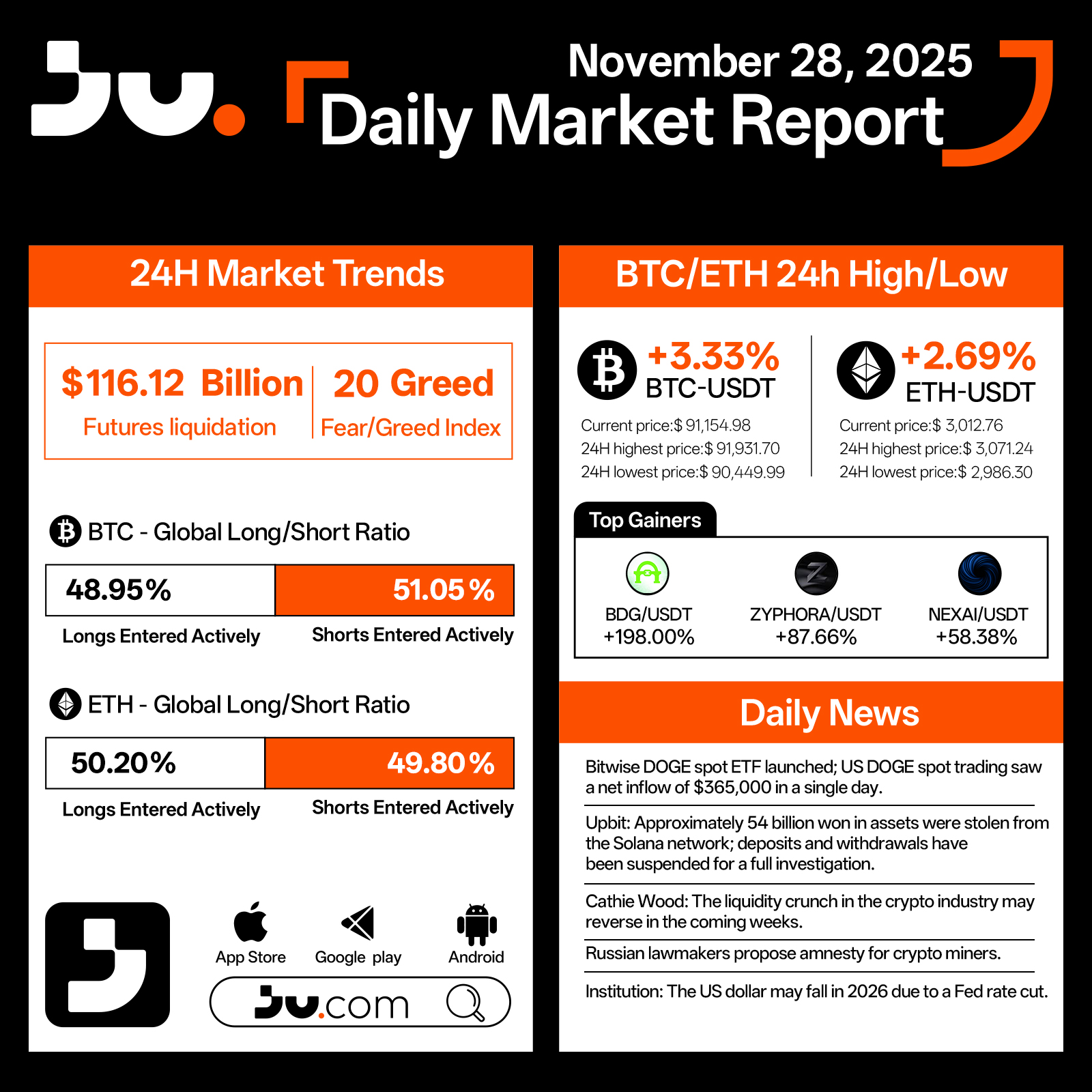
Daily Market Report - Nov 28, 2025
Crypto markets strengthened further on November 28, with sentiment showing noticeable improvement. Total futures liquidations over the past 24 hours dropped to $116.12 billion, while the Fear & Greed Index rose to 20, marking the most optimistic reading of the week. Bitcoin (BTC) climbed 3.33% to $91,154.98, trading between a high of $91,931.70 and a low of $90,449.99. Ethereum (ETH) followed with a 2.69% gain, settling at $3,012.76, with intraday volatility ranging from $3,071.24 down to $2,986.30.
BTC’s global long–short ratio remained slightly bearish with 48.95% longs and 51.05% shorts, while ETH maintained a mild long bias at 50.20% longs versus 49.80% shorts, showing a cautiously optimistic market posture. Among the day’s top performers, BDG/USDT surged 198%, ZYPHORA/USDT rose 87.66%, and NEXAI/USDT advanced 58.38%, highlighting strong speculative flows within specific high-momentum sectors.
Several major developments shaped today’s narrative. The Bitwise DOGE spot ETF officially launched, recording a $365,000 net inflow in its first day of trading. South Korea’s Upbit suffered a significant security breach involving approximately 54 billion KRW in Solana-based assets, prompting an immediate suspension of deposits and withdrawals. Cathie Wood suggested that liquidity conditions in the crypto sector may shift in the coming weeks, potentially marking the beginning of a new capital cycle. Russian lawmakers proposed an amnesty policy for crypto miners, signaling a shift toward more structured regulatory oversight. Meanwhile, institutional analysts projected that the US dollar could weaken again in 2026, driven by expectations of a Federal Reserve rate cut.
With BTC and ETH extending their upward momentum and speculative activity gaining strength, market sentiment has clearly improved. As the month draws to a close, traders will closely monitor ETF flows, regulatory developments, and security risks to gauge whether this recovery can sustain into early December.
#cryptocurrency #blockchain #Bitcoin #ETH
The U.S. Department of Justice on Tuesday charged the founder of a Chicago-based crypto ATM company with taking in at least $10 million in criminal proceeds, and moving the money into digital wallets to conceal its origins.
- The indictment, unsealed in the Northern District of Illinois, accused Firas Isa of running the operation through Virtual Assets LLC, a company that did business as Crypto Dispensers and operated cash-to-cryptocurrency ATMs across the United States.
- According to the filing, victims and criminals sent the funds to Isa, his company, or a co-conspirator. While Bitcoin ATMs are supposed to institute know-your-customer (KYC) policies to curb money laundering through the machines, prosecutors said Isa converted the illicit funds the Crypto Dispensers ATMs received into cryptocurrency before transferring it to other wallets.
- “The indictment alleges that Isa knew the money was derived from fraud,” the DOJ wrote.
- The DOJ did not say in the indictment which cryptocurrencies or wallet providers were allegedly used by Isa in the scheme. Isa did not immediately respond to a request for comment by Decrypt.
- Isa and Virtual Assets LLC were each charged with one count of money-laundering conspiracy, a charge that carries a maximum sentence of 20 years in federal prison. Both entered not-guilty pleas. A status hearing was set for January 30, 2026, before U.S. District Judge Elaine Bucklo.
- The charge arrived at a time when federal prosecutors are adjusting how they police the crypto market. In April, the Justice Department said it would dissolve its National Cryptocurrency Enforcement Team and stop bringing criminal cases against exchanges, mixing services, or cold-wallet holders for the actions of their users.
- Last week, the DOJ, FBI, and U.S. Secret Service announced a new Scam Center Strike Force aimed at combating crypto scams that originated in China.
- Prosecutors noted that the indictment against Isa and Virtual Assets is an allegation, and they are presumed innocent unless the government proves guilt beyond a reasonable doubt.
If Isa or Virtual Assets LLC were convicted, they would be required to forfeit any property involved in the alleged money-laundering offense, including a personal money judgment, and the government could seek substitute assets if the original property could not be recovered.
#Bitcoin #BitcoinATM #Jucom #cryptocurrency #blockchain $BTC/USDT $ETH/USDT $JU/USDT
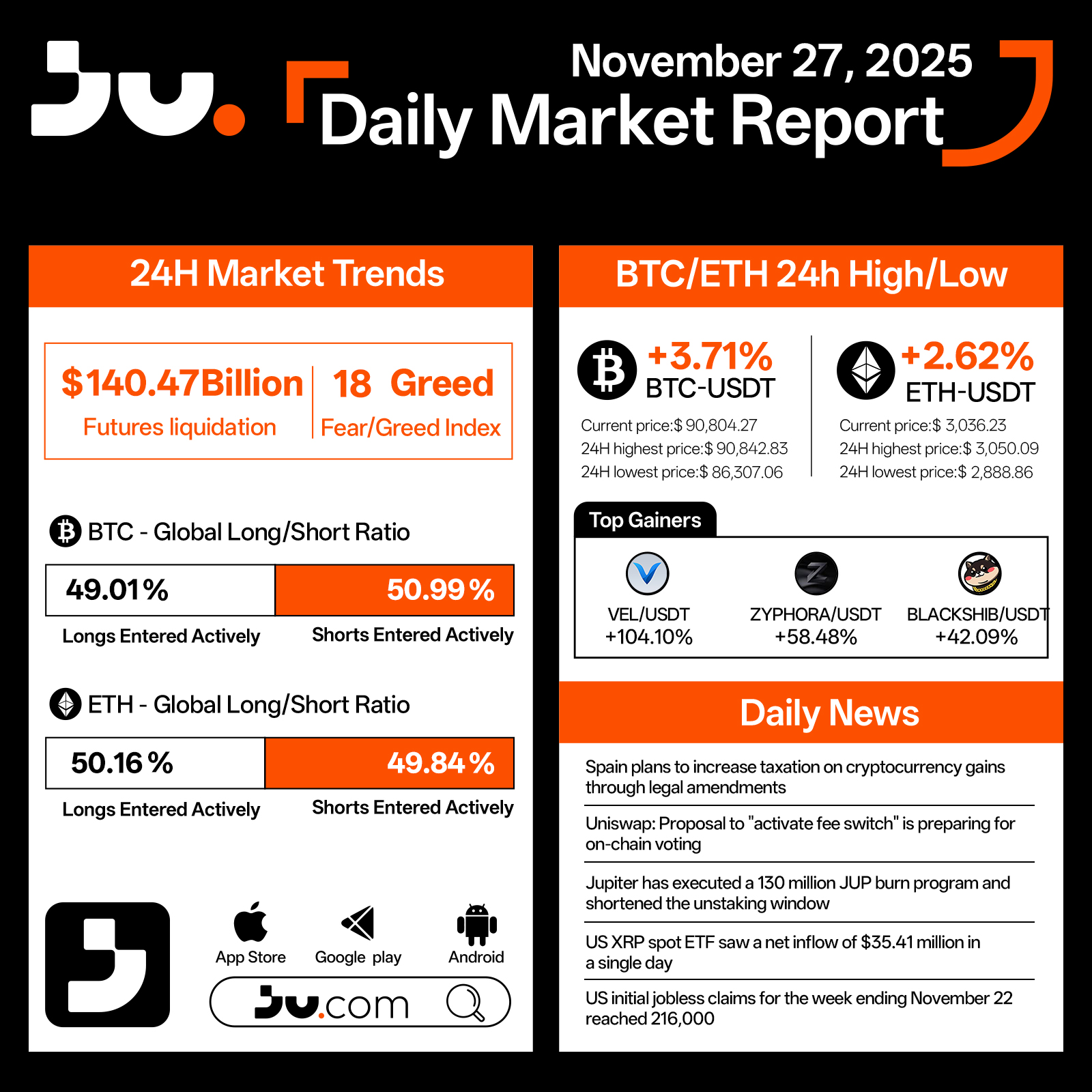
Daily Market Report - Nov 27, 2025
Crypto markets strengthened on November 27, showing a notable rebound in momentum. Total futures liquidations reached $140.47 billion, while the Fear & Greed Index climbed to 18, suggesting that although sentiment remains cautious, panic is gradually easing. Bitcoin (BTC) rose 3.71% to $90,804.27, trading between a high of $90,842.83 and a low of $86,307.06 over the past 24 hours. Ethereum (ETH) gained 2.62%, last trading at $3,036.23, with intraday movements ranging from $3,050.09 to $2,888.86.
Long–short ratios remain balanced but cautious. BTC saw 49.01% longs versus 50.99% shorts, while ETH skewed slightly bullish at 50.16% longs and 49.84% shorts, reflecting a market that is stabilizing but still hesitant to take strong directional positions. Among top-performing tokens, VEL/USDT surged 104.10%, ZYPHORA/USDT advanced 58.48%, and BLACKSHIB/USDT gained 42.09%, highlighting strong speculative activity in select high-volatility assets.
Regulatory and macro developments contributed to today’s narrative. Spain announced plans to increase taxes on cryptocurrency gains through upcoming legal amendments, underscoring the tightening regulatory climate across Europe. Uniswap’s proposal to activate its “fee switch” is moving toward on-chain voting, potentially reshaping the protocol’s long-term revenue design.
Jupiter executed a 130 million JUP burn program and shortened its unlocking schedule, reinforcing its commitment to token value management. Meanwhile, the US XRP spot ETF recorded an impressive $354.41 million net inflow in a single day, reflecting ongoing institutional appetite for digital assets. U.S. initial jobless claims for the week ending November 22 reached 216,000, indicating a gradually cooling labor market.
With BTC and ETH both staging strong rebounds, market sentiment shows signs of recovery, though investors remain highly sensitive to regulatory shifts and macroeconomic indicators. As the month draws to a close, liquidity conditions and policy developments will play an increasingly important role in shaping short-term market direction.
#cryptocurrency #blockchain #finance #Bitcoin